Results by title
54 books match the query 'Anthropologists' and 4 start with m
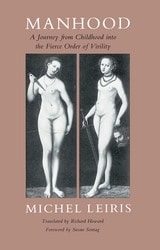
Manhood
A Journey from Childhood into the Fierce Order of VirilityMichel Leiris
University of Chicago Press, 1992
"Not only one of the frankest of autobiographies, but also a brilliantly written book, Leiris' Manhood mingles memories, philosophic reflections, sexual revelation, meditations on bullfighting, and the life-long progress of self-discovery."—Washington Post Book World
"Leiris writes to appall, and thereby to receive from his readers the gift of a strong emotion—the emotion needed to defend himself against the indignation and disgust he expects to arouse in his readers."—Susan Sontag, New York Review of Books
"Leiris writes to appall, and thereby to receive from his readers the gift of a strong emotion—the emotion needed to defend himself against the indignation and disgust he expects to arouse in his readers."—Susan Sontag, New York Review of Books
[more]
Margaret Mead Made Me Gay
Personal Essays, Public IdeasEsther Newton
Duke University Press, 2000
Margaret Mead Made Me Gay is the intellectual autobiography of cultural anthropologist Esther Newton, a pioneer in gay and lesbian studies. Chronicling the development of her ideas from the excitement of early feminism in the 1960s to friendly critiques of queer theory in the 1990s, this collection covers a range of topics such as why we need more precise sexual vocabularies, why there have been fewer women doing drag than men, and how academia can make itself more hospitable to queers. It brings together such classics as “The Mythic Mannish Lesbian” and “Dick(less) Tracy and the Homecoming Queen” with entirely new work such as “Theater: Gay Anti-Church.”
Newton’s provocative essays detail a queer academic career while offering a behind-the-scenes view of academic homophobia. In four sections that correspond to major periods and interests in her life—”Drag and Camp,” “Lesbian-Feminism,” “Butch,” and “Queer Anthropology”—the volume reflects her successful struggle to create a body of work that uses cultural anthropology to better understand gender oppression, early feminism, theatricality and performance, and the sexual and erotic dimensions of fieldwork. Combining personal, theoretical, and ethnographic perspectives, Margaret Mead Made Me Gay also includes photographs from Newton’s personal and professional life.
With wise and revealing discussions of the complex relations between experience and philosophy, the personal and the political, and identities and practices, Margaret Mead Made Me Gay is important for anyone interested in the birth and growth of gay and lesbian studies.
[more]
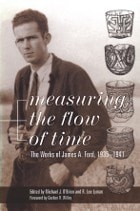
Measuring the Flow of Time
The Works of James A. Ford, 1935-1941James A. Ford, edited by R. Lee Lyman and Michael J. O'Brien
University of Alabama Press, 1999
This collection of Ford's works focuses on the development of ceramic chronology—a key tool in Americanist archaeology.
[more]
My Life with Things
The Consumer DiariesElizabeth Chin
Duke University Press, 2016
Unconventional and provocative, My Life with Things is Elizabeth Chin's meditation on her relationship with consumer goods and a critical statement on the politics and method of anthropology. Chin centers the book on diary entries that focus on everyday items—kitchen cabinet knobs, shoes, a piano—and uses them to intimately examine the ways consumption resonates with personal and social meaning: from writing love haikus about her favorite nail polish and discussing the racial implications of her tooth cap, to revealing how she used shopping to cope with a miscarriage and contemplating how her young daughter came to think that she needed Lunesta. Throughout, Chin keeps Karl Marx and his family's relationship to their possessions in mind, drawing parallels between Marx's napkins, the production of late nineteenth-century table linens, and Chin's own vintage linen collection. Unflinchingly and refreshingly honest, Chin unlocks the complexities of her attachments to, reliance on, and complicated relationships with her things. In so doing, she prompts readers to reconsider their own consumption, as well as their assumptions about the possibilities for creative scholarship.
[more]