Results by title
133 books match the query 'Argentina' and 10 start with m

Mafalda
A Social and Political History of Latin America's Global ComicIsabella Cosse
Duke University Press, 2019
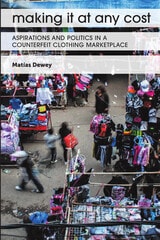
Making It at Any Cost
Aspirations and Politics in a Counterfeit Clothing MarketplaceBy Matías Dewey
University of Texas Press, 2020
La Salada is South America’s largest marketplace for fraudulently labeled clothing, a sprawling and dangerous bazaar on the fringes of Buenos Aires where counterfeit goods are bought and sold, armed thieves roam the nearby streets, and corrupt police and politicians turn a blind eye to widespread unlawful behaviors. Despite conditions traditionally considered inhospitable to economic growth—including acute interpersonal distrust, pervasive personal insecurity, and rampant violence—business in La Salada is booming under an established order completely detached from the state.
Matías Dewey dives deep into the world of La Salada to examine how market exchanges function outside the law and how agreements and norms develop in the economy for counterfeit clothing. Drawing on seven months of ethnographic research and more than a hundred interviews, Dewey argues that aspirations for a better future shape garment workers’ everyday practices, from their home-based sweatshops to the market stalls. The book unearths a new configuration of garment production and commercialization detached from global supply chains, submerged in the shadows of informality and illegality, and rooted in aspiration and opportunity.

Memories of Buenos Aires
Signs of State Terrorism in ArgentinaMax Page
University of Massachusetts Press, 2013
In the 1970s, Argentina was the leader in the “Dirty War,” a violent campaign by authoritarian South American regimes to repress left-wing groups and any others who were deemed subversive. Over the course of a decade, Argentina's military rulers tortured and murdered upwards of 30,000 citizens. Even today, after thirty years of democratic rule, the horror of that time continues to roil Argentine society.
Argentina has also been in the vanguard in determining how to preserve sites of torture, how to remember the “disappeared,” and how to reflect on the causes of the Dirty War. Across the capital city of Buenos Aires are hundreds of grassroots memorials to the victims, documenting the scope of the state's reign of terror. Although many books have been written about this era in Argentina's history, the original Spanish-language edition of Memories of Buenos Aires was the first to identify and interpret all of these sites. It was published by the human rights organization Memoria Abierta, which used interviews with survivors to help unearth that painful history.
This translation brings this important work to an English-speaking audience, offering a comprehensive guidebook to clandestine sites of horror as well as innovative sites of memory. The book divides the 48 districts of the city into 9 sectors, and then proceeds neighborhood-by-neighborhood to offer descriptions of 202 known “sites of state terrorism” and 38 additional places where people were illegally detained, tortured, and killed by the government.

Memories of Buenos Aires
Signs of State Terrorism in ArgentinaMax Page
University of Massachusetts Press, 2013
In the 1970s, Argentina was the leader in the “Dirty War,” a violent campaign by authoritarian South American regimes to repress left-wing groups and any others who were deemed subversive. Over the course of a decade, Argentina's military rulers tortured and murdered upwards of 30,000 citizens. Even today, after thirty years of democratic rule, the horror of that time continues to roil Argentine society.
Argentina has also been in the vanguard in determining how to preserve sites of torture, how to remember the “disappeared,” and how to reflect on the causes of the Dirty War. Across the capital city of Buenos Aires are hundreds of grassroots memorials to the victims, documenting the scope of the state's reign of terror. Although many books have been written about this era in Argentina's history, the original Spanish-language edition of Memories of Buenos Aires was the first to identify and interpret all of these sites. It was published by the human rights organization Memoria Abierta, which used interviews with survivors to help unearth that painful history.
This translation brings this important work to an English-speaking audience, offering a comprehensive guidebook to clandestine sites of horror as well as innovative sites of memory. The book divides the 48 districts of the city into 9 sectors, and then proceeds neighborhood-by-neighborhood to offer descriptions of 202 known “sites of state terrorism” and 38 additional places where people were illegally detained, tortured, and killed by the government.
Memory, Transitional Justice, and Theatre in Postdictatorship Argentina
Noe Montez
Southern Illinois University Press, 2018
Montez explores how the sociohistorical phenomenon of the Teatroxlaidentidad—an annual showcase staged with the support of Argentina’s Grandmothers of the Plaza de Mayo—acted as a vehicle for drawing attention to the hundreds of children kidnapped from their families during the dictatorship and looks at why the memory narratives regarding the Malvinas Islands (also known as the Falklands) range from ideological appropriations of the islands, to absurdist commentaries about the failed war that signaled the dictatorship’s end, to the islands’ heavily contested status today.
Memory, Transitional Justice, and Theatre in Postdictatorship Argentina explores the vibrant role of theatrical engagement in postdictatorship Argentina, analyzes plays by artists long neglected in English-language articles and books, and explores the practicalities of staging performances in Latin America.

Migrant Marketplaces
Food and Italians in North and South AmericaElizabeth Zanoni
University of Illinois Press, 2018
Elizabeth Zanoni provides a cutting-edge comparative look at Italian people and products on the move between 1880 and 1940. Concentrating on foodstuffs—a trade dominated by Italian entrepreneurs in New York and Buenos Aires—Zanoni reveals how consumption of these increasingly global imports affected consumer habits and identities and sparked changing and competing connections between gender, nationality, and ethnicity. Women in particular—by tradition tasked with buying and preparing food—had complex interactions that influenced both global trade and their community economies. Zanoni conveys the complicated and often fraught values and meanings that surrounded food, meals, and shopping.
A groundbreaking interdisciplinary study, Migrant Marketplaces offers a new perspective on the linkages between migration and trade that helped define globalization in the late nineteenth and early twentieth centuries.
Mobilizing Romani Ethnicity
Romani Political Activism in Argentina, Colombia and SpainAnna Mirga-Kruszelnicka
Central European University Press, 2022
The Roma issue is generally treated as a European matter. Indeed, the Roma are the largest European minority—their presence outside of Europe is a result of various waves of migration over the past four hundred years. Likewise, the stereotypes associated with the Roma—the problematized, stigmatized status of a “Gypsy” as well as the historical and contemporary manifestations of antigypsyism—are also of European origin. This book claims, however, that the perception of Roma being strictly a European issue is flawed, and that re-connecting the Roma issue globally represents an important learning experience and an added value.
The book offers a critical exploration of Romani political activism in Colombia and Argentina, and compares it to that in Spain, narrated from the intimate perspective of Romani actors themselves. By outlining parallel lineages of Romani activism in three countries and on two continents, the author arrives at broad conclusions regarding the nature of ethnic mobilization. Mirga-Kruszelnicka proposes a new synergetic conceptualization of this multidirectional concept as an interplay between political opportunities, mobilizing structures, and frames of identity.
Contributing to the vivid debate about the relationship between the researcher and the researched, the book also includes an original discussion of the positionality of scholars of Romani background.
Modernity for the Masses
Antonio Bonet's Dreams for Buenos AiresBy Ana María León
University of Texas Press, 2021
2022 PROSE Award Finalist in Architecture and Urban Planning
2022 Association for Latin American Art Arvey Foundation Book Award, Honorable Mention
Throughout the early twentieth century, waves of migration brought working-class people to the outskirts of Buenos Aires. This prompted a dilemma: Where should these restive populations be situated relative to the city’s spatial politics? Might housing serve as a tool to discipline their behavior?
Enter Antonio Bonet, a Catalan architect inspired by the transatlantic modernist and surrealist movements. Ana María León follows Bonet's decades-long, state-backed quest to house Buenos Aires's diverse and fractious population. Working with totalitarian and populist regimes, Bonet developed three large-scale housing plans, each scuttled as a new government took over. Yet these incomplete plans—Bonet's dreams—teach us much about the relationship between modernism and state power.
Modernity for the Masses finds in Bonet's projects the disconnect between modern architecture’s discourse of emancipation and the reality of its rationalizing control. Although he and his patrons constantly glorified the people and depicted them in housing plans, Bonet never consulted them. Instead he succumbed to official and elite fears of the people's latent political power. In careful readings of Bonet's work, León discovers the progressive erasure of surrealism's psychological sensitivity, replaced with an impulse, realized in modernist design, to contain the increasingly empowered population.

Multi-Ethnic Bird Guide of the Sub-Antarctic Forests of South America
Ricardo Rozzi
University of North Texas Press, 2010

Musicians in Transit
Argentina and the Globalization of Popular MusicMatthew B. Karush
Duke University Press, 2017