Results by title
117 books match the query 'Asian Americans' and 11 start with m
Making Of Asian America
Through Political ParticipationPei-te Lien
Temple University Press, 2001
Professor Lien looks at political participation by Asian Americans prior to 1965 and then examines, at both organizational and mass politics levels, how race, ethnicity, and transnationalism help to construct a complex American electorate. She looks not only at rates of participation among Asian Americans as compared with blacks, Latinos, American Indians, and non-Hispanic whites, but also among specific groups of Asian Americans—Chinese, Japanese, Filipinos, Koreans, Asian Indians, and Vietnamese. She also discusses how gender, socioeconomic class, and place of birth affect political participation.
With documentation ranging from historical narrative to opinion survey data, Professor Lien creates a picture of a diverse group of politically active people who are intent on carving out a place for themselves in American political life.
Making the Human
Race, Allegory, and Asian AmericansCorinne Mitsuye Sugino
Rutgers University Press, 2025
Winner of the 2026 Cultural Studies Association First Book Prize
From the debate over affirmative action to the increasingly visible racism amidst the COVID-19 pandemic, Asian Americans have emerged as key figures in a number of contemporary social controversies. In Making the Human: Race, Allegory, and Asian Americans, Corinne Mitsuye Sugino offers the lens of racial allegory to consider how media, institutional, and cultural narratives mobilize difference to normalize a white, Western conception of the human. Rather than focusing on a singular arena of society, Sugino considers contemporary sources across media, law, and popular culture to understand how they interact as dynamic sites of meaning-making. Drawing on scholarship in Asian American studies, Black studies, cultural studies, communication, and gender and sexuality studies, Sugino argues that Asian American racialization and gendering plays a key role in shoring up abstract concepts such as “meritocracy,” “family,” “justice,” “diversity,” and “nation” in ways that naturalize hierarchy. In doing so, Making the Human grapples with anti-Asian racism’s entanglements with colonialism, antiblackness, capitalism, and gendered violence.
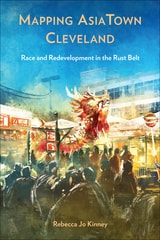
Mapping AsiaTown Cleveland
Race and Redevelopment in the Rust BeltRebecca Jo Kinney
Temple University Press, 2025
Mapping AsiaTown Cleveland challenges ideas about the invisibility of Asian Americans in the urban Midwest by linking the contemporary development of Cleveland’s “AsiaTown” to the multiple and fragmented histories of Cleveland’s Asian American communities from the 1940s to present day. Kinney’s sharp insights illustrate how region matters for Japanese Americans who resettled from concentration camps and Chinese Americans food purveyors, as well as the ways in which Asian American community leaders have had to fight for visibility and representation in city planning—even as the Cleveland Asian Festival is branded as a marquee “diversity” event for the city.
Mapping AsiaTown Cleveland recognizes the vibrant Asian American community formations and belonging that have developed in seemingly unexpected spaces and places.
In the series Asian American History and Culture
Minor Re/Visions
Asian American Literacy Narratives as a Rhetoric of CitizenshipMorris Young
Southern Illinois University Press, 2004
Through a blend of personal narrative, cultural and literary analysis, and discussions about teaching, Minor Re/Visions: Asian American Literacy Narratives as a Rhetoric of Citizenship shows how people of color use reading and writing to develop and articulate notions of citizenship. Morris Young begins with a narration of his own literacy experiences to illustrate the complicated relationship among literacy, race, and citizenship and to reveal the tensions that exist between competing beliefs and uses of literacy among those who are part of dominant American culture and those who are positioned as minorities.
Influenced by the literacy narratives of other writers of color, Young theorizes an Asian American rhetoric by examining the rhetorical construction of American citizenship in works such as Richard Rodriguez’s Hunger of Memory, Victor Villanueva’s Bootstraps: From an American Academic of Color, Carlos Bulosan’s America Is in the Heart, and Maxine Hong Kingston’s “Song for a Barbarian Reed Pipe” from Woman Warrior. These narratives, Young shows, tell stories of transformation through education, the acquisition of literacy, and cultural assimilation and resistance. They also offer an important revision to the American story by inserting the minor and creating a tension amid dominant discourses about literacy, race, and citizenship. Through a consideration of the literacy narratives of Hawai`i, Young also provides a context for reading literacy narratives as responses to racism, linguistic discrimination, and attempts at “othering” in a particular region.
As we are faced with dominant discourses that construct race and citizenship in problematic ways and as official institutions become even more powerful and prevalent in silencing minor voices, Minor Re/Visions reveals the critical need for revising minority and dominant discourses. Young’s observations and conclusions have important implications for the ways rhetoricians and compositionists read, teach, and assign literacy narratives.
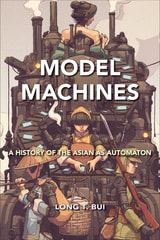
Model Machines
A History of the Asian as AutomatonLong T. Bui
Temple University Press, 2022
In the contemporary Western imagination, Asian people are frequently described as automatons, which disavows their humanity. In Model Machines, Long Bui investigates what he calls Asian roboticism or the ways Asians embody the machine and are given robotic characteristics.
Bui offers the first historical overview of the overlapping racialization of Asians and Asian Americans through their conflation with the robot-machine nexus. He puts forth the concept of the “model machine myth,” which holds specific queries about personhood, citizenship, labor, and rights in the transnational making of Asian/America.
The case studies in Model Machines chart the representation of Chinese laborers, Japanese soldiers, Asian sex workers, and other examples to show how Asians are reimagined to be model machines as a product of globalization, racism, and colonialism. Moreover, it offers examples of how artists and everyday people resisted that stereotype to consider different ways of being human. Starting from the early nineteenth century, the book ends in the present with the new millennium, where the resurgence of China presages the “rise of the machines” and all the doomsday scenarios this might spell for global humanity at large.
Model-Minority Imperialism
Victor Bascara
University of Minnesota Press, 2006
Modeling Citizenship
Jewish and Asian American WritingAuthored by Cathy Schlund-Vials
Temple University Press, 2011
Navigating deftly among historical and literary readings, Cathy Schlund-Vials examines the analogous yet divergent experiences of Asian Americans and Jewish Americans in Modeling Citizenship. She investigates how these model minority groups are shaped by the shifting terrain of naturalization law and immigration policy, using the lens of naturalization, not assimilation, to underscore questions of nation-state affiliation and sense of belonging.
Modeling Citizenship examines fiction, memoir, and drama to reflect on how the logic of naturalization has operated at discrete moments in the twentieth century. Each chapter focuses on two exemplary literary works. For example, Schlund-Vials shows how Mary Antin's Jewish-themed play The Promised Land is reworked into a more contemporary Chinese American context in Gish Jen's Mona in the Promised Land.
In her compelling analysis, Schlund-Vials amplifies the structural, cultural, and historical significance of these works and the themes they address.
Monitored Peril
Asian Americans and the Politics of TV RepresentationDarrell Y. Hamamoto
University of Minnesota Press, 1994
The first major study of Asian American representation on U.S. television.
Early in the movement of Asian labor to the United States, immigrants from the Far East were viewed by the dominant Euro-American society as a peril to a white, Christian nation. How far have we come since then? This first comprehensive study of Asian American representation on network television supplies some unsettling answers.
A meticulous work of history, cultural criticism, and political analysis, Monitored Peril illuminates the unstable relationship between the discursive practices of commercial television programs, liberal democratic values, and white supremacist ideology. The book clearly demonstrates the pervasiveness of racialized discourse throughout U.S. society, especially as it is reproduced by network television. In treating his topic, Darrell Hamamoto addresses a wide variety of issues facing diverse Asian American communities: interracial conflict, conservative politics, U.S.-Japan trade friction, and postcolonial Vietnam. Through an examination of selected programs from the 1950s to the present, he attempts to correct the consistently distorted optic of network television. Finally, he calls for an engaged independent Asian American media practice, and for the expansion of public sector television. Selected as a CHOICE Outstanding Academic Book for 1995ISBN 0-8166-2368-6 cloth $49.95xISBN 0-8166-2369-4 paper $18.95320 pages 6 x 9AugustContentsPreface1. White Christian Nation2. Asians in the American West3. War against Japanese America4. Asian Americans and U.S. Empire5. Southeast Asian America6. Contemporary Asian America7. Counterprogramming EpilogueRelated BacklistThe Bronze Screen: Chicana and Chicano Film CultureRosa Linda FregosoExplores Chicana and Chicano popular culture in Hollywood commercial and independent cinema. (1993)
Mu, 49 Marks of Abolition
Sora Y. Han
Duke University Press, 2024
Multiracial Mandarin
Asian Americans and Impossible LanguageDavid Shuang Song
University of Minnesota Press, 2026
Understanding the entanglement of language education with ethnicity and racialization
Who has the “right” to learn Mandarin Chinese? In Multiracial Mandarin, author David Shuang Song examines how matters of race and privilege shape US Mandarin language education and who has access to it. Through a two-year ethnographic study of two Bay Area high schools where diasporic and heritage speakers learn Mandarin alongside Black and Latinx students, Song advances a sociological and educational–linguistic inquiry into how language interacts with our understanding of identity and equity.
Comparing classroom activities in two public schools, Song investigates teachers who seek to make Mandarin accessible while detaching it from its cultural roots. As he explores the difficulties of limited resources, racial inequality, and pedagogical practices inherent in multiracial Mandarin instruction, Song shows how language education complicates how educators understand Asian American students and troubles conventional conversations around race and racial equity in schools.
Arguing that language practice and instruction must always be considered in relation to diaspora, ethnicity, and racialization, Multiracial Mandarin offers a frank analysis of the risks and benefits of teaching a diasporic language and asks if this practice ought to be replicated in more schools. As he applies innovative conceptual frameworks for talking about language among Asian Americans, Song’s timely and theoretically sophisticated analysis has wide-ranging implications for how students, teachers, and administrators approach essential questions around education, privilege, and language survival.
Retail e-book files for this title are screen-reader friendly.
Musicians from a Different Shore
Asians and Asian Americans in Classical MusicMari Yoshihara
Temple University Press, 2008
Musicians of Asian descent enjoy unprecedented prominence in concert halls, conservatories, and classical music performance competitions. In the first book on the subject, Mari Yoshihara looks into the reasons for this phenomenon, starting with her own experience of learning to play piano in Japan at the age of three. Yoshihara shows how a confluence of culture, politics and commerce after the war made classical music a staple in middle-class households, established Yamaha as the world's largest producer of pianos and gave the Suzuki method of music training an international clientele. Soon, talented musicians from Japan, China and South Korea were flocking to the United States to study and establish careers, and Asian American families were enrolling toddlers in music classes.
Against this historical backdrop, Yoshihara interviews Asian and Asian American musicians, such as Cho-Liang Lin, Margaret Leng Tan, Kent Nagano, who have taken various routes into classical music careers. They offer their views about the connections of race and culture and discuss whether the music is really as universal as many claim it to be. Their personal histories and Yoshihara's observations present a snapshot of today's dynamic and revived classical music scene.