264 books match the query 'Asian Studies' and 12 start with m
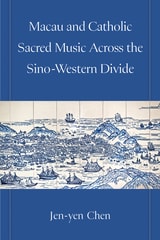
cover of Macau and Catholic Sacred Music Across the Sino-Western Divide

Macau and Catholic Sacred Music Across the Sino-Western Divide

Jen-yen Chen

University of Michigan Press, 2026

For three centuries, the former Portuguese colony of Macau served as the gateway into mainland China and the locale for the development of an Asian Catholic culture that encompassed distinctive musical practices and styles. Macau and Catholic Music Across the Sino-Western Divide draws extensively upon historical documents in Chinese and Portuguese for a polylingual approach to Catholic sacred music. Jen-yen Chen follows this music from the sixteenth century through the twentieth by reading literary accounts of sound, primary source documents, and musical notation to examine the impacts of linguistic, political, and cultural divides and the ways sounds have traveled across these divides. Chen covers Chinese responses to Western sounds in Macau and southern China, illuminating the strategies for the use of sounds and musicking adopted by Jesuit missionaries; and the complexities of identity formation negotiated by Macau Catholics who confront exceptionalist historical discourses of Chinese or Portuguese “greatness.” 

Drawing from sound studies and  musicological methods, Chen argues that Chinese descriptions of Catholic sounds in Macau, including the ringing of church bells, the playing of the organ, and choral singing, illuminate spatial, sonic, and ideological mobilities that reconfigure Chinese and European identities. Macau and Catholic Music Across the Sino-Western Divide also extends to contemporary times to explore how present day members of Macau’s Catholic community position themselves in relation to the historical narratives often told about their city, cultivating a rich individuality of identity that refuses conformity to fixed notions of Asianness or Westernness.
[more]
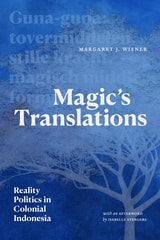
cover of Magic’s Translations: Reality Politics in Colonial Indonesia

Magic’s Translations

Reality Politics in Colonial Indonesia

Margaret J. Wiener

Duke University Press, 2025
“Do you believe in magic?” This familiar question suggests magic is easily recognized but unreal. In Magic’s Translations, Margaret J. Wiener argues that such views are shaped by historical power struggles, especially in Europe’s relations with the wider world. Focusing on nineteenth- and twentieth-century Dutch interactions with Indonesians, Wiener reveals how colonial agents framed unfamiliar practices, practitioners, and objects as “magic,” rendering distinct phenomena fundamentally alike and advancing colonizing projects that deemed magic antithetical to reason and reality. While colonial authorities, including ethnologists, mobilized the concept of magic to differentiate Europeans from Indonesians, nature from culture, reason from superstition, and fact from fetish, their efforts produced unexpected outcomes: Some Indonesian artifacts and acts not only retained their power but invaded European experiences. As anthropologists were among the key translators of magic throughout the world, Wiener intersperses accounts of magic’s translations in the Indies with reflections on anthropology’s ongoing engagement with the concept. She demonstrates that magic became an object of expert knowledge, political control, and popular fascination, rather than a self-evident category or relic of naïve belief.
[more]
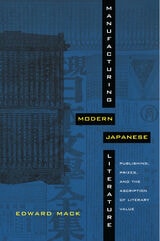
cover of Manufacturing Modern Japanese Literature: Publishing, Prizes, and the Ascription of Literary Value

Manufacturing Modern Japanese Literature

Publishing, Prizes, and the Ascription of Literary Value

Edward Mack

Duke University Press, 2010
Emphasizing how modes of book production, promotion, and consumption shape ideas of literary value, Edward Mack examines the role of Japan’s publishing industry in defining modern Japanese literature. In the late nineteenth century and early twentieth, as cultural and economic power consolidated in Tokyo, the city’s literary and publishing elites came to dominate the dissemination and preservation of Japanese literature. As Mack explains, they conferred cultural value on particular works by creating prizes and multivolume anthologies that signaled literary merit. One such anthology, the Complete Works of Contemporary Japanese Literature (published between 1926 and 1931), provided many readers with their first experience of selected texts designated as modern Japanese literature. The low price of one yen per volume allowed the series to reach hundreds of thousands of readers. An early prize for modern Japanese literature, the annual Akutagawa Prize, first awarded in 1935, became the country’s highest-profile literary award. Mack chronicles the history of book production and consumption in Japan, showing how advances in technology, the expansion of a market for literary commodities, and the development of an extensive reading community enabled phenomena such as the Complete Works of Contemporary Japanese Literature and the Akutagawa Prize to manufacture the very concept of modern Japanese literature.
[more]
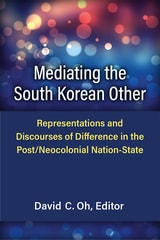
cover of Mediating the South Korean Other: Representations and Discourses of Difference in the Post/Neocolonial Nation-State

Mediating the South Korean Other

Representations and Discourses of Difference in the Post/Neocolonial Nation-State

David C. Oh, Editor

University of Michigan Press, 2022

Multiculturalism in Korea formed in the context of its neoliberal, global aspirations, its postcolonial legacy with Japan, and its subordinated neocolonial relationship with the United States. The Korean ethnoscape and mediascape produce a complex understanding of difference that cannot be easily reduced to racism or ethnocentrism. Indeed the Korean word, injongchabyeol, often translated as racism, refers to discrimination based on any kind of “human category.” Explaining Korea’s relationship to difference and its practices of othering, including in media culture, requires new language and nuance in English-language scholarship.

This collection brings together leading and emerging scholars of multiculturalism in Korean media culture to examine mediated constructions of the “other,” taking into account the nation’s postcolonial and neocolonial relationships and its mediated construction of self. “Anthrocategorism ,” a more nuanced translation  of injongchabyeol, is proffered as a new framework for understanding difference in ways that are locally meaningful in a society and media system in which racial or even ethnic differences are not the most salient. The collection points to the construction of racial others that elevates, tolerates, and incorporates difference; the construction of valued and devalued ethnic others, and the ambivalent construction of co-ethnic others as sympathetic victims or marginalized threats.
[more]
cover of Men at Home: Imagining Liberation in Colonial and Postcolonial India

Men at Home

Imagining Liberation in Colonial and Postcolonial India

Gyanendra Pandey

Duke University Press, 2025
In Men at Home, Gyanendra Pandey offers a detailed exploration of men’s comportment and conduct in the home and the implications of their ambiguous commitment to this critical part of their lives. The author draws on a wealth of archival materials—autobiographies, memoirs, fiction, and ethnographies—to situate Indian men firmly in the domestic world, underlining their dependence on the family and home. He investigates how men negotiate marriage, intimacy, and conjugality and focuses the effects of the humiliating and constant assertion of gender, caste, and class power in familial interactions. To uncover the nuances of these relationships, Pandey attends to the domestic commitments of upper-, middle-, and lower-class men across religion and caste. He considers issues of honor and shame, rights and responsibilities, citizenship and belonging through this exploration of how men across the subcontinent understand themselves in and beyond their domestic relationships. As much as it is a book about masculinity and conjugality, this is a book about Indian modernity, nationalism, and society as seen from the location of men in the home.
[more]
cover of Migrant Labour in Global Factories: Care, welfare and government under market socialism in China and Vietnam

Migrant Labour in Global Factories

Care, welfare and government under market socialism in China and Vietnam

Jake Lin, Minh T. N. Nguyen, and Jingyu Mao

University College London, 2026

This interdisciplinary study investigates the unique challenges faced by migrant workers in the market socialist countries of China and Vietnam. 

The labor of hundreds of millions of internal migrant workers plays a crucial role for China and Vietnam’s national development and the expansion of global production chains in these market socialist countries. As the Communist party states have been promoting both marketization and welfare expansion since their respective reforms began, contradictions between the commodification and social protection of labor lead to significant obstacles to migrant workers’ welfare and well-being in the post-reform era.

Bringing into focus the connection between the reconfiguration of labor and changes in the two countries’ welfare systems, Migrant Labour in Global Factories analyzes how these contradictions shape the care of their huge migrant labor forces. It explores how they unfold in the historical and political contexts of both countries, bringing a range of relevant theories about welfare and social policymaking to bear on the features of the market socialist economy. The book argues that the evolving welfare systems in China and Vietnam fail to meaningfully address the social consequences of labor commodification in contexts where neoliberal development is instrumentalized to serve the political control and legitimacy of the party states. This is often at the cost of long-term and sustainable social policies for migrant labor in global factories.

[more]
cover of Mishearing Home: A Sinophone Poetics of Sound

Mishearing Home

A Sinophone Poetics of Sound

Yun Emily Wang

Duke University Press, 2027
[more]
cover of Modern Chinese Literary and Cultural Studies in the Age of Theory: Reimagining a Field

Modern Chinese Literary and Cultural Studies in the Age of Theory

Reimagining a Field

Rey Chow, ed.

Duke University Press, 2000

These groundbreaking essays use critical theory to reflect on issues pertaining to modern Chinese literature and culture and, in the process, transform the definition and conceptualization of the field of modern Chinese studies itself. The wide range of topics addressed by this international group of scholars includes twentieth-century literature produced in Taiwan, Hong Kong, and mainland China; film, art, history, popular culture, and literary and cultural criticism; as well as the geographies of migration and diaspora.

One of the volume’s provocative suggestions is that the old model of area studies—an offshoot of U.S. Cold War strategy that found its anchorage in higher education—is no longer feasible for the diverse and multifaceted experiences that are articulated under the rubric of “Chineseness.” As Rey Chow argues in her introduction, the notion of a monolithic Chineseness bound ultimately to mainland China is, in itself, highly problematic because it recognizes neither the material realities of ethnic minorities within China nor those of populations in places such as Tibet, Taiwan, and post–British Hong Kong. Above all, this book demonstrates that, as the terms of a chauvinistic sinocentrism become obsolete, the critical use of theory—particularly by younger China scholars whose enthusiasm for critical theory coincides with changes in China’s political economy in recent years—will enable the emergence of fresh connections and insights that may have been at odds with previous interpretive convention.
Originally published as a special issue of the journal boundary 2, this collection includes two new essays and an afterword by Paul Bové that places its arguments in the context of contemporary cultural politics. It will have far-reaching implications for the study of modern China and will be of interest to scholars of theory and culture in general.

Contributors. Stanley K. Abe, Ien Ang, Chris Berry, Paul Bové, Sung-cheng Yvonne Chang, Rey Chow, Dorothy Ko, Charles Laughlin, Leung Ping-kwan, Kwai-cheung Lo, Christopher Lupke, David Der-wei Wang, Michelle Yeh
[more]
cover of Money, Trains, and Guillotines: Art and Revolution in 1960s Japan

Money, Trains, and Guillotines

Art and Revolution in 1960s Japan

William Marotti

Duke University Press, 2013
During the 1960s a group of young artists in Japan challenged official forms of politics and daily life through interventionist art practices. William Marotti situates this phenomenon in the historical and political contexts of Japan after the Second World War and the international activism of the 1960s. The Japanese government renewed its Cold War partnership with the United States in 1960, defeating protests against a new security treaty through parliamentary action and the use of riot police. Afterward, the government promoted a depoliticized everyday world of high growth and consumption, creating a sanitized national image to present in the Tokyo Olympics of 1964. Artists were first to challenge this new political mythology. Marotti examines their political art, and the state's aggressive response to it. He reveals the challenge mounted in projects such as Akasegawa Genpei's 1,000-yen prints, a group performance on the busy Yamanote train line, and a plan for a giant guillotine in the Imperial Plaza. Focusing on the annual Yomiuri Indépendant exhibition, he demonstrates how artists came together in a playful but powerful critical art, triggering judicial and police response. Money, Trains, and Guillotines expands our understanding of the role of art in the international 1960s, and of the dynamics of art and policing in Japan.
[more]
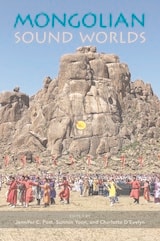
cover of Mongolian Sound Worlds

Mongolian Sound Worlds

Edited by Jennifer C. Post, Sunmin Yoon, and Charlotte D'Evelyn

University of Illinois Press, 2022

Music cultures today in rural and urban Mongolia and Inner Mongolia emerge from centuries-old pastoralist practices that were reshaped by political movements in the twentieth century. Mongolian Sound Worlds investigates the unique sonic elements, fluid genres, social and spatial performativity, and sounding objects behind new forms of Mongolian music--forms that reflect the nation’s past while looking towards its globalized future. Drawing on fieldwork in locations across the Inner Asian region, the contributors report on Mongolia’s genres and musical landscapes; instruments like the morin khuur, tovshuur, and Kazakh dombyra; combined fusion band culture; and urban popular music. Their broad range of concerns include nomadic herders’ music and instrument building, ethnic boundaries, heritage-making, ideological influences, nationalism, and global circulation.

A merger of expert scholarship and eyewitness experience, Mongolian Sound Worlds illuminates a diverse and ever-changing musical culture.

Contributors: Bayarsaikhan Badamsuren, Otgonbaayar Chuulunbaatar, Andrew Colwell, Johanni Curtet, Charlotte D’Evelyn, Tamir Hargana, Peter K. Marsh, K. Oktyabr, Rebekah Plueckhahn, Jennifer C. Post, D. Tserendavaa, and Sunmin Yoon
[more]
cover of Mormonisms in Asia: Stories of Global Faith and Local Lives

Mormonisms in Asia

Stories of Global Faith and Local Lives

Edited by Melissa Wei-Tsing Inouye and Laurie F. Maffly-Kipp

University of Illinois Press, 2026

Mormonism is often described as the quintessentially American religion, one that is highly centralized around its leadership and demographic presence in Utah. But given a dramatic increase in non-U.S. membership since 1960 in both the Church of Jesus Christ of Latter-day Saints and the Community of Christ, new questions about these movements come to the fore: How are these Restoration traditions lived and experienced in other parts of the world? How do church members outside the United States understand their relationship to a sacralized American past and an administrative hierarchy in Salt Lake City? And how has the relatively recent explosion of membership outside of the United States begun to shift the faith’s institutional, political, and cultural dynamics within those traditions? Most importantly, how do church members from different localities and cultures relate to each other, forming a global community? Or do they?

This volume focuses on Asia, a region that includes more than half the world's population, but where Restoration traditions specifically and Christianity broadly are minority faiths. It uses a combination of focused case studies and theoretical analysis to highlight broader trends and themes that those studies suggest about the meaning of a globalized faith in the twenty-first century. The first section of this book lays out ways of thinking about Mormonism’s global presence in terms of the nation-state, and the essays explore where and how Restoration traditions as institutional actors have made their way into new political and social contexts. The second section studies the tensions created by the encounters of LDS norms with preexisting cultural and political values in local settings. These essays burrow more deeply into political and religious realities and explore the variations in Mormon cultural assumptions about politics and society, as well as the relationship between local congregants and the Mormon administrative center. The final section presents fine-grained
studies that focus attention on one of the central features of LDS lived religion: the role of gender and the family in the religious community. In each case, divine dictates necessarily bump up against traditional societal norms that converts must navigate.

Contributors: John-Charles Duffy, Stacilee Ford, Taunalyn Ford, Conan Grames, David J. Howlett, Melissa Wei-Tsing Inouye, Keisha Lai, Laurie Maffly-Kipp, Matthew Martinich, Meagan Rainock, Shinji Takagi, Pierre Vendassi
[more]
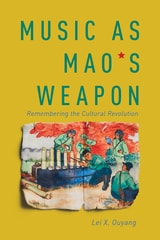
cover of Music as Mao's Weapon: Remembering the Cultural Revolution

Music as Mao's Weapon

Remembering the Cultural Revolution

Lei X. Ouyang

University of Illinois Press, 2022

A Choice Outstanding Academic Title for 2022

China's Cultural Revolution (1966-1976) produced propaganda music that still stirs unease and, at times, evokes nostalgia. Lei X. Ouyang uses selections from revolutionary songbooks to untangle the complex interactions between memory, trauma, and generational imprinting among those who survived the period of extremes. Interviews combine with ethnographic fieldwork and surveys to explore both the Cultural Revolution's effect on those who lived through it as children and contemporary remembrance of the music created to serve the Maoist regime. As Ouyang shows, the weaponization of music served an ideological revolution but also revolutionized the senses. She examines essential questions raised by this phenomenon, including: What did the revolutionization look, sound, and feel like? What does it take for individuals and groups to engage with such music? And what is the impact of such an experience over time?

Perceptive and provocative, Music as Mao's Weapon is an insightful look at the exploitation and manipulation of the arts under authoritarianism.

[more]