Results by title
109 books match the query 'Astronomy' and 7 start with m
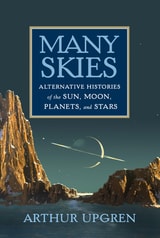
Many Skies
Alternative Histories of the Sun, Moon, Planets, and StarsUpgren, Arthur
Rutgers University Press, 2012
These and other imaginative scenarios are the subject of Arthur Upgren's inventive book Many Skies: Alternative Histories of the Sun, Moon, Planets, and Stars. Although the night sky as we know it seems eternal and inevitable, Upgren reminds us that, just as easily, it could have been very different.
Had the solar sytem happened to be in the midst of a star cluster, we might have many more bright stars in the sky. Yet had it been located beyond the edge of the Milky Way galaxy, we might have no stars at all. If Venus or Mars had a moon as large as ours, we would be able to view it easily with the unaided eye. Given these or other alternative skies, what might Ptolemy or Copernicus have concluded about the center of the solar sytem and the Sun?
This book not only examines the changes in science that these alternative solar, stellar, and galactic arrangements would have brought, it also explores the different theologies, astrologies, and methods of tracking time that would have developed to reflect them. Our perception of our surroundings, the number of gods we worship, the symbols we use in art and literature, even the way we form nations and empires are all closely tied to our particular (and accidental) placement in the universe.
Many Skies, however, is not merely a fanciful play on what might have been. Upgren also explores the actual ways that human interferences such as light pollution are changing the night sky. Our atmosphere, he warns, will appear very different if we have belt of debris circling the globe and blotting out the stars, as will happen if advertisers one day pollute space with brilliant satellites displaying their products.
From fanciful to foreboding, the scenarios in Many Skies will both delight and inspire reflection, reminding us that ours is but one of many worldviews based on our experience of a universe that is as much a product of accident as it is of intention.
Mars
Edited by H. H. Kieffer, B. M. Jakosky, C. W. Snyder, and M. S. Matthews
University of Arizona Press, 1992
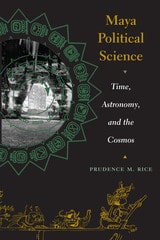
Maya Political Science
Time, Astronomy, and the CosmosBy Prudence M. Rice
University of Texas Press, 2004
How did the ancient Maya rule their world? Despite more than a century of archaeological investigation and glyphic decipherment, the nature of Maya political organization and political geography has remained an open question. Many debates have raged over models of centralization versus decentralization, superordinate and subordinate status—with far-flung analogies to emerging states in Europe, Asia, and Africa. But Prudence Rice asserts that neither the model of two giant "superpowers" nor that which postulates scores of small, weakly independent polities fits the accumulating body of material and cultural evidence.
In this groundbreaking book, Rice builds a new model of Classic lowland Maya (AD 179-948) political organization and political geography. Using the method of direct historical analogy, she integrates ethnohistoric and ethnographic knowledge of the Colonial-period and modern Maya with archaeological, epigraphic, and iconographic data from the ancient Maya. On this basis of cultural continuity, she constructs a convincing case that the fundamental ordering principles of Classic Maya geopolitical organization were the calendar (specifically a 256-year cycle of time known as the may) and the concept of quadripartition, or the division of the cosmos into four cardinal directions. Rice also examines this new model of geopolitical organization in the Preclassic and Postclassic periods and demonstrates that it offers fresh insights into the nature of rulership, ballgame ritual, and warfare among the Classic lowland Maya.
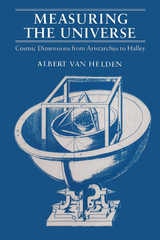
Measuring the Universe
Cosmic Dimensions from Aristarchus to HalleyAlbert Van Helden
University of Chicago Press, 1986
"Van Helden's authoritative treatment is concise and informative; he refers to numerous sources of information, draws on the discoveries of modern scholarship, and presents the first book-length treatment of this exceedingly important branch of science."—Edward Harrison, American Journal of Physics
"Van Helden writes well, with a flair for clear explanation. I warmly recommend this book."—Colin A. Ronan, Journal of the British Astronomical Association

Mercury
Edited by Faith Vilas, Clark R. Chapman, and Mildred Shapley Matthews
University of Arizona Press, 1989
"This book is another in the excellent University of Arizona Space Science Series, each of which is based on a conference. . . .but goes far beyond a conference proceedings to present a comprehensive summary of current knowledge. . . .I recommend this book as a valuable compendium of current knowledge."—Pageoph
"This collection will be a most valuable addition to any research library."—Choice
Meteorites and the Early Solar System II
Edited by Dante S. Lauretta and Harry Y. McSween
University of Arizona Press, 2006
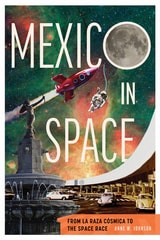
Mexico in Space
From la Raza Cósmica to the Space RaceAnne W. Johnson
University of Arizona Press, 2026
From Aztec sun stones to satellite launches, from muralist visions to dark sky parks, Mexico’s engagement with outer space is fundamental to its identity. Mexico in Space offers a groundbreaking look at how the country has navigated the tensions between technological dependence and sovereign dreams.
Anthropologist Anne W. Johnson reveals Mexico’s unique relationship with outer space, describing Indigenous knowledge, nationalist projects, artistic visions, and community practices. Through rich ethnographic detail and historical insight, Johnson challenges the notion that space is for everyone and shows whose voices truly shape the world’s cosmic futures. Johnson introduces us to satellite engineers, community astronomers, space generation youth, and artists imagining Mars, each crafting alternative cosmic futures.
As space exploration increasingly becomes the domain of billionaires and superpowers, this book offers a compelling counternarrative, demonstrating how Mexican cosmic engagements suggest more just, inclusive ways of inhabiting Earth and beyond and providing vital lessons for reimagining humanity’s place in the cosmos.