Results by title
51 books match the query 'Atrocities' and 2 start with m
Memorializing Violence
Transnational Feminist ReflectionsAlison Crosby
Rutgers University Press, 2025
Memorializing Violence brings together feminist and queer reflections on the transnational lives of memorialization practices, asking what it means to grapple with loss, mourning, grief, and desires to collectively remember and commemorate–as well as urges to forget–in the face of disparate yet entangled experiences of racialized and gendered colonial, imperial, militarized, and state violence. The volume uses a transnational feminist approach to ask, How do such efforts in seemingly unconnected remembrance landscapes speak to, with, and through each other in a world order inflected by colonial, imperial, and neoliberal logics, structures, and strictures? How do these memorializing initiatives not only formulate within but move through complex transnational flows and circuits, and what transpires as they do? What does it mean to inhabit loss, mourning, resistance, and refusal through memorialization at this moment, and what’s at stake in doing so? What might transnational feminist analyses of gender, race, sexuality, class, and nation have to offer in this regard?
[more]
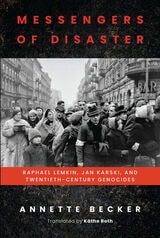
Messengers of Disaster
Raphael Lemkin, Jan Karski, and Twentieth-Century GenocidesAnnette Becker, Translated by Käthe Roth
University of Wisconsin Press, 2021
Leading up to World War II, two Polish men witnessed the targeted extermination of Jews under Adolf Hitler and the German Reich before the reality of the Holocaust was widely known. Raphael Lemkin, a Jewish lawyer who coined the term "genocide," and Jan Karski, a Catholic member of the Polish resistance, independently shared this knowledge with Winston Churchill and Franklin D. Roosevelt. Having heard false rumors of wartime atrocities before, the leaders met the messengers with disbelief and inaction, leading to the eventual murder of more than six million people.
Messengers of Disaster draws upon little-known texts from an array of archives, including the International Committee of the Red Cross in Geneva and the International Tracing Service in Bad Arolsen. Carrying the knowledge of disaster took a toll on Lemkin and Karski, but their work prepared the way for the United Nations to unanimously adopt the first human rights convention in 1948 and influenced the language we use to talk about genocide today. Annette Becker's detailed study of these two important figures illuminates how distortions of fact can lead people to deny knowledge of what is happening in front of their own eyes.
Messengers of Disaster draws upon little-known texts from an array of archives, including the International Committee of the Red Cross in Geneva and the International Tracing Service in Bad Arolsen. Carrying the knowledge of disaster took a toll on Lemkin and Karski, but their work prepared the way for the United Nations to unanimously adopt the first human rights convention in 1948 and influenced the language we use to talk about genocide today. Annette Becker's detailed study of these two important figures illuminates how distortions of fact can lead people to deny knowledge of what is happening in front of their own eyes.
[more]