Results by title
169 books match the query 'Auto-narrator' and 5 start with m

Madness and Enterprise
Psychiatry, Economic Reason, and the Emergence of Pathological ValueNima Bassiri
University of Chicago Press, 2024
This is an auto-narrated audiobook version of this book.
Uncovers a powerful relationship between pathology and money: beginning in the nineteenth century, the severity of mental illness was measured against a patient’s economic productivity.
Madness and Enterprise reveals the economic norms embedded within psychiatric thinking about mental illness in the North Atlantic world. Over the course of the nineteenth century, various forms of madness were subjected to a style of psychiatric reasoning that was preoccupied with money. Psychiatrists across Western Europe and the United States attributed financial and even moral value to an array of pathological conditions, such that some mental disorders were seen as financial assets and others as economic liabilities. By turning to economic conduct and asking whether potential patients appeared capable of managing their financial affairs or even generating wealth, psychiatrists could often bypass diagnostic uncertainties about a person’s mental state.
Through an exploration of the intertwined histories of psychiatry and economic thought, Nima Bassiri shows how this relationship transformed the very idea of value in the modern North Atlantic, as the most common forms of social valuation—moral value, medical value, and economic value—were rendered equivalent and interchangeable. If what was good and what was healthy were increasingly conflated with what was remunerative (and vice versa), then a conceptual space opened through which madness itself could be converted into an economic form and subsequently redeemed—and even revered.
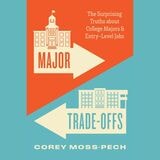
Major Trade-Offs
The Surprising Truths about College Majors and Entry-Level JobsCorey Moss-Pech
University of Chicago Press, 2025
This is an auto-narrated audiobook version of this book.
An eye-opening look at the relationship between students’ majors and their entry-level jobs.
Humanities majors are used to answering the question, “So, what are you going to do with that degree?” The common misconception is that students in humanities programs don’t learn any useful skills for the real world. In Major Trade-Offs, sociologist Corey Moss-Pech argues that not only do humanities majors learn real-world skills, but they actually use them when they graduate. Despite this discrepancy, graduates with so-called practical degrees like business and engineering are much more likely to find employment, and they earn higher salaries. Why do we belittle a liberal arts education despite the valuable skills that students acquire during their studies?
Major Trade-Offs addresses this question by following students from different majors as they enter the workforce. To understand the relationship between majors and entry-level jobs, Moss-Pech conducted nearly 200 interviews with roughly ninety students from four majors at a large Midwestern university: engineering, business, English, and communications. He follows these students through their senior years, chronicling their internships and the support their universities provide in helping them pursue their career paths. He found that graduates from practical majors entered the labor market successfully, typically through structured internship programs. However, many ended up in entry-level jobs that, while well-paid, were largely clerical and didn’t necessarily require a degree to perform. On the other hand, liberal arts majors rarely accessed structured internships and were largely left to carve out their own paths, but did use their degree skills once they secured a job. These results challenge popular myths about the “marketability” of these different majors and offer a new vision for the future of higher education. Liberal arts skills are essential in the labor market, and yet educators and policymakers still push resources into the practical arts, perpetuating the myth that those majors are more valuable while depriving students of a well-rounded education and leaving them no better prepared for the workforce than liberal arts students.
Of interest to students, educators, and employers, Major Trade-Offs calls on colleges and universities to advocate for liberal arts majors, leveling the playing field for students as they plan for entry-level work.

Make Yourselves Gods
Mormons and the Unfinished Business of American SecularismPeter Coviello
University of Chicago Press, 2019
From the perspective of Protestant America, nineteenth-century Mormons were the victims of a peculiar zealotry, a population deranged––socially, sexually, even racially––by the extravagances of belief they called “religion.” Make Yourselves Gods offers a counter-history of early Mormon theology and practice, tracking the Saints from their emergence as a dissident sect to their renunciation of polygamy at century’s end.
Over these turbulent decades, Mormons would appear by turns as heretics, sex-radicals, refugees, anti-imperialists, colonizers, and, eventually, reluctant monogamists and enfranchised citizens. Reading Mormonism through a synthesis of religious history, political theology, native studies, and queer theory, Peter Coviello deftly crafts a new framework for imagining orthodoxy, citizenship, and the fate of the flesh in nineteenth-century America. What emerges is a story about the violence, wild beauty, and extravagant imaginative power of this era of Mormonism—an impassioned book with a keen interest in the racial history of sexuality and the unfinished business of American secularism.
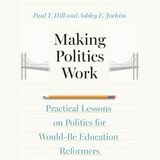
Making Politics Work
Practical Lessons on Politics for Would-Be Education ReformersPaul T. Hill and Ashley E. Jochim
University of Chicago Press, 2025
An expansive study shows how politics can work for, not just against, efforts to improve America’s schools.
The education reform project has always been about making America’s schools more effective for the children who attend them. In Making Politics Work, authors Paul T. Hill and Ashley E. Jochim show that this project cannot succeed without mastering what is the single largest constraint on its success: politics.
Drawing upon more than a decade of work with dozens of school systems, Hill and Jochim show how failures to secure political support or mitigate inevitable opposition dooms the education reform project from the start. But this outcome is not inevitable. By tracing the evolution of the “portfolio strategy” across 27 localities that implemented it, they uncover practical lessons that superintendents, state leaders, and foundation officials can use to increase the likelihood that their ideas for improving public education don’t join the list of once-promising initiatives that could not be sustained in the face of intractable political conflict.

Marriage Material
How an Enduring Institution Is Changing Same-Sex RelationshipsAbigail Ocobock
University of Chicago Press, 2024
A cutting-edge study of marriage’s transformative effects on same-sex relationships.
It is no secret that marriage rates in the United States are at an all-time low. Despite this significant decline, the institution of marriage endures in our society amid historic changes to its meaning and practice. How does the continuing strength of marriage impact the relationships of same-sex couples after the legalization of same-sex marriage?
Drawing on over one hundred interviews with LGBTQ+ people, Marriage Material reveals the transformative impact marriage equality has had on same-sex relationships. Sociologist Abigail Ocobock looks to same-sex couples across a wide age range to illuminate the complex ways institutional mechanisms work in tandem to govern the choices and behaviors of individuals with different marriage experiences. Ocobock examines both the influence of marriage on the dynamics of same-sex relationships and how LGBTQ+ people challenge heteronormative assumptions about marriage, highlighting the complex interplay between institutional constraint and individual agency.
Marriage Material presents a bold challenge to dominant scholarly and popular ideas about the decline of marriage, making clear that gaining access to legal marriage has transformed same-sex relationships, both for better and for worse.