Results by title
330 books match the query 'Brazil' and 12 start with m
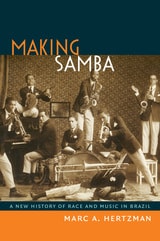
Making Samba
A New History of Race and Music in BrazilMarc A. Hertzman
Duke University Press, 2013
The success of "Pelo telephone" embroiled Donga in controversy. A group of musicians claimed that he had stolen their work, and a prominent journalist accused him of selling out his people in pursuit of profit and fame. Within this single episode are many of the concerns that animate Making Samba, including intellectual property claims, the Brazilian state, popular music, race, gender, national identity, and the history of Afro-Brazilians in Rio de Janeiro. By tracing the careers of Rio's pioneering black musicians from the late nineteenth century until the 1970s, Marc A. Hertzman revises the histories of samba and of Brazilian national culture.
Mama Africa
Reinventing Blackness in BahiaPatricia de Santana Pinho
Duke University Press, 2010
Pinho explores how Bahian cultural production influences and is influenced by black diasporic cultures and the idealization of Africa—to the extent that Bahia draws African American tourists wanting to learn about their heritage. Analyzing the conceptions of blackness produced by the blocos afro, she describes how Africa is re-inscribed on the body through clothes, hairstyles, and jewelry; once demeaned, blackness is reclaimed as a source of beauty and pride. Turning to the body’s interior, Pinho explains that the myth of Mama Africa implies that black appearances have corresponding black essences. Musical and dance abilities are seen as naturally belonging to black people, and these traits are often believed to be transmitted by blood. Pinho argues that such essentialized ideas of blackness render black culture increasingly vulnerable to exploitation by the state and commercial interests. She contends that the myth of Mama Africa, while informing oppositional black identities, overlaps with a constraining notion of Bahianness promoted by the government and the tourist industry.
Marcoré
By Antonio Olavo Pereira
University of Texas Press, 1970
Marcoré, first published in Rio de Janeiro in 1957, won the coveted prize for fiction awarded by the Brazilian Academy of Letters and has been praised by leading critics and writers in Brazil. The novel has maintained favor with the Brazilian public and has also been published and received with enthusiasm in Portugal.
Adopting the intimist, introspective approach characteristic of such writers as Machado de Assis and Graciliano Ramos, Pereira tells a moving, bittersweet tale of personal problems and family relationships. The central character of Marcoré is the narrator, a modest, introverted individual who, aware of his own human condition, tends to view life with pessimism tempered with compassion.
As the narrator reflects on his life and relationships in a small town in the state of São Paulo, an unobtrusive document of Brazilian family life unfolds. The novel contains several highly dramatic scenes as well as many tender and entertaining ones and introduces a set of very human, very credible characters, including a most irascible mother-in-law and a wife who makes a strange vow.
The reactions, thoughts, and hidden motivations of the characters are revealed in precise and economical language—evidence of the author's powers of observation and knowledge of human nature.
Rachel de Queiroz has described Marcoré as "a beautiful and tormented book." It has become a modern Brazilian classic.
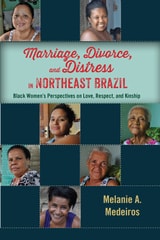
Marriage, Divorce, and Distress in Northeast Brazil
Black Women's Perspectives on Love, Respect, and KinshipMedeiros, Melanie A.
Rutgers University Press, 2018

Masters of Contemporary Brazilian Song
MPB, 1965-1985By Charles A. Perrone
University of Texas Press, 1993
Masters of Contemporary Brazilian Song is a critical study of MPB (música popular brasileira), a term that refers to varieties of urban popular music of the 1960s and 1970s, incorporating samba, Bossa Nova, and new materials.

Memories of Lazarus
By Adonias Filho
University of Texas Press, 1969
These are the recollections of Alexandre—of his life, his death-in-life, and his ultimate death, as they are played out against the mobile tapestry of the valley where he was born. The valley itself, in the backlands of the state of Bahia, Brazil, alternates at different stages in Alexandre’s consciousness between reality and symbol. It swings from a harsh regional specificity to become the panorama of all human life, its endless, eroding wind the devouring hostility of all environments and its pain the pain of every human being in the face of his own brutality and that of others.
Throughout the novel Alexandre’s mind ranges from sharp awareness, through hallucination, to oblivion (“a man dies while alive,” says Jeronimo, his mentor), and back again as he experiences the violent, obtuse phenomena of life in the valley—his universe and ours. This latter-day Lazarus leaves the resisting hills and black sky once only, hounded by the valley dwellers who believe he has murdered his wife, her father, and her brother. Yet despite his awareness of the horror of the valley and his intuition of something beyond it, it is precisely his contact with the gentler existence to which he escapes that forces Alexandre to recognize his nature for what it is. Turning his back on a greater and more varied range of feeling and experience, he chooses the narrow ferocity of the valley, to which he returns to die the final death for which the earlier deaths have prepared him.
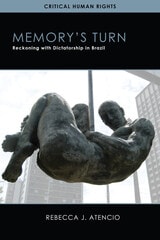
Memory’s Turn
Reckoning with Dictatorship in BrazilRebecca J. Atencio
University of Wisconsin Press, 2014
In clear and engaging prose, Rebecca J. Atencio tells the story of the slow turn to memory in Brazil, a turn that has taken place in both politics and in cultural production. She shows how testimonial literature, telenovelas, literary novels, theatrical plays, and memorials have interacted with policies adopted by the Brazilian state, often in unexpected ways. Under the right circumstances, official and cultural forms of reckoning combine in Brazil to produce what Atencio calls cycles of cultural memory. Novel meanings of the past are forged, and new cultural works are inspired, thus creating the possibility for further turns in the cycle.
The first book to analyze Brazil’s reckoning with dictatorship through both institutional and cultural means, Memory’s Turn is a rich, informative exploration of the interplay between these different modes of memory reconstruction.
Winner, Alfred B. Thomas Award, Southeastern Council of Latin American Studies
Honorable Mention, Roberto Reis Book Prize, Brazilian Studies Association
Metaphysical Community
The Interplay of the Senses and the IntellectBy Greg Urban
University of Texas Press, 1996
Winner, Senior Book Prize, American Ethnological Society
Starting with the post-structuralist idea that truth systems are lodged in discourse, and that discourse varies from society to society, Greg Urban seeks to discover the nature and extent of that variation. His journey to an Amerindian society in which dreams are more prominent than everyday aspects of the sensible world leads him to radically reformulate one of the main problematics of Western thought: the relationship between our sensations of the world and the understandings we form of them.
Metaphysical Community proposes that this dichotomy comes from the interplay between two sides of discourse-its intelligible side as a carrier of meanings, and its sensible side as thing-in-the-world that must be replicated. This insight leads to the heart of the book-the exploration of the uneasy tension that binds experience and understanding, phenomena and noumena.
Urban challenges basic assumptions that underlie social and cultural anthropology and much of the social sciences and humanities. His provocative insights will be of interest to all those concerned with anthropology, cultural studies, literary criticism, the sociology and politics of culture, and philosophy.
Mexico’s Community Forest Enterprises
Success on the Commons and the Seeds of a Good AnthropoceneDavid Barton Bray
University of Arizona Press, 2020
Mexico presents a unique case in which much of the nation’s forests were placed as commons in the hands of communities, who, with state support and their own entrepreneurial vigor, created community forest enterprises (CFEs). David Barton Bray, who has spent more than thirty years engaged with and researching Mexican community forestry, shows that this reform has transformed forest management in that country at a scale and level of maturity unmatched anywhere else in the world.
For decades Mexico has been conducting a de facto large-scale experiment in the design of a national social-ecological system (SES) focused on community forests. What happens when you give subsistence communities rights over forests, as well as training, organizational support, equipment, and financial capital? Do the communities destroy the forest in the name of economic development, or do they manage them sustainably, generating current income while maintaining intergenerational value as a resource for their children? Bray shares the scientific and social evidence that can now begin to answer these questions. This is an invaluable resource for students, researchers, and the interested public on the future of global forest resilience and the possibilities for a good Anthropocene.
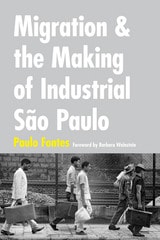
Migration and the Making of Industrial São Paulo
Paulo Fontes
Duke University Press, 2016
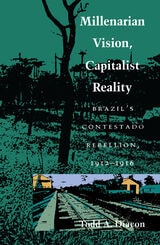
Millenarian Vision, Capitalist Reality
Brazil’s Contestado Rebellion, 1912–1916Todd A. Diacon
Duke University Press, 1991
Combining oral history with detailed archival research, Millenarian Vision, Capitalist Reality depicts a peasant community whose security in economic, social, and religious relations was suddenly disrupted by the intrusion of international capital. Diacon shows how a “deadly triumvirate” comprised to foreign capital, state power, and local bosses engineered a land tenure revolution that threatened smallholders’ subsistence, sparking rebellion among the Contestado peasants.
Unlike most analysis of millenarian movements, Diacon combines a material analysis with a careful exploration of the movement’s millenarian ideology to demonstrate how a particular combination of external and internal forces produced a crisis of values in the Contestado society. Such a crisis, Diacon concludes, gave a special power to the millenarian vision that promised not only outward reform, but inner salvation as well. This work offers a significant contribution to the literature of millenarian movements, popular religion, peasant rebellions, and the transition to capitalism in Brazil.
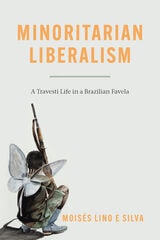
Minoritarian Liberalism
A Travesti Life in a Brazilian FavelaMoisés Lino e Silva
University of Chicago Press, 2022
Normative liberalism has promoted the freedom of privileged subjects, those entitled to rights—usually white, adult, heteronormative, and bourgeois—at the expense of marginalized groups, such as Black people, children, LGBTQ people, and slum dwellers. In this visceral ethnography of Rocinha, the largest favela in Rio de Janeiro, Brazil, Moisés Lino e Silva explores what happens when liberalism is challenged by people whose lives are impaired by normative understandings of liberty. He calls such marginalized visions of freedom “minoritarian liberalism,” a concept that stands in for overlapping, alternative modes of freedom—be they queer, favela, or peasant.
Lino e Silva introduces readers to a broad collective of favela residents, most intimately accompanying Natasha Kellem, a charismatic self-declared travesti (a term used in Latin America to indicate a specific form of female gender construction opposite to the sex assigned at birth). While many of those the author meets consider themselves “queer,” others are treated as “abnormal” simply because they live in favelas. Through these interconnected experiences, Lino e Silva not only pushes at the boundaries of anthropological inquiry, but also offers ethnographic evidence of non-normative routes to freedom for those seeking liberties against the backdrop of capitalist exploitation, transphobia, racism, and other patterns of domination.