Results by title
62 books match the query 'British' and 4 start with m
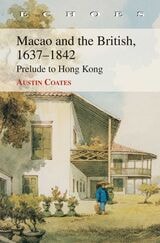
Macao and the British, 1637–1842
Prelude to Hong KongAustin Coates
Hong Kong University Press, 2009
The story of the British acquisition of Hong Kong is intricately related to that of the Portuguese enclave of Macao. The British acquired Hong Kong in 1841, following 200 years of European endeavours to induce China to engage in foreign trade. As a residential base of European trade, Portuguese Macao enabled the West to maintain continuous relations with China from 1557 onwards. Opening with a vivid description of the first English voyage to China in 1637. Macao and the British traces the ensuing course of Anglo-Chinese relations, during which time Macao skillfully—and without fortifications—escaped domination by the British and Chinese. The account covers the opening of regular trade by the East India Company in 1770, including the ‘country’ trade between India and China and Britain’s first embassies to Peking, and relates the bedeviling effect of the opium trade. The story culminates in the resulting war from which Britain won, as part of its concessions, the obscure island of Hong Kong. Among those who feature in this lucid and lively account are the merchant princes Jardine and Matheson, the missionary Robert Morrison, the artist George Chinnery, and Captain Charles Elliot, Hong Kong’s maligned founder.
[more]
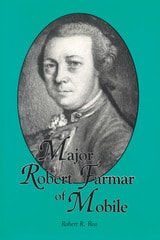
Major Robert Farmar of Mobile
Robert R. Rea
University of Alabama Press, 1990
The flamboyant military career of a colonist loyal to the British crown before the Revolution.
"An engaging biography [and] a colorful tale. . . . Robert Farmar, a son of New Jersey, used his position among that colony's elite to secure a commission as a captain in the British Army during the War of Jenkins' Ear and King George's War, serving in the unsuccessful assaults at Cartegena, Cuba, and Panama and then in the disaster at Fontenoy in Flanders and in the reversals at Rocoux and Laffeldt. . . . During the Seven Years' War he participated in the capture of Havana.
[more]
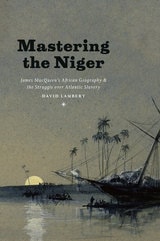
Mastering the Niger
James MacQueen's African Geography and the Struggle over Atlantic SlaveryDavid Lambert
University of Chicago Press, 2013
In Mastering the Niger, David Lambert recalls Scotsman James MacQueen (1778–1870) and his publication of A New Map of Africa in 1841 to show that Atlantic slavery—as a practice of subjugation, a source of wealth, and a focus of political struggle—was entangled with the production, circulation, and reception of geographical knowledge. The British empire banned the slave trade in 1807 and abolished slavery itself in 1833, creating a need for a new British imperial economy. Without ever setting foot on the continent, MacQueen took on the task of solving the “Niger problem,” that is, to successfully map the course of the river and its tributaries, and thus breathe life into his scheme for the exploration, colonization, and commercial exploitation of West Africa.
Lambert illustrates how MacQueen’s geographical research began, four decades before the publication of the New Map, when he was managing a sugar estate on the West Indian colony of Grenada. There MacQueen encountered slaves with firsthand knowledge of West Africa, whose accounts would form the basis of his geographical claims. Lambert examines the inspirations and foundations for MacQueen’s geographical theory as well as its reception, arguing that Atlantic slavery and ideas for alternatives to it helped produce geographical knowledge, while geographical discourse informed the struggle over slavery.
[more]
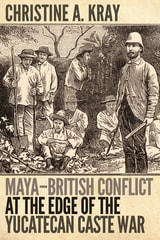
Maya-British Conflict at the Edge of the Yucatecan Caste War
Christine A. Kray
University Press of Colorado, 2023
Maya-British Conflict at the Edge of the Yucatecan Caste War interrogates the 1862 alliance forged between the San Pedro Maya and the British during the Caste War of Yucatán (1847–1901). Illuminating the complex interactions among Maya groups, Yucatecans of Spanish descent, and British settlers in what is now Belize, Christine A. Kray uses storytelling techniques, suspense, and humor, via historical documents and oral history interviews to tell a new story about the dynamics at the heart of the Social War.
Official British declarations of neutrality in the Caste War were confounded by a variety of political and economic factors, including competing land claims befuddled by a tangled set of treaties, mahogany extraction by British companies in contested territories, Maya rent demands, British trade in munitions to different groups of Maya combatants, and a labor system reliant on debt servitude. All these factors contributed to uneasy alliances and opportunistic crossings of imagined geopolitical borders in both directions, ultimately leading to a new military conflict in the western and northern regions of the territory claimed by Britain. What frequently began as hyper-local disputes spun out into international affairs as actors called upon more powerful groups for assistance. Evading reductionism, this work traces the decisions and actions of key figures as they maneuvered through the miasma of violence, abuse, deception, fear, flight, and glimpses of freedom.
Positioning the historiographic and ethnographic gaze on the English side without adopting the colonialist narratives and objectives found in English repositories, Maya-British Conflict at the Edge of the Yucatecan Caste War is an important and original contribution to a neglected area of study. It will appeal to students, scholars, and general readers interested in anthropology, Latin American cultures and history, Central American history, British imperialism, Indigenous rights, political anthropology, and colonialism and culture.
[more]