Results by title
267 books match the query 'Children' and 10 start with m
Making Americans
Children's Literature from 1930 to 1960Gary D. Schmidt
University of Iowa Press, 2013
Although some later critics have argued that the books published in this era offered a vision of a safe, secure, simple world without injustice or unhappy endings, Gary D. Schmidt shows that the progressive political agenda shared by many Americans who wrote, illustrated, published, and taught children’s books had a powerful effect. Authors like James Daugherty, Laura Ingalls Wilder, Lois Lenski, Ingri and Edgar Parin D’Aulaire, Virginia Lee Burton, Robert McCloskey, and many others addressed directly and indirectly the major social issues of a turbulent time: racism, immigration and assimilation, sexism, poverty, the Great Depression, World War II, the atomic bomb, and the threat of a global cold war.
The central concern that many children’s book authors and illustrators wrestled with was the meaning of America and democracy itself, especially the tension between individual freedoms and community ties. That process produced a flood of books focused on the American experience and intent on defining it in terms of progress toward inclusivity and social justice. Again and again, children’s books addressed racial discrimination and segregation, gender roles, class differences, the fate of Native Americans, immigration and assimilation, war, and the role of the United States in the world. Fiction and nonfiction for children urged them to see these issues as theirs to understand, and in some ways, theirs to resolve. Making Americans is a study of a time when the authors and illustrators of children’s books consciously set their eyes on national and international sights, with the hope of bringing the next generation into a sense of full citizenship.

Making Fathers Pay
The Enforcement of Child SupportDavid L. Chambers
University of Chicago Press, 1979
Making Fathers Pay is David L. Chambers's study of the child-support collection process in Michigan, the state most successful in inducing fathers to pay. He begins by reporting the perilous financial problems of divorced mothers with children, problems faced even by mothers who work full time and receive child support. The study then examines the characteristics of fathers who do and do not pay support and the characteristics of collections systems that work.
Chambers's findings are based largely on records of fathers' support payments in twenty-eight Michigan counties, some of which jail hundreds of men for nonpayment every year. Chambers finds that in places well organized to collect support, jailing nonpayers seems to produce higher payments from men jailed and from men not jailed, but only at a high social cost. He also raises grave doubts about the fairness of the judicial process that leads to jail. While Chambers's total sample includes 12,000 men, he interweaves through his text moving interviews with members of one family caught in the painful predicaments that men, women, and children face upon separation.
To increase support for children at lower social costs, Chambers advocates a national system of compulsory deductions from the wages of non-custodial parents who earn more than enough for their own subsistence.
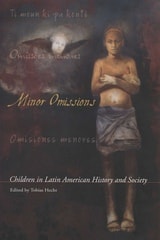
Minor Omissions
Children in Latin American History and SocietyEdited by Tobias Hecht
University of Wisconsin Press, 2002
Latin American history—the stuff of wars, elections, conquests, inventions, colonization, and all those other events and processes attributed to adults—has also been lived and partially forged by children. Taking a fresh look at Latin American and Caribbean society over the course of more than half a millennium, this book explores how the omission of children from the region's historiography may in fact be no small matter.
Children currently make up one-third of the population of Latin America and the Caribbean, and over the centuries they have worked, played, worshipped, committed crimes, and fought and suffered in wars. Regarded as more promising converts to the Christian faith than adults, children were vital in European efforts to invent loyal subjects during the colonial era. In the contemporary economies of Latin America and the Caribbean—where 23 percent of people live on a dollar per day or less—the labor of children may spell the difference between survival and starvation for millions of households.
Minor Omissions brings together scholars of history, anthropology, religion, and art history as well as a talented young author who has lived in the streets of a Brazilian city since the age of nine. The book closes with the prophetic dystopian tale "The Children's Rebellion" by the noted Uruguayan writer Cristina Peri Rossi.
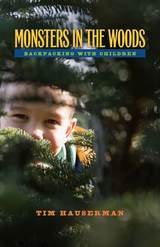
Monsters In The Woods
Backpacking With ChildrenTim Hauserman
University of Nevada Press, 2007
How and why you should take your children backpacking
Despite America’s enthusiasm for outdoors activities like hiking and backpacking, most books on these subjects focus on adults. Backpacking, however, is an ideal activity for the entire family. Tim Hauserman, who is both an experienced outdoors guide and the father of two daughters, now offers a handbook for parents who would like to introduce their children to backpacking and camping. Hauserman provides practical, humorous advice for families new to the outdoors and for trail-savvy parents planning to take their children along for the first time: how to prepare, what to bring, who carries what, how far to walk, what to do in camp, safety precautions, dealing with mishaps, and proper trail and campground etiquette. He includes guidance about appropriate distances and pack weights for every age level of child, as well as tips about backpacking with an infant and bringing the family dog along on the adventure. He even suggests appealing destinations in the Sierra Nevada appropriate for various age groups and recounts some of his (and his daughters’) favorite hikes. Hauserman’s down-to-earth encouragement is based on decades of backpacking and camping with his own children, their friends, and other groups of youngsters. He is candid about his experiences and the lessons he learned from his own mistakes and how he dealt with them. Ultimately, the reward of sharing a special adventure and the peace and beauty of the outdoors makes all the effort worthwhile.
Monstrous Youth
Transgressing the Boundaries of Childhood in the United StatesSara Austin
The Ohio State University Press, 2022
More Nights than Days
A Survey of Writings of Child Genocide SurvivorsYudit Kiss
Central European University Press, 2023
More Nights Than Days is a unique exploration of the experience of children who survived the Holocaust—including Roma and Sinti victims—and the genocides in Cambodia, Rwanda, and Bosnia. Children are among the principal victims of armed conflicts and slaughters; nonetheless, they perceive events through the prism of their unique perspective and have a range of coping techniques adults don't possess.
This overview of writings of ninety-one child survivors bears evidence from a wide range of human ruthlessness. The author presents little-known texts along with famous memoirs and autobiographical fiction, with abundant quotations. Many of these are not only compelling as historical testimony, but poetic and stirringly expressive. Yudit Kiss has not written a historical study or literary criticism of the children’s books. She explores, instead, what the authors went through and what they felt and understood about their experience. An accessible and captivating reading, this volume presents a close-up, human size dimension of the destruction. The books written by child survivors also describe the resources and means that helped them to remain human even in the deepest well of inhumanity, offering precious lessons about resistance and resilience.M
Mothers and Children
Feminist Analyses and Personal NarrativesEdited by Susan E Chase and Mary F. Rogers
Rutgers University Press, 2001

Mozart and the Mediation of Childhood
Adeline Mueller
University of Chicago Press, 2021
The story of Wolfgang Amadeus Mozart’s precocity is so familiar as to be taken for granted. In scholarship and popular culture, Mozart the Wunderkind is often seen as belonging to a category of childhood all by himself. But treating the young composer as an anomaly risks minimizing his impact. In this book, Adeline Mueller examines how Mozart shaped the social and cultural reevaluation of childhood during the Austrian Enlightenment. Whether in a juvenile sonata printed with his age on the title page, a concerto for a father and daughter, a lullaby, a musical dice game, or a mass for the consecration of an orphanage church, Mozart’s music and persona transformed attitudes toward children’s agency, intellectual capacity, relationships with family and friends, political and economic value, work, school, and leisure time.
Thousands of children across the Habsburg Monarchy were affected by the Salzburg prodigy and the idea he embodied: that childhood itself could be packaged, consumed, deployed, “performed”—in short, mediated—through music. This book builds upon a new understanding of the history of childhood as dynamic and reciprocal, rather than a mere projection or fantasy—as something mediated not just through texts, images, and objects but also through actions. Drawing on a range of evidence, from children’s periodicals to Habsburg court edicts and spurious Mozart prints, Mueller shows that while we need the history of childhood to help us understand Mozart, we also need Mozart to help us understand the history of childhood.
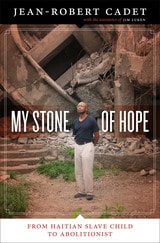
My Stone of Hope
From Haitian Slave Child to AbolitionistBy Jean-Robert Cadet
University of Texas Press, 2011
There are 27 million slaves living in the world today—more than at any time in history. Three hundred thousand of them are impoverished children in Haiti, who "stay with" families as unpaid and uneducated domestic workers, subject to physical, emotional, and sexual abuse. This practice, known locally as restavek ("staying with"), is so widespread that one in ten Haitian children is caught up in this form of slavery.
Jean-Robert Cadet was a restavek in Haiti from the late 1950s until the early 1970s. He told the harrowing story of his youth in Restavec: From Haitian Slave Child to Middle-Class American—a landmark book that exposed ongoing child slavery in Haiti. Now in My Stone of Hope, Cadet continues his story from his early attempts to adjust to freedom in American society to his current life mission of eliminating child slavery through advocacy and education. As he recounts his own struggles to surmount the psychological wounds of slavery, Cadet puts a human face on the suffering that hundreds of thousands of Haitians still endure daily. He also builds a convincing case that child slavery is not just one among many problems that Haiti faces as the Western Hemisphere's poorest nation. Rather, he argues that the systematic abuse of so many of its children is Haiti's fundamental problem, because it creates damaged adults who seem incapable of governing the country justly or managing its economy productively.
For everyone concerned about the fate of Haiti, the welfare of children, and the freedom of people around the globe, My Stone of Hope sounds an irresistible call to action.
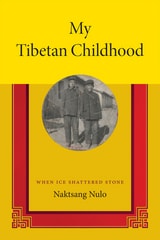
My Tibetan Childhood
When Ice Shattered StoneNatksang Nulo
Duke University Press, 2014
The real significance of this episodic narrative is the way it shows, through the eyes of a child, the suppressed histories of China's invasion of Tibet. The author's matter-of-fact accounts cast the atrocities that he relays in stark relief. Remarkably, Naktsang lived to tell his tale. His book was published in 2007 in China, where it was a bestseller before the Chinese government banned it in 2010. It is the most reprinted modern Tibetan literary work. This translation makes a fascinating if painful period of modern Tibetan history accessible in English.