Results by title
662 books match the query 'China' and 30 start with m
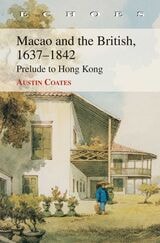
Macao and the British, 1637–1842
Prelude to Hong KongAustin Coates
Hong Kong University Press, 2009
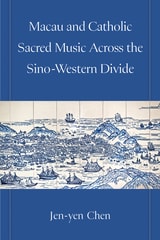
Macau and Catholic Sacred Music Across the Sino-Western Divide
Jen-yen Chen
University of Michigan Press, 2026
Drawing from sound studies and musicological methods, Chen argues that Chinese descriptions of Catholic sounds in Macau, including the ringing of church bells, the playing of the organ, and choral singing, illuminate spatial, sonic, and ideological mobilities that reconfigure Chinese and European identities. Macau and Catholic Music Across the Sino-Western Divide also extends to contemporary times to explore how present day members of Macau’s Catholic community position themselves in relation to the historical narratives often told about their city, cultivating a rich individuality of identity that refuses conformity to fixed notions of Asianness or Westernness.
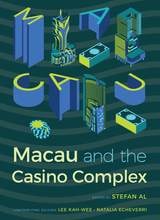
Macau and the Casino Complex
Stefan Al
University of Nevada Press, 2018
In only a decade, Macau has exploded from a sleepy backwater to the world’s casino capital. It was bound to happen. Macau, a former Portuguese colony that became a special administrative region within the People’s Republic of China in 1999, was the only place in China where gambling was legal. With a consumer base of 1.3 billion mainland Chinese deprived of casino gambling, and the world’s largest growing consumer class, international corporations rushed in to enter the games. As a result, the casino influx has permanently transformed the Macau peninsula: its ocean reclaimed, hillside excavated, roads congested, air polluted, and glimmering hotel towers tossed into the skyline, dwarfing the 19th century church towers.
Essays by a number of experts give a deeper insight on topics ranging from the myth of the Chinese gambler, the role of feng shui in casino design, the city’s struggle with heritage conservation, the politics of land reclamation, and the effect of the casino industry on the public realm. Drawings and photographs in vivid color visualize Macau’s patchwork of distinct urban enclaves: from downtown casinos, their neon-blasting storefronts eclipsing adjacent homes and schools, to the palatial complexes along a new highway, a Las Vegas-style strip. They also reveal how developers go to great lengths to impress the gambler with gimmicks such as fluorescent lighting, botanic gardens, feng shui dragon statues, cast members’ costumes, Chinese art imitations, and crystal chandelier-decked elevators. It is a book that helps readers grasp the complex process of the development of the casino industry and its overall impact on the social and architectural fabric of the first and last colonial enclave in China.
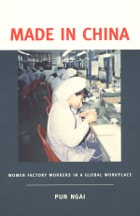
Made in China
Women Factory Workers in a Global WorkplacePun Ngai
Duke University Press, 2005
Pun Ngai conducted ethnographic work at an electronics factory in southern China’s Guangdong province, in the Shenzhen special economic zone where foreign-owned factories are proliferating. For eight months she slept in the employee dormitories and worked on the shop floor alongside the women whose lives she chronicles. Pun illuminates the workers’ perspectives and experiences, describing the lure of consumer desire and especially the minutiae of factory life. She looks at acts of resistance and transgression in the workplace, positing that the chronic pains—such as backaches and headaches—that many of the women experience are as indicative of resistance to oppressive working conditions as they are of defeat. Pun suggests that a silent social revolution is underway in China and that these young migrant workers are its agents.
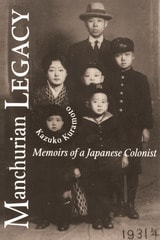
Manchurian Legacy
Memoirs of a Japanese ColonistKazuko Kuramoto
Michigan State University Press, 1999
Kazuko Kuramoto was born and raised in Dairen, Manchuria, in 1927, at the peak of Japanese expansionism in Asia. Dairen and the neighboring Port Arthur were important colonial outposts on the Liaotung Peninsula; the train lines established by Russia and taken over by the Japanese, ended there. When Kuramoto's grandfather arrived in Dairen as a member of the Japanese police force shortly after the end of the Russo-Japanese War in 1905, the family's belief in Japanese supremacy and its "divine" mission to "save" Asia from Western imperialists was firmly in place. As a third-generation colonist, the seventeen-year-old Kuramoto readily joined the Red Cross Nurse Corps in 1944 to aid in the war effort and in her country's sacred cause. A year later, her family listened to the emperor's radio broadcast ". . . we shall have to endure the unendurable, to suffer the insufferable." Japan surrendered unconditionally.
Manchurian Legacy is the story of the family's life in Dairen, their survival as a forgotten people during the battle to reclaim Manchuria waged by Russia, Nationalist China, and Communist China, and their subsequent repatriation to a devastated Japan. Kuramoto describes a culture based on the unthinking oppression of the colonized by the colonizer. And, because Manchuria was, in essence, a Japanese frontier, her family lived a freer and more luxurious life than they would have in Japan—one relatively unscathed by the war until after the surrender.
As a commentator Kuramoto explores her culture both from the inside, subjectively, and from the outside, objectively. Her memoirs describe her coming of age in a colonial society, her family's experiences in war-torn Manchuria, and her "homecoming" to Japan—where she had never been—just as Japan is engaged in its own cultural upheaval.
Manufacturing Confucianism
Chinese Traditions and Universal CivilizationLionel M. Jensen
Duke University Press, 1998
Tracing the history of the Jesuits’ invention of Confucius and of themselves as native defenders of Confucius’s teaching, Jensen reconstructs the cultural consequences of the encounter between the West and China. For the West, a principal outcome of this encounter was the reconciliation of empirical investigation and theology on the eve of the scientific revolution. Jensen also explains how Chinese intellectuals in the early twentieth century fashioned a new cosmopolitan Chinese culture through reliance on the Jesuits’ Confucius and Confucianism. Challenging both previous scholarship and widespread belief, Jensen uses European letters and memoirs, Christian histories and catechisms written in Chinese, translations and commentaries on the Sishu, and a Latin summary of Chinese culture known as the Confucius Sinarum Philosophus to argue that the national self-consciousness of Europe and China was bred from a cultural ecumenism wherein both were equal contributors.
Mao Zedong and China in the Twentieth-Century World
A Concise HistoryRebecca E. Karl
Duke University Press, 2010
Mao Zedong’s “Talks at the Yan’an Conference on Literature and Art”
A Translation of the 1943 Text with CommentaryBonnie S. McDougall
University of Michigan Press, 1980
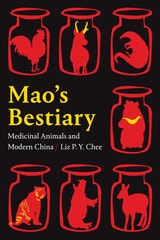
Mao's Bestiary
Medicinal Animals and Modern ChinaLiz P. Y. Chee
Duke University Press, 2021
Marginal Sights
Staging the Chinese in AmericaJames S. Moy
University of Iowa Press, 1994
Masculinity Besieged?
Issues of Modernity and Male Subjectivity in Chinese Literature of the Late Twentieth CenturyXueping Zhong
Duke University Press, 2000
Before the 1990s onslaught of popular culture decentered the role of intellectuals within the nation, they had come to embody Chinese masculinity during the previous decade. The focus on masculinity in literature had become unprecedented in scale and the desire for “real men” began to permeate Chinese popular culture, making icons out of Rambo and Takakura Ken. Stories by Zhang Xianliang and Liu Heng portraying male anxiety about masculine sexuality are employed by Zhong to show how “marginal” males negotiate their sexual identities in relation to both women and the state. Looking at writers popular among not only the well-educated but also the working and middle classes, she discusses works by Han Shaogong, Yu Hua, and Wang Shuo and examines instances of self-loathing male voices, particularly as they are articulated in Mo Yan’s well-known work Red Sorghum. In her last chapter Zhong examines “roots literature,” which speaks of the desire to create strong men as a part of the effort to create a geopolitically strong Chinese nation. In an afterword, Zhong situates her study in the context of the 1990s.
This book will be welcomed by scholars of Chinese cultural studies, as well as in literary and gender studies.

Media, Market, and Democracy in China
Between the Party Line and the Bottom LineYuezhi Zhao
University of Illinois Press, 1998
How do market forces influence the media in China? How does the Party both introduce and try to contain the market's influence? How do commercial imperatives both accommodate and challenge Party control?
Yuezhi Zhao interviewed a wide range of scholars, media administrators, and media professionals to answer these and other questions. Working in China in 1994 and 1995, she monitored media content, carried out extensive documentary research in Beijing, and held off-the-record meetings with Chinese media insiders. What she found informs an in-depth look at the intertwining nature of the Communist Party and the news media in China, how they affect each other, and what the future might hold for each.
A rare on-the-ground portrait, Media, Market, and Democracy in China is must reading for scholars, media and business professionals, and policymakers who need to understand what happened to China and its mass media during a period of dynamic growth and change.
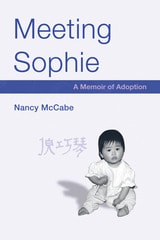
Meeting Sophie
A Memoir of AdoptionNancy McCabe
University of Missouri Press, 2003
The baby is screaming again. My baby. I hoist her off the narrow hotel bed--again--and try to cradle her as I rock my torso back and forth in an uncomfortable straight-backed chair.
This baby does not cradle. She doesn't know how to cuddle, to be soothed in anyone's arms. She howls and arches away, squirms and flops, a sixteen-pound fish out of water. I'm not used to holding babies, and she's not used to be being held, but when I try to put her down, she wails. My arms feel chafed, raw, and my wrists ache from the hours of straining to hang on to her.
Huge tears pool in her eyes. These tears could break my heart. These screams could break my eardrums.
Melancholy Drift
Marking Time in Chinese CinemaJean Ma
Hong Kong University Press, 2010
Memoirs from the Beijing Film Academy
The Genesis of China's Fifth GenerationZhen Ni
Duke University Press, 2002
Merchants' Daughters
Women, Commerce, and Regional Culture in South ChinaEdited by Helen F. Siu
Hong Kong University Press, 2010
Metro Movies
Cinematic Urbanism in Post-Mao ChinaHarry H. Kuoshu
Southern Illinois University Press, 2010
Metro Movies: Cinematic Urbanism in Post-Mao China takes readers on a comprehensive tour of the urbanization of Chinese cinema. Focusing primarily on movies from the end of the twentieth century, it is the first single-authored work to explore the relationship between the changes in Chinese society—caused in part by the advent of postsocialism, the growth of cities, and globalization—and the transformation of Chinese cinema. Author Harry H. Kuoshu examines such themes as displacement, cinematic representation, youth subculture, the private emotional lives of emerging urbanites, raw urban realism, and the allegorical contrast of the city and the countryside to illustrate the artistic richness and cultural diversity of this cinematic genre.
Kuoshu discusses the work of director Huang Jianxin, whose films follow and critique China’s changing urban political culture. He dedicates a chapter to filmmakers who followed Huang and attempted to redefine the concept of art films to regain the local audience. These directors address Chinese moviegoers’ disappointment with the international adoption of Chinese art films, their lack of interest in conventional Chinese films, and their fascination with emerging audio-video media. A considerable amount of attention is given to films of the 1990s, which focus on the social changes surfacing in China, from the trend of hooliganism and the Beijing rock scene to the arrival of an urban pop culture lifestyle driven by expansionist commerce and materialism. Kuoshu also explores recent films that confront the seedier aspects of city life, as well as films that demonstrate how urbanization has touched every fiber of Chinese living.
Metro Movies illustrates how cinematic urbanism is no longer a genre indicator but is instead an era indicator, revealing the dominance of metropolitan living on modern Chinese culture. It gives new insight into contemporary Chinese politics and culture and provides readers with a better understanding of China’s urban cinema. This book will be an excellent addition to college film courses and will fascinate any reader with an interest in film studies or Chinese culture.
Mexican Americans and Education
El saber es poderEstela Godinez Ballón
University of Arizona Press, 2015
Mexican Americans and Education begins with a brief overview of historical educational conditions that have impacted the experiences and opportunities of Mexican American students, and moves into an examination of major contemporary institutional barriers to academic success, including segregation, high-stakes testing, and curriculum tracking. Ballón also explores the status of Mexican American students in higher education and introduces theories and pedagogies that aim to understand and improve school conditions. Through her extensive examination of the major issues impacting Mexican American students, Ballón provides a broad introduction to an increasingly relevant topic.
Ballón uses understandable and accessible language to examine institutional and ideological factors that have negatively impacted Mexican Americans’ public school experiences, while also focusing on their strengths and possibilities for future action. This unique overview serves as a foundation for both education and Chicana/o studies courses, as well as in teacher and professional development.
Minority Rules
The Miao and the Feminine in China's Cultural PoliticsLouisa Schein
Duke University Press, 2000
Posing questions about gender, cultural politics, and identity, Schein examines how non-Miao people help to create Miao ethnicity by depicting them as both feminized keepers of Chinese tradition and as exotic others against which dominant groups can assert their own modernity. In representing and consuming aspects of their own culture, Miao distance themselves from the idea that they are less than modern. Thus, Schein explains, everyday practices, village rituals, journalistic encounters, and tourism events are not just moments of cultural production but also performances of modernity through which others are made primitive. Schein finds that these moments frequently highlight internal differences among the Miao and demonstrates how not only minorities but more generally peasants and women offer a valuable key to understanding China as it renegotiates its place in the global order.
Misers, Shrews, and Polygamists
Sexuality and Male-Female Relations in Eighteenth-Century Chinese FictionKeith McMahon
Duke University Press, 1995
In many examples of rare erotic fiction, and in other works as well-known as Dream of the Red Chamber, Keith McMahon identifies a sexual economy defined by the figures of the "miser" and the "shrew"—caricatures of the retentive, self-containing man and the overflowing, male-enervating woman. Among these and other characters, the author explores the issues surrounding the practice of polygamy, the logic of its overvaluation of masculinity, and the nature of sexuality generally in Chinese society. How does the man with many wives manage and justify his sexual authority? Why and how might he escape or limit this presumed authority, sometimes to the point of portraying himself as abject before the shrewish woman? How do women accommodate or coddle the man, or else oppose, undermine, or remold him? And in what sense does the man place himself lower than the spiritually and morally superior woman?
The most extensive English-language study of Chinese literature from the eighteenth century, this examination of polygamy will interest not only students of Chinese history, culture, and literature but also all those concerned with histories of gender and sexuality.
Modern China and Opium
A ReaderAlan Baumler, Editor
University of Michigan Press, 2001
Modern China, 1840–1972
An Introduction to Sources and Research AidsAndrew J. Nathan
University of Michigan Press, 1973
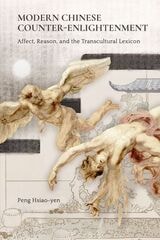
Modern Chinese Counter-Enlightenment
Affect, Reason, and the Transcultural LexiconPeng Hsiao-yen
Hong Kong University Press, 2023
In Modern Chinese Counter-Enlightenment, Peng Hsiao-yen argues that a trend of Counter-Enlightenment had grown from the late Qing to the May Fourth era in the 1910s to the 1920s and continued to the 1940s. She demonstrates how Counter-Enlightenment was manifested with case studies such as Lu Xun’s writings in the late 1900s, the Aesthetic Education movement from the 1910s to 1920s, and the Science and Lifeview debate in the 1920s. During the period, the life philosophy movement, highlighting the epistemic debate on affect and reason, is connected with its counterparts in Germany, France, and Japan. The movement had a widespread and long-term impact on Chinese philosophy and literature. Using the transcultural lexicon as methodology, this book traces how the German term Lebensanschauung (life view), a key concept in Rudolf Eucken’s life philosophy, constituted a global tide of Counter-Enlightenment that influenced the thought of leading Chinese intellectuals in the Republican era. Peng contends that Chinese intellectuals’ transcultural connections with others in the philosophical pursuit of knowledge triggered China’s self-transformation. She successfully reconstructs the missing link in the Chinese theater of the worldwide dialectic of Enlightenment and Counter-Enlightenment.
Modern Chinese Literary and Cultural Studies in the Age of Theory
Reimagining a FieldRey Chow, ed.
Duke University Press, 2000
One of the volume’s provocative suggestions is that the old model of area studies—an offshoot of U.S. Cold War strategy that found its anchorage in higher education—is no longer feasible for the diverse and multifaceted experiences that are articulated under the rubric of “Chineseness.” As Rey Chow argues in her introduction, the notion of a monolithic Chineseness bound ultimately to mainland China is, in itself, highly problematic because it recognizes neither the material realities of ethnic minorities within China nor those of populations in places such as Tibet, Taiwan, and post–British Hong Kong. Above all, this book demonstrates that, as the terms of a chauvinistic sinocentrism become obsolete, the critical use of theory—particularly by younger China scholars whose enthusiasm for critical theory coincides with changes in China’s political economy in recent years—will enable the emergence of fresh connections and insights that may have been at odds with previous interpretive convention.
Originally published as a special issue of the journal boundary 2, this collection includes two new essays and an afterword by Paul Bové that places its arguments in the context of contemporary cultural politics. It will have far-reaching implications for the study of modern China and will be of interest to scholars of theory and culture in general.
Contributors. Stanley K. Abe, Ien Ang, Chris Berry, Paul Bové, Sung-cheng Yvonne Chang, Rey Chow, Dorothy Ko, Charles Laughlin, Leung Ping-kwan, Kwai-cheung Lo, Christopher Lupke, David Der-wei Wang, Michelle Yeh
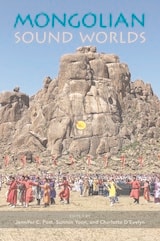
Mongolian Sound Worlds
Edited by Jennifer C. Post, Sunmin Yoon, and Charlotte D'Evelyn
University of Illinois Press, 2022
A merger of expert scholarship and eyewitness experience, Mongolian Sound Worlds illuminates a diverse and ever-changing musical culture.
Contributors: Bayarsaikhan Badamsuren, Otgonbaayar Chuulunbaatar, Andrew Colwell, Johanni Curtet, Charlotte D’Evelyn, Tamir Hargana, Peter K. Marsh, K. Oktyabr, Rebekah Plueckhahn, Jennifer C. Post, D. Tserendavaa, and Sunmin Yoon
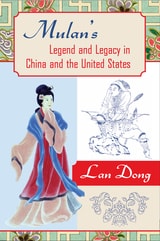
Mulan's Legend and Legacy in China and the United States
Authored by Lan Dong
Temple University Press, 2010
Mulan, the warrior maiden who performed heroic deeds in battle while dressed as a male soldier, has had many incarnations from her first appearance as a heroine in an ancient Chinese folk ballad. Mulan’s story was retold for centuries, extolling the filial virtue of the young woman who placed her father's honor and well-being above her own. With the publication of Maxine Hong Kingston’s The Woman Warrior in the late 1970s, Mulan first became familiar to American audiences who were fascinated with the extraordinary Asian American character. Mulan’s story was recast yet again in the popular 1998 animated Disney film and its sequel.
In Mulan’s Legend and Legacy in China and the United States, Lan Dong traces the development of this popular icon and asks, "Who is the real Mulan?" and "What does authenticity mean for the critic looking at this story?" Dong charts this character’s literary voyage across historical and geographical borders, discussing the narratives and images of Mulan over a long time span—from premodern China to the contemporary United States to Mulan’s counter-migration back to her homeland.
As Dong shows, Mulan has been reinvented repeatedly in both China and the United States so that her character represents different agendas in each retelling—especially after she reached the western hemisphere. The dutiful and loyal daughter, the fierce, pregnant warrior, and the feisty teenaged heroine—each is Mulan representing an idea about female virtue at a particular time and place.
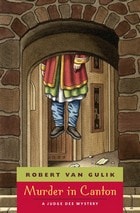
Murder in Canton
A Judge Dee MysteryRobert van Gulik
University of Chicago Press, 1966
Murder in Canton takes place in the year 680, as Judge Dee, recently promoted to lord chief justice, is sent incognito to Canton to investigate the disappearance of a court censor. With the help of his trusted lieutenants Chiao Tai and Tao Gan, and that of a clever blind girl who collects crickets, Dee solves a complex puzzle of political intrigue and murder through the three separate subplots "the vanished censor," "the Smaragdine dancer," and "the Golden Bell."
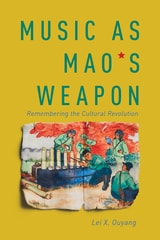
Music as Mao's Weapon
Remembering the Cultural RevolutionLei X. Ouyang
University of Illinois Press, 2022
China's Cultural Revolution (1966-1976) produced propaganda music that still stirs unease and, at times, evokes nostalgia. Lei X. Ouyang uses selections from revolutionary songbooks to untangle the complex interactions between memory, trauma, and generational imprinting among those who survived the period of extremes. Interviews combine with ethnographic fieldwork and surveys to explore both the Cultural Revolution's effect on those who lived through it as children and contemporary remembrance of the music created to serve the Maoist regime. As Ouyang shows, the weaponization of music served an ideological revolution but also revolutionized the senses. She examines essential questions raised by this phenomenon, including: What did the revolutionization look, sound, and feel like? What does it take for individuals and groups to engage with such music? And what is the impact of such an experience over time?
Perceptive and provocative, Music as Mao's Weapon is an insightful look at the exploitation and manipulation of the arts under authoritarianism.
My Old Faithful
StoriesYang Huang
University of Massachusetts Press, 2018
Showing both the drama of familial intimacy and the ups and downs of the everyday, My Old Faithful introduces readers to a close-knit Chinese family. These ten interconnected short stories, which take place in China and the United States over a thirty-year period, merge to paint a nuanced portrait of family life, full of pain, surprises, and subtle acts of courage. Richly textured narratives from the mother, the father, the son, and the daughters play out against the backdrop of China's social and economic change.
With quiet humor and sharp insight into the ordinary, Yang Huang writes of a father who spanks his son out of love, a brother who betrays his sister, and a woman who returns to China after many years to find her country changed in ways both expected and startling.
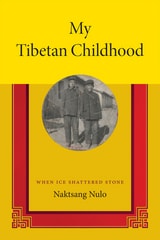
My Tibetan Childhood
When Ice Shattered StoneNatksang Nulo
Duke University Press, 2014
The real significance of this episodic narrative is the way it shows, through the eyes of a child, the suppressed histories of China's invasion of Tibet. The author's matter-of-fact accounts cast the atrocities that he relays in stark relief. Remarkably, Naktsang lived to tell his tale. His book was published in 2007 in China, where it was a bestseller before the Chinese government banned it in 2010. It is the most reprinted modern Tibetan literary work. This translation makes a fascinating if painful period of modern Tibetan history accessible in English.