Results by title
74 books match the query 'Church' and 3 start with m
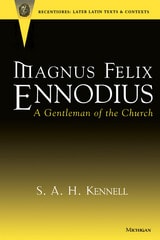
Magnus Felix Ennodius
A Gentleman of the ChurchS. A. H. Kennell
University of Michigan Press, 2000
Magnus Felix Ennodius (474-521), deacon of Milan and bishop of Pavia in the turbulent years after the fall of the Roman Empire in the West, was a prolific writer of letters, poetry, speeches, and pamphlets on the controversies that beset the church in his day. In the Middle Ages, he was read as a model of style and source of canon law. More recently, however, Ennodius' writings have been denigrated as the vapid product of a frivolous mind more concerned with form than content. Magnus Felix Ennodius: A Gentleman of the Church sets the record straight by restoring Ennodius to his social and literary context. Ennodius stands revealed as a man on the cusp of the ancient and medieval worlds, his thought still shaped according to classical norms, but his writings informed with a sensibility that prefigures that of the Christian Middle Ages. As the only book-length study of Ennodius, here the author explores all aspects of Ennodius' life and literary production to augment the collective understanding of him on two major fronts, rhetoric and meaning, so that he can take his place as an important author and historical figure. Deeply insightful, and refreshingly original, the author breaks new ground in studying this period of history, so often overshadowed by the classical and middle ages that immediately precede and succeed it.
S. A. H. Kennell is Adjunct Professor of Classics, Memorial University of Newfoundland.
S. A. H. Kennell is Adjunct Professor of Classics, Memorial University of Newfoundland.
[more]
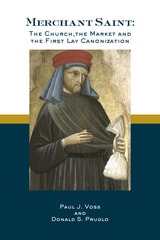
Merchant Saint
The Church, the Market, and the First Lay Canonizationprudlo
St. Augustine's Press, 2024
Paul Voss and Donald Prudlo trace Western attitudes to money, merchants, and the market through 3,000 years of history. They focus their attention on one person in particular, Omobono of Cremona (1117–1197), as an axial figure in the wholesale reappraisal of the value of business, entrepreneurship, and white-collar work in Christian Europe. More precisely, Voss and Prudlo examine the evolution of the mentality of wealth and economics in the Catholic Church, beginning from the Scriptural disdain for material pursuits and moving to the eventually declared sainthood of Omobono, a lay merchant living amid the hectic rhythm of a life of business. As the authors note, "His story resonates today with an unexpected poignancy for the contribution it makes to the pressing issues of economic justice, free markets, work-life balance, the 'theology of work,' and Catholic history." The reconstruction of the socio-theological perspective of wealth is a fascinating contribution to contemporary attempts to reconcile culture, capitalism, and the common good. Omobono stands as the first lay individual proposed by the Catholic Church as a model of heroic virtue, and thought him commercial life came thereby also to be 'canonized' as a possible path to sanctity.
Voss and Prudlo provide a rich resource for readers concerned with the proper aims and boundaries of a life in the world of commerce, the nature of work, the ethics of profit, the problem of money-lending, the virtues needed for moral capitalism, and the tension between otium and negotium. Voss and Prudlo have accumulated a veritable trove of primary text materials relating to the life of Omobono, and provide translations and commentary to complete their analysis. This fascinating account crosses the threshold of pure history and stimulates inquiry in the fields of philosophy, economics, and theology.
Voss and Prudlo provide a rich resource for readers concerned with the proper aims and boundaries of a life in the world of commerce, the nature of work, the ethics of profit, the problem of money-lending, the virtues needed for moral capitalism, and the tension between otium and negotium. Voss and Prudlo have accumulated a veritable trove of primary text materials relating to the life of Omobono, and provide translations and commentary to complete their analysis. This fascinating account crosses the threshold of pure history and stimulates inquiry in the fields of philosophy, economics, and theology.
[more]
Mystery of the Church, People of God
Rose Beal
Catholic University of America Press, 2014
Congar coined the term "total ecclesiology" in his ground-breaking outline for a theology of the laity, A Way towards a Theology of the Laity. In Mystery of the Church, People of God, Rose M. Beal argues that "total ecclesiology" is the necessary and appropriate lens for a comprehensive interpretation of Congar's ecclesiological project prior to the Second Vatican Council (1962-1965). Beal works from Congar's published works from 1931 to 1954, as well as from unpublished texts from the same time period, to integrate and propose a comprehensive interpretation of his ecclesiological purposes and methods.
[more]