Results by title
121 books match the query 'Cinema' and 4 start with m
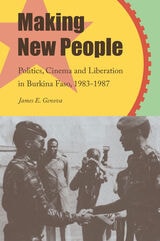
Making New People
Politics, Cinema, and Liberation in Burkina Faso, 1983–1987James Genova
Michigan State University Press, 2022
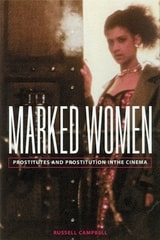
Marked Women
Prostitutes and Prostitution in the CinemaRussell Campbell
University of Wisconsin Press, 2006
Julia Roberts played a prostitute, famously, in Pretty Woman. So did Jodie Foster in Taxi Driver, Jane Fonda in Klute, Anna Karina in Vivre sa vie, Greta Garbo in Anna Christie, and Charlize Theron, who won an Academy Award for Monster. This engaging and generously illustrated study explores the depiction of female prostitute characters and prostitution in world cinema, from the silent era to the present-day industry. From the woman with control over her own destiny to the woman who cannot get away from her pimp, Russell Campbell shows the diverse representations of prostitutes in film.
Marked Women classifies fifteen recurrent character types and three common narratives, many of them with their roots in male fantasy. The “Happy Hooker,” for example, is the liberated woman whose only goal is to give as much pleasure as she receives, while the “Avenger,” a nightmare of the male imagination, represents the threat of women taking retribution for all the oppression they have suffered at the hands of men. The “Love Story,” a common narrative, represents the prostitute as both heroine and anti-heroine, while “Condemned to Death” allows men to manifest, in imagination only, their hostility toward women by killing off the troubled prostitute in an act of cathartic violence.
The figure of the woman whose body is available at a price has fascinated and intrigued filmmakers and filmgoers since the very beginning of cinema, but the manner of representation has also been highly conflicted and fiercely contested. Campbell explores the cinematic prostitute as a figure shaped by both reactionary thought and feminist challenges to the norm, demonstrating how the film industry itself is split by fascinating contradictions.
Miriam Hansen
Cinema, Experience, and the Public SphereDavid Bathrick, Andreas Huyssen, and Eric Rentschler, special issue editors
Duke University Press, 0
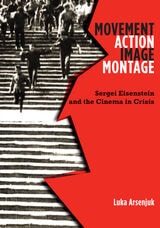
Movement, Action, Image, Montage
Sergei Eisenstein and the Cinema in CrisisLuka Arsenjuk
University of Minnesota Press, 2018
A major new study of Sergei Eisenstein delivers fresh, in-depth analyses of the iconic filmmaker’s body of work
What can we still learn from Sergei Eisenstein? Long valorized as the essential filmmaker of the Russian Revolution and celebrated for his indispensable contributions to cinematic technique, Eisenstein’s relevance to contemporary culture is far from exhausted. In Movement, Action, Image, Montage, Luka Arsenjuk considers the auteur as a filmmaker and a theorist, drawing on philosophers such as Georg Wilhelm Friedrich Hegel and Gilles Deleuze—as well as Eisenstein’s own untranslated texts—to reframe the way we think about the great director and his legacy.
Focusing on Eisenstein’s unique treatment of the foundational concepts of cinema—movement, action, image, and montage—Arsenjuk invests each aspect of the auteur’s art with new significance for the twenty-first century. Eisenstein’s work and thought, he argues, belong as much to the future as the past, and both can offer novel contributions to long-standing cinematic questions and debates.
Movement, Action, Image, Montage brings new elements of Eisenstein’s output into academic consideration, by means ranging from sustained and comprehensive theorization of Eisenstein’s practice as a graphic artist to purposeful engagement with his recently published, unfinished book Method, still unavailable in English translation. This tour de force offers new and significant insights on Eisenstein’s oeuvre—the films, the art, and the theory—and is a landmark work on an essential filmmaker.