Results by title
55 books match the query 'Creating' and 2 start with m
Malignant Growth
Creating the Modern Cancer Research Establishment, 1875–1915Alan I Marcus
University of Alabama Press, 2018
An examination of the first attempt to conquer cancer in the late nineteenth and early twentieth centuries.
In Malignant Growth: Creating the Modern Cancer Research Establishment, 1875–1915, Alan I Marcus explores a relatively understudied period in the history of cancer by providing a careful investigation of the first public crusade to determine the cause of cancer. The search for cancer’s cause during the heady era of bacteriology was colored by the Germ Theory of Disease. Researchers had demonstrated in malady after malady that each disease was the result of a singular and specific pathogenic agent. That model led investigators to optimistically conclude that they would soon find the cause of what was termed the “emperor of all maladies,” cases of which were apparently increasing at a prodigious rate worldwide.
In this accessible history of science and medicine, Marcus exposes the complex story of the efforts made from 1875 through 1915 to first conquer and, failing that, to control cancer—a dual approach that remains in force to this day. He reveals the messiness of real-time scientific research, tracing the repeated lurches of promise, discoveries of hope, and the inevitable despair that always followed. Other barriers existed to the research, such as inconsistency in test standards and inter-laboratory competition and mistrust. Researchers approached cancer from such disparate specialties as clinical medicine, zoology, botany, chemistry, nutrition, bacteriology, pathology, and microbiology. Although they came from diverse fields, each steadfastly maintained that cancer operated in an analogous fashion to other bacteriological diseases.
Virtually every country and a slew of various clinicians and investigators waged this first war on cancer, operating in remarkably diverse scientific venues. Cancer laboratories and hospitals, as well as organizations like the American Cancer Society, were born out of this first offensive on cancer. Even as cancer continues to proliferate today, these institutions that initially formed to defeat cancer more than a hundred years ago persist and continue to expand.
[more]
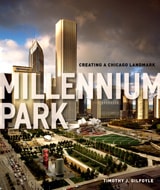
Millennium Park
Creating a Chicago LandmarkTimothy J. Gilfoyle
University of Chicago Press, 2006
At its opening on July 16, 2004, Chicago’s Millennium Park was hailed as one of the most important millennium projects in the world. “Politicians come and go; business leaders come and go,” proclaimed mayor Richard M. Daley, “but artists really define a city.” Part park, part outdoor art museum, part cultural center, and part performance space, Millennium Park is now an unprecedented combination of distinctive architecture, monumental sculpture, and innovative landscaping. Including structures and works by Frank Gehry, Anish Kapoor, Jaume Plensa, and Kathryn Gustafson, the park represents the collaborative efforts of hundreds to turn an unused railroad yard in the heart of the city into a world-class civic space—and, in the process, to create an entirely new kind of cultural philanthropy.
Timothy Gilfoyle here offers a biography of this phenomenal undertaking, beginning before 1850 when the site of the park, the “city’s front yard,” was part of Lake Michigan. Gilfoyle studied the history of downtown; spent years with the planners, artists, and public officials behind Millennium Park; documented it at every stage of its construction; and traced the skeins of financing through municipal government, global corporations, private foundations, and wealthy civic leaders. The result is a thoroughly readable and lavishly illustrated testament to the park, the city, and all those attempting to think and act on a monumental scale. And underlying Gilfoyle’s history is also a revealing study of the globalization of art, the use of culture as an engine of economic expansion, and the nature of political and philanthropic power.
Born out of civic idealism, raised in political controversy, and maturing into a
symbol of the new Chicago, Millennium Park is truly a twenty-first-century
landmark, and it now has the history it deserves.
[more]