Results by title
87 books match the query 'Criticism, Textual' and 4 start with m
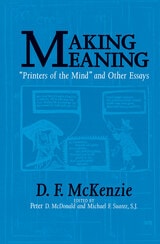
Making Meaning
"Printers of the Mind" and Other EssaysD. F. McKenzie
University of Massachusetts Press, 2002
The greatest bibliographer of our time, was how historian Robert Darnton described D. F. McKenzie. Yet until now many of McKenzie's major essays, scattered in specialist journals and inaccessible publications, have circulated mainly in tattered photocopies. This volume, edited by two of McKenzie's former students, brings together for the first time a wide range of his writings on bibliography, the book trade, and the “sociology of texts.” Selected by the author himself before his sudden death in 1999, the essays range from the material transmission of Shakespeare's plays in the seventeenth century to the connections among oral, manuscript, and print cultures.
Making Meaning reflects McKenzie's virtuosity as a traditional bibliographer and reveals how his thought-provoking scholarship made him a driving force in the genesis and development of the new interdisciplinary field of book history. His refusal to recognize the traditional boundary between bibliography and literary history re-energized the study of the social, political, economic, and cultural aspects of book production and reception.
The editors' introduction and headnotes situate McKenzie's innovative and controversial thinking in the debates of his time.
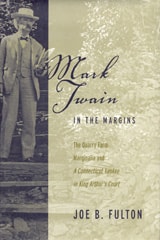
Mark Twain in the Margins
The Quarry Farm Marginalia and a Connecticut Yankee in King Arthur's CourtJoe B. Fulton
University of Alabama Press, 2007
Revealing the notes behind the novel and the scholar behind the legend.
The common characterization of Mark Twain as an uneducated and improvisational writer took hold largely because of the novelist's own frequent claims about his writing practices. But using recently discovered evidence--Twain's marginal notes in books he consulted as he worked on A Connecticut Yankee in King Arthur's Court—Joe Fulton argues for a reconsideration of scholarly views about Twain's writing process, showing that this great American author crafted his novels with careful research and calculated design.
Fulton analyzes Twain's voluminous marginalia in the copies of Macaulay's History of England, Carlyle's History of the French Revolution, and Lecky's History of the Rise of Rationalism and England in the Eighteenth Century available to Twain in the library of Quarry Farm, the New York farm where the novelist and his family routinely spent their summers. Comparing these marginal notes to entries in Twain's writing journal, the manuscript of Connecticut Yankee, and the book as published in 1889, Fulton establishes that Twain's research decisively influenced the novel. Fulton reveals Twain to be both the writer from experience he claimed to be and the careful craftsman that he attempted to downplay. By redefining Twain's aesthetic, Fulton reinvigorates current debates about what constitutes literary realism.
Fulton's transcriptions of the marginalia appear in an appendix; together with his analysis, they provide a valuable new resource for Twain scholars.
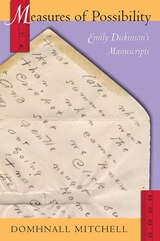
Measures of Possibility
Emily Dickinson's ManuscriptsDomhnall Mitchell
University of Massachusetts Press, 2005
In Measures of Possibility, Domhnall Mitchell sets out to test the hypothesis of Dickinson's textual radicalism, and its consequences for readers, students, and teachers, by looking closely at features such as spacing, the physical direction of the writing, and letter-shapes in handwritten lyric and epistolary texts. Through systematic contextualization and cross-referencing, Mitchell provides the reader with a critical apparatus by which to measure the extent to which contemporary approaches to Dickinson's autograph procedures can reasonably be formulated as corresponding to the poet's own purposes.
Myths of the Popol Vuh in Cosmology, Art, and Ritual
Holley Moyes
University Press of Colorado, 2021
The chapters are grouped into four sections. The first section interprets the Highland Maya worldview through examination of the text, analyzing interdependence between deities and human beings as well as the textual and cosmological coherence of the Popol Vuh as a source. The second section analyzes the Precolumbian Maya archaeological record as it relates to the myths of the Popol Vuh, providing new interpretations of the use of space, architecture, burials, artifacts, and human remains found in Classic Maya caves. The third explores ancient Maya iconographic motifs, including those found in Classic Maya ceramic art; the nature of predatory birds; and the Hero Twins’ deeds in the Popol Vuh. The final chapters address mythological continuities and change, reexamining past methodological approaches using the Popol Vuh as a resource for the interpretation of Classic Maya iconography and ancient Maya religion and mythology, connecting the myths of the Popol Vuh to iconography from Preclassic Izapa, and demonstrating how narratives from the Popol Vuh can illuminate mythologies from other parts of Mesoamerica.
The Myths of the Popol Vuh in Cosmology, Art, and Ritual is the first volume to bring together multiple perspectives and original interpretations of the Popol Vuh myths. It will be of interest not only to Mesoamericanists but also to art historians, archaeologists, ethnohistorians, iconographers, linguists, anthropologists, and scholars working in ritual studies, the history of religion, historic and Precolumbian literature and historic linguistics.
Contributors: Jaime J. Awe, Karen Bassie-Sweet, Oswaldo Chinchilla Mazariegos, Michael D. Coe, Iyaxel Cojtí Ren, Héctor Escobedo, Thomas H. Guderjan, Julia Guernsey, Christophe Helmke, Nicholas A. Hopkins, Barbara MacLeod, Jesper Nielsen, Colin Snider, Karl A. Taube