Results by title
160 books match the query 'Cross-cultural studies' and 10 start with m

Mammographies
The Cultural Discourses of Breast Cancer NarrativesMary K. DeShazer
University of Michigan Press, 2015
While breast cancer continues to affect the lives of millions, contemporary writers and artists have responded to the ravages of the disease in creative expression. Mary K. DeShazer’s book looks specifically at breast cancer memoirs and photographic narratives, a category she refers to as mammographies, signifying both the imaging technology by which most Western women discover they have this disease and the documentary imperatives that drive their written and visual accounts of it. Mammographies argues that breast cancer narratives of the past ten years differ from their predecessors in their bold address of previously neglected topics such as the link between cancer and environmental carcinogens, the ethics and efficacy of genetic testing and prophylactic mastectomy, and the shifting politics of prosthesis and reconstruction.
Mammographies is distinctive among studies of contemporary illness narratives in its exclusive focus on breast cancer, its analysis of both memoirs and photographic texts, its attention to hybrid and collaborative narratives, and its emphasis on ecological, genetic, transnational, queer, and anti-pink discourses. DeShazer’s methodology—best characterized as literary critical, feminist, and interdisciplinary—includes detailed interpretation of the narrative strategies, thematic contours, and visual imagery of a wide range of contemporary breast cancer memoirs and photographic anthologies. The author explores the ways in which the narratives constitute a distinctive testimonial and memorial tradition, a claim supported by close readings and theoretical analysis that demonstrates how these narratives question hegemonic cultural discourses, empower reader-viewers as empathic witnesses, and provide communal sites for mourning, resisting, and remembering.
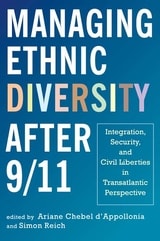
Managing Ethnic Diversity after 9/11
Integration, Security, and Civil Liberties in Transatlantic PerspectiveChebel d'Appollonia, Ariane
Rutgers University Press, 2010
Managing Ethnic Diversity after 9/11 compares these two strategies and considers that both may have engendered greater radicalization--and a greater chance of home-grown terrorism. Essays address how transatlantic countries, including the United Kingdom, the United States, France, Germany, Spain, Italy, and the Netherlands have integrated ethnic minorities, especially Arabs and Muslims, since 9/11. Discussing the "securitization of integration," contributors argue that the neglect of civil integration has challenged the rights of these minorities and has made greater security more remote.

Many Mirrors
Body Image and Social RelationsEdited by Nicole Sault
Rutgers University Press, 1994
“We've needed a book like Many Mirrors for a long time. In the veritable explosion of new scholarship on the human body, this book stands out in its focus on empirical research. Many Mirrors will move . . . the Anthropology of the Body a giant step forward.”--C. H. Browner, University of California at Los Angeles
In every society, people define and change their physical appearance in response to their relationships to others: we add clothes and masks, remove them, build up our muscles, perforate our flesh, cut parts away, comb our hair, and modify our diets. In rural Jamaica, fat women are considered desirable; in American suburbia, teenage girls are obsessed with thinness. Bedouin women use tattoos to express their secret longings; Asian American women undergo cosmetic surgery to conform to internalized western standards of beauty. Even with mirrors to see ourselves, we rely on the reactions of others to learn how we look and who we are.
Where contemporary Western culture sees the body as a concrete thing with an objective, observable reality, separate from the self, many other societies regard the person as an integrated whole that includes the mind, the body, and the spirit. Through the contributors' studies of individual cultures and through the editor’s unifying “body image system”, this volume gives us a new conceptual framework for understanding how women and men in any society perceive, describe, and alter their bodies.
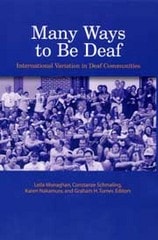
Many Ways to Be Deaf
International Variation in Deaf CommunitiesLeila Monaghan
Gallaudet University Press, 2003

Mapping Indigenous Presence
North Scandinavian and North American PerspectivesEdited by Kathryn W. Shanley and Bjørg Evjen; Foreword by S. James Anaya
University of Arizona Press, 2015
Mapping Indigenous Presence presents a set of comparative Indigenous studies essays with contemporary perspectives, attesting to the importance of the roles Indigenous people have played as overseers of their own lands and resources, as creators of their own cultural richness, and as political entities capable of governing themselves. This interdisciplinary collection explores the Indigenous experience of Sámi peoples of Norway and Native Americans of Montana in their respective contexts—yet they are in many ways distinctly different within the body politic of their respective countries. Although they share similarities as Indigenous peoples within nation-states and inhabit somewhat similar geographies, their cultures and histories differ significantly.
Sámi people speak several languages, while Indigenous Montana is made up of twelve different tribes with at least ten distinctly different languages; both peoples struggle to keep their Indigenous languages vital. The political relationship between Sámi people and the mainstream Norwegian government and culture has historically been less contentious that that of the Indigenous peoples of Montana with the United States and with the state of Montana, yet the Sámi and the Natives of Montana have struggled against both the ideology and the subsequent assimilation policy of the savagery-versus-civilization model. The authors attempt to increase understanding of how these two sets of Indigenous peoples share important ontological roots and postcolonial legacies, and how research may be used for their own self-determination and future directions.
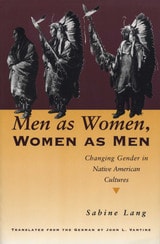
Men as Women, Women as Men
Changing Gender in Native American CulturesBy Sabine Lang
University of Texas Press, 1998
As contemporary Native and non-Native Americans explore various forms of "gender bending" and gay and lesbian identities, interest has grown in "berdaches," the womanly men and manly women who existed in many Native American tribal cultures. Yet attempts to find current role models in these historical figures sometimes distort and oversimplify the historical realities.
This book provides an objective, comprehensive study of Native American women-men and men-women across many tribal cultures and an extended time span. Sabine Lang explores such topics as their religious and secular roles; the relation of the roles of women-men and men-women to the roles of women and men in their respective societies; the ways in which gender-role change was carried out, legitimized, and explained in Native American cultures; the widely differing attitudes toward women-men and men-women in tribal cultures; and the role of these figures in Native mythology. Lang's findings challenge the apparent gender equality of the "berdache" institution, as well as the supposed universality of concepts such as homosexuality.

Mimetic Politics
Dyadic Patterns in Global PoliticsRoberto Farneti
Michigan State University Press, 2015
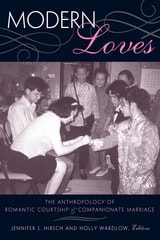
Modern Loves
The Anthropology of Romantic Courtship and Companionate MarriageJennifer S. Hirsch and Holly Wardlow, Editors
University of Michigan Press, 2006
In this first comparative ethnographic look at the global transformation toward marital ideals characterized by emotional intimacy, companionship, and mutual choice—discussed here as "companionate marriage"—Modern Loves asks how this shift is occurring and explores the factors that promote and hinder it, just who is pushing for these more companionate relationships, and what advantages men and women see in modern love. The contributors analyze the intricate negotiations surrounding love, marriage, and sex in Mexico, India, Papua New Guinea, Brazil, Pakistan, Nigeria, Singapore, and Hong Kong and among Latino youth in East Los Angeles. Modern Loves presents the new global approach to kinship studies, examining both the microlevel practices that constitute and bind relationships and the macrolevel forces that shape the landscape of love.
Jennifer S. Hirsch is Associate Professor in the Department of Sociomedical Sciences, Mailman School of Public Health, Columbia University. Holly Wardlow is Assistant Professor of Anthropology at the University of Toronto.
"What‘s love got to do with it? Hirsch and Wardlow answer this question by demonstrating the relevance—indeed, centrality—of the ideologies and practices surrounding romantic love and companionate marriage to the study of social transformation more broadly. The essays compiled in this volume explore the material, structural, and demographic underpinnings of the global shift in marital ideals while also tracing some of the sources of this marital shift in mass media, missionization, and the spread of individualism. The contributors of the chapters provide ethnographically rich examples of the ways in which people living in different societies interpret and act upon these global forces and images in sometimes overlapping and sometimes varying ways. This volume is an important and thoughtful contribution to the study of emotion, gender, kinship, and social change." —Laura M. Ahearn, Department of Anthropology, Rutgers University
"With its rich descriptions of the nuances in romantic love and its lucid analysis of the political economy of conjugal relations, this book will be widely read and loved by anthropologists as well as the concerned public."
—Yunxiang Yan, Department of Anthropology, UCLA
"Modern Loves offers an overview of current scholarship on love in the context of sexual relationships cross-culturally, and provides a view of the complexity of varied aspects of emotion, social structure, and social change in contemporary sexual relationships. It clearly makes the case for a political economic understanding of the emergence of ideologies of love, marriage, and courtship as part of expanding global economies."
—Linda-Anne Rebhun, Department of Anthropology, Yale University
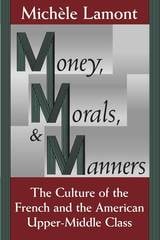
Money, Morals, and Manners
The Culture of the French and the American Upper-Middle ClassMichèle Lamont
University of Chicago Press, 1992
Money, Morals, and Manners is an ambitious and sophisticated attempt to illuminate the nature of social class in modern society. For all those who downplay the importance of unequal social groups, it will be a revelation.
"A powerful, cogent study that will provide an elevated basis for debates in the sociology of culture for years to come."—David Gartman, American Journal of Sociology
"A major accomplishment! Combining cultural analysis and comparative approach with a splendid literary style, this book significantly broadens the understanding of stratification and inequality. . . . This book will provoke debate, inspire research, and serve as a model for many years to come."—R. Granfield, Choice
"This is an exceptionally fine piece of work, a splendid example of the sociologist's craft."—Lewis Coser, Boston College
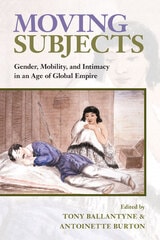
Moving Subjects
Gender, Mobility, and Intimacy in an Age of Global EmpireEdited by Tony Ballantyne and Antoinette Burton
University of Illinois Press, 2008
Moving Subjects is the first of its kind to make a case not simply for the necessity of a spatial analysis of imperial formations, but for the indispensability of an investigative approach that links space and movement with the domain of the intimate. Through careful archival research and a commitment to excavating the variety of "mobile intimacies" at the heart of imperial power, its agents, and its interlocutors, contributors offer new evidence and approaches for scholars engaged in capturing the historical nuances of imperial domination.
Contributors are Tony Ballantyne, Antoinette Burton, Adrian Carton, David Haines, Katherine Ellinghaus, Charlotte Macdonald, Michael A. McDonnell, Kirsten McKenzie, Michelle Moran, Fiona Paisley, Adele Perry, Dana Rabin, Christine M. Skwiot, Rachel Standfield, Frances Steel, Elizabeth Vibert, and Kerry Wynn.