Results by title
91 books match the query 'Deaf people' and 6 start with m
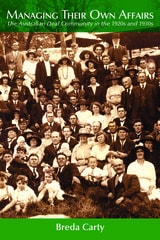
Managing Their Own Affairs
The Australian Deaf Community in the 1920s and 1930sBreda Carty
Gallaudet University Press, 2017
During this time, deaf Australians aspired to manage their own affairs. They enjoyed some success by establishing “breakaways” from the Deaf Societies, and they also established an independent national organization, which was contested and ultimately suppressed by the Deaf Societies. These developments were influenced by wider social movements in Australian society, such as the mobilization of minority groups in their push for autonomy and equal rights. Although most of the breakaway Deaf organizations did not survive beyond the 1930s, they significantly affected the power structures and relationships between deaf and hearing people in Australia. The Australian Deaf community’s attempts to organize independently during these years have been largely erased from collective memory, making Carty’s examination a particularly important and necessary addition to the historical literature.
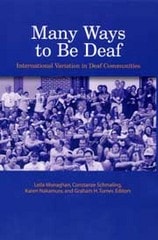
Many Ways to Be Deaf
International Variation in Deaf CommunitiesLeila Monaghan
Gallaudet University Press, 2003
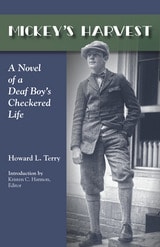
Mickey’s Harvest
A Novel of a Deaf Boy’s Checkered LifeHoward L. Terry
Gallaudet University Press, 2015
Mickey Dunmore’s story begins with the sinking of his father’s merchant sailing ship and ends with a cliffhanger in World War I. In school, after an illness caused his deafness, Mickey finds himself constantly fighting the hearing boys and later competing with the signing students when he attends a residential school for deaf students. In college, he and his best friend Dick Wagner leave early to travel the nation with the hobos, carnies, and grifters. In one town, they outfox a barker who was using a deaf girl to “read” the minds of their marks. Further on, they meet Bunny, the Mighty Mite deaf man who helps expose a hearing woman posing as deaf to scam sympathetic people. Mickey faces his greatest challenge when he falls in love with Marion Carrel, a deaf girl whose hearing father forbids their romance on eugenics grounds.
Terry, who became deaf at the age of 11, states from the outset that he means for his novel to reveal the biases confronting deaf people at the time. As a tonic, he populates Mickey’s Harvest with artistic, talented deaf individuals who engage readers in an earlier, colorful time as they “show their stuff.”
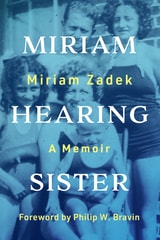
Miriam Hearing Sister
A MemoirMiriam Zadek
Gallaudet University Press, 2022
The prevailing ideological movements of the time permeate her family life. Zadek reveals the traumatic impact of eugenics and the fears surrounding the genetic transmission of deafness. She considers the effects of adhering to the oral method of communication in her home when sign language could have given her family the ability to interact with each other more fully. In this environment, Zadek became an astute communicator and learned to adapt to both the hearing and the deaf world, where she was known as “Miriam Hearing Sister.” Her memoir is an elegant literary work that offers an understanding of how biases and stigmas resonate and evolve, and it showcases her loving family of strong women who pushed against stereotypes and have thrived across generations.
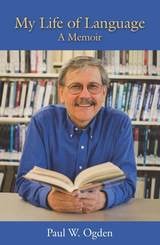
My Life of Language
A Memoirogden
Gallaudet University Press, 2017
Paul W. Ogden has dedicated his life to educating young deaf and hard of hearing people and raising awareness of what it means to be deaf in a hearing world. He has taught and mentored a generation of teachers, and his classic volume, The Silent Garden, has served as a guide for parents and educators for over thirty years. Now he tells his personal story of challenges faced and lessons learned, revealing that the critical, guiding factors for him have always been language and successful communication.
Born in a time when many deaf children had no access to language, Paul learned spoken and written language skills at a young age through the painstaking efforts of his mother. His tight-knit family, which included one deaf and two hearing older brothers, facilitated open and constant communication using a variety of methods. His father was a pastor who was involved in the civil rights movement. He struggled with depression, an illness that would take the life of one of Paul’s brothers. As a student at a residential deaf school where the use of American Sign Language (ASL) was suppressed, Paul continued to build on the speech and lipreading skills he had learned at home. He returned home for high school and graduated as co-valedictorian—unaware of the standing ovation he received as he walked to the podium.
Following a rewarding experience as an undergraduate at Antioch College, Paul went on to earn a PhD from the University of Illinois, a rare accomplishment for a deaf person at that time. During his graduate studies, he finally had the opportunity to learn ASL. As an award-winning professor of Deaf Studies at California State University, Fresno, he successfully petitioned for the university to recognize ASL as a language, and he established the Silent Garden program, which has grown into a flourishing provider of training and resources to support the Deaf community. In My Life of Language, Paul offers eloquent reflections on both the joyful and difficult periods of his life as he navigated relationships, faced discrimination, questioned his faith, and found great happiness in his marriage.
My Sense of Silence
Memoirs of a Childhood with DeafnessLennard J. Davis
University of Illinois Press, 1999
Selected as an "Editors Choice" by the Chicago Tribune
Lennard J. Davis grew up as the hearing child of deaf parents. In this candid, affecting, and often funny memoir, he recalls the joys and confusions of this special world, especially his complex and sometimes difficult relationships with his working-class Jewish immigrant parents. Gracefully slipping through memory, regret, longing, and redemption, My Sense of Silence is an eloquent remembrance of human ties and human failings.