Results by title
102 books match the query 'Demography' and 3 start with m
Men without Work
Post-Pandemic Edition (2022)Eberstadt, Nicholas
Templeton Press, 2022
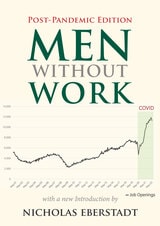
Nicholas Eberstadt’s landmark 2016 study, Men Without Work, cast a spotlight on the collapse of work for men in modern America. Rosy reports of low unemployment rates and “full or near full employment” conditions, he contends, were overlooking a quiet, continuing crisis: Depression-era work rates for American men of “prime working age” (25–54).
The grim truth: over six million prime-age men were neither working nor looking for work. Conventional unemployment measures ignored these labor force dropouts, but their ranks had been rising relentlessly for half a century. Eberstadt’s unflinching analysis was, in the words of The New York Times, “an unsettling portrait not just of male unemployment, but also of lives deeply alienated from civil society.”
The famed American work ethic was once near universal: men of sound mind and body took pride in contributing to their communities and families. No longer, warned Eberstadt. And now—six years and one catastrophic pandemic later—the problem has not only worsened: it has seemingly been spreading among prime-age women and workers over fifty-five.
In a brand new introduction, Eberstadt explains how the government’s response to Covid-19 inadvertently exacerbated the flight from work in America. From indiscriminate pandemic shutdowns to almost unconditional “unemployment” benefits, Americans were essentially paid not to work.
Thus today, despite the vaccine rollouts, inexplicable numbers of working age men and women are sitting on the sidelines while over 11 million jobs go unfilled. Current low rates of unemployment, touted by pundits and politicians, are grievously misleading. The truth is that fewer prime-age American men are looking for readily available work than at any previous juncture in our history. And others may be catching the “Men Without Work” virus too.
Given the devastating economic impact of the Covid calamity and the unforeseen aftershocks yet to come, this reissue of Eberstadt’s groundbreaking work is timelier than ever.
[more]
Migration and Residential Mobility in the United States
Larry Long
Russell Sage Foundation, 1988
Americans have a reputation for moving often and far, for being committed to careers or lifestyles, not place. Now, with curtailed fertility, residential mobility plays an even more important role in the composition of local populations—and by extension, helps shape local and national economic trends, social service requirements, and political constituencies. In Migration and Residential Mobility in the United States, Larry Long integrates diverse census and survey data and draws on many academic disciplines to offer a uniquely comprehensive view of internal migration patterns since the 1930s. Long describes an American population that lives up to its reputation for high mobility, but he also reports a surprising recent decline in interstate migration and an unexpected fluctuation in the migration balance toward nonmetropolitan areas. He provides unprecedented insight into reasons for moving and explores return and repeat migration, regional balance, changing migration flows of blacks and whites, and the policy implications of movement by low-income populations. How often, how far, and why people move are important considerations in characterizing the lifestyles of individuals and the nature of social institutions. This volume illuminates the extent and direction, as well as the causes and consequences, of population turnover in the United States. A Volume in the Russell Sage Foundation Census Series
[more]
Mixed Heritage in the Family
Racial Identity, Spousal Choice, and ChildrearingCarolyn Liebler
Russell Sage Foundation, 2025
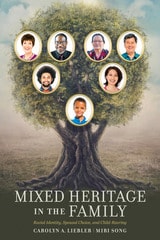
As interracial unions and multiracial people become more common in the United States, mixed-heritage people have come to be regarded by some as a bellwether of race relations in the country. Is the growth of this population a sign that we are now in a post-racial era and our racial identities no longer impact our daily lives? In Mixed Heritage in the Family,sociologists Carolyn A. Liebler and Miri Song explore how racially mixed people navigate racial boundaries as they choose spouses and raise families.
Liebler and Song break new ground by being the first to combine and integrate the study of three aspects of life for people of mixed racial heritage – identity, spouse choice, and childrearing. This integrated approach reveals how complicated racial identification can be, and how it can be expressed in one’s choice of partner or in how one raises their children. The authors draw on census data and interviews with Asian-White, Black-White, and American Indian/Alaska Native-White mixed people to better understand how their identity choices are related to their choice of spouse and how they racially identify and raise their children.
Increasingly, mixed people in the United States are identifying with multiple races. However, the authors find that mixed-race people are not a monolith and that how and why they identify varies considerably between and within each group. They found several common factors that influenced whether mixed-race people choose to identify as biracial, solely White, or solely as a racial minority. These factors include the history of the specific minority race in the U.S., the racial demographics of where they were raised, their social and cultural exposure to their White and non-White backgrounds, their attachment to their racial backgrounds, and how they are seen racially by others.
The way mixed-heritage people identify was closely tied to the race of their spouse. However, having a White spouse did not necessarily mean the mixed-race person felt disconnected from their non-White heritage. White spouses varied in their racial consciousness and their interest in the culture of their mixed-race spouse’s minority ancestry. The spouse’s race, and the nature of racial overlap between the spouses, was also key in the racial upbringing of a mixed-heritage person’s child. In families where the parents share a minority racial heritage, couples lean into their shared ‘family race’, which guides their parenting choices and family life. Many mixed heritage parents found it important to foster racial pride in their children and combat negative racial stereotypes.
Liebler and Song caution against making superficial predictions about the state of race relations in the U.S. based on an increase in the multiracial population. They show that race has not become less salient in the lives of many mixed-race people—American society is not post-racial.
Mixed Heritage in the Family breaks new ground, provides compelling insights in its examination of the lives of mixed-race people, and shows how complicated racial identification can be.
[more]