Results by title
603 books match the query 'Description and travel' and 30 start with m

Making Home in Havana
Pietropaolo, Vincenzo
Rutgers University Press, 2002
Havana is a city that rarely fails to captivate. But much of the unique beauty and culture of this historic city is rapidly disappearing. As Cuban society finds itself at a crossroads, Havana is more than ever a city on the edge, for although frozen in time as a consequence of Fidel Castro’s revolution, it has certainly not been well preserved. Time, climate, and neglect have eroded a rare architectural legacy, making the need to document this heritage even more pressing than ever before.
Making Home in Havana is an elegant book of photographs and testimonies, recording, questioning, and evoking the meaning of place — in particular, the meaning of home. The combination of fine photography and the words of residents of former palaces, humble apartments, and other dwellings offer us an irresistible portrait of Havana that might otherwise be lost forever.Vincenzo Pietropaolo and Cecelia Lawless have made numerous visits to Havana in order to fully understand and convey the essence of what home means to the inhabitants of the dwellings of the El Vedado and Centro Habana neighborhoods. Together, they—and we—explore how a building becomes a home through its human history as well as its architectural features. With some renovation already underway in colonial Havana, they concentrate on largely unexplored and unrecognized sections that continue to fall into ruin. The intimacy of their connection with the buildings and people offers us a rare combination of documentary realism and high art. Buildings and people speak their histories to us in classic humanistic style. Residents of Havana tell their stories of lifelong efforts to turn decay into beauty, while the photographer’s evocative pictures enable us to feel exactly what they are talking about — a creation of time and space called home.
Malibu Diary
Notes From An Urban RefugeePenelope O'Malley
University of Nevada Press, 2004
Mapping Historical Las Vegas
A Cartographic JourneyJoe Weber
University of Nevada Press, 2022
Reaching past the city limits, Mapping Historical Las Vegas also examines the development of public lands, military bases, and the canyons and valleys of the Colorado River before the Hoover Dam was built and Lake Mead was created. Weber also includes information on dams, highways, railroads, and other projects that were planned but never constructed— showing what might have been in one of the nation’s largest cities.
With 137 color maps generated using Geographic Information Systems, along with extensive mapping by Weber that draws on his decades of experience in the region, Mapping Historical Las Vegas offers a unique perspective on one of the world’s most famous desert cities.

Mardi and a Voyage Thither
Volume ThreeHerman Melville
Northwestern University Press, 1998
This scholarly edition aims to present a text as close to the author's intention as surviving evidence permits. Based on collations of all editions publishing during Melville's lifetime, it incorporates author corrections and many emendations made by the present editors. This edition of Mardi is an Approved Text of the Center for Editions of American Authors (Modern Language Association of America).
Mardi and a Voyage Thither
Volume Three, Scholarly EditionHerman Melville
Northwestern University Press, 1970
This scholarly edition aims to present a text as close to the author's intention as surviving evidence permits. Based on collations of all editions publishing during Melville's lifetime, it incorporates author corrections and many emendations made by the present editors. This edition of Mardi is an Approved Text of the Center for Editions of American Authors (Modern Language Association of America).
Mark Twain on the Move
A Travel ReaderAlan Gribben
University of Alabama Press, 2008
Journeys, humor, and insight from Mark Twain's travel narratives - America’s literary master.
Mark Twain on the Move gathers the very best passages from all five of Mark Twain’s travel narratives: The Innocents Abroad (1869), Roughing It (1872), A Tramp Abroad (1880), Life on the Mississippi (1883), and Following the Equator (1897). Although Twain’s travel narratives were his best sellers throughout his career, modern readers are largely unfamiliar with them. Thus, readers are not only missing some of Twain’s most hilarious and insightful material, they are also missing a complete understanding of a beloved literary and cultural icon.
Mark Twain on the Move presents the best of these works—sometimes respectful, often irreverent and outlandish—at their most lively and captures his renowned experiences as an American tourist. And they demonstrate why Twain’s greatest popularity in his lifetime derived from his travel writings rather than from his novels. Twain was always entertaining and provocative while on the move and this collection captures that fabled energy for modern readers.
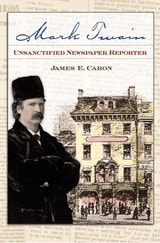
Mark Twain, Unsanctified Newspaper Reporter
James E. Caron
University of Missouri Press, 2008
Before Mark Twain became a national celebrity with his best-selling The Innocents Abroad, he was just another struggling writer perfecting his craft—but already “playin’ hell” with the world. In the first book in more than fifty years to examine the initial phase of Samuel Clemens’s writing career, James Caron draws on contemporary scholarship and his own careful readings to offer a fresh and comprehensive perspective on those early years—and to challenge many long-standing views of Mark Twain’s place in the tradition of American humor.
Tracing the arc of Clemens’s career from self-described “unsanctified newspaper reporter” to national author between 1862 and 1867, Caron reexamines the early and largely neglected writings—especially the travel letters from Hawaii and the letters chronicling Clemens’s trip from California to New York City. Caron connects those sets of letters with comic materials Clemens had already published, drawing on all known items from this first phase of his career—even the virtually forgotten pieces from the San Francisco Morning Call in 1864—to reveal how Mark Twain’s humor was shaped by the sociocultural context and how it catered to his audience’s sensibilities while unpredictably transgressing its standards.
Caron reveals how Sam Clemens’s contemporaries, notably Charles Webb, provided important comic models, and he shows how Clemens not only adjusted to but also challenged the guidelines of the newspapers and magazines for which he wrote, evolving as a comic writer who transmuted personal circumstances into literary art. Plumbing Mark Twain’s cultural significance, Caron draws on anthropological insights from Victor Turner and others to compare the performative aspects of Clemens’s early work to the role of ritual clowns in traditional societies
Brimming with fresh insights into such benchmarks as “Our Fellow Savages of the Sandwich Islands” and “Jim Smiley and His Jumping Frog,” this book is a gracefully written work that reflects both patient research and considered judgment to chart the development of an iconic American talent. Mark Twain, Unsanctified Newspaper Reporter should be required reading for all serious scholars of his work, as well as for anyone interested in the interplay between artistic creativity and the literary marketplace.
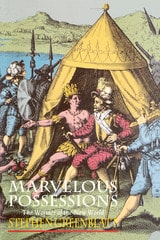
Marvelous Possessions
The Wonder of the New WorldStephen Greenblatt
University of Chicago Press, 1991
In a series of innovative readings of travel narratives, judicial documents, and official reports, Stephen Greenblatt shows that the experience of the marvelous, central to both art and philosophy, was cunningly yoked by Columbus and others to the service of colonial appropriation. He argues that the traditional symbolic actions and legal rituals through which European sovereignty was asserted were strained to the breaking point by the unprecedented nature of the discovery of the New World. But the book also shows that the experience of the marvelous is not necessarily an agent of empire: in writers as different as Herodotus, Jean de Léry, and Montaigne—and notably in Mandeville's Travels, the most popular travel book of the Middle Ages—wonder is a sign of a remarkably tolerant recognition of cultural difference.
Marvelous Possession is not only a collection of the odd and exotic through which Stephen Greenblatt powerfully conveys a sense of the marvelous, but also a highly original extension of his thinking on a subject that has occupied him throughout his career. The book reaches back to the ancient Greeks and forward to the present to ask how it is possible, in a time of disorientation, hatred of the other, and possessiveness, to keep the capacity for wonder from being poisoned?
"A marvellous book. It is also a compelling and a powerful one. Nothing so original has ever been written on European responses to 'The wonder of the New World.'"—Anthony Pagden, Times Literary Supplement
"By far the most intellectually gripping and penetrating discussion of the relationship between intruders and natives is provided by Stephen Greenblatt's Marvelous Possessions."—Simon Schama, The New Republic
"For the most engaging and illuminating perspective of all, read Marvelous Possessions."—Laura Shapiro, Newsweek
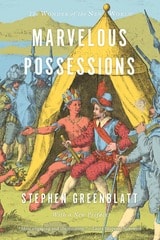
Marvelous Possessions
The Wonder of the New WorldStephen Greenblatt
University of Chicago Press, 2017
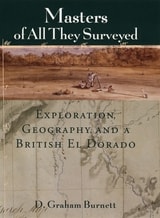
Masters of All They Surveyed
Exploration, Geography, and a British El DoradoD. Graham Burnett
University of Chicago Press, 2000
In answering these questions, D. Graham Burnett brings to light the work of several such explorers, particularly Sir Robert H. Schomburgk, the man who claimed to be the first to reach the site of Ralegh's El Dorado. Commissioned by the Royal Geographical Society and later by the British Crown, Schomburgk explored and mapped regions in modern Brazil, Venezuela, and Guyana, always in close contact with Amerindian communities. Drawing heavily on the maps, reports, and letters that Schomburgk sent back to England, and especially on the luxuriant images of survey landmarks in his Twelve Views in the Interior of Guiana (reproduced in color in this book), Burnett shows how a vast network of traverse surveys, illustrations, and travel narratives not only laid out the official boundaries of British Guiana but also marked out a symbolic landscape that fired the British imperial imagination.
Engagingly written and beautifully illustrated, Masters of All They Surveyed will interest anyone who wants to understand the histories of colonialism and science.
Maya for Travelers and Students
A Guide to Language and Culture in YucatanBy Gary Bevington
University of Texas Press, 1995
The Yucatan Peninsula draws many North American and European travelers each year to view the ruins of the pre-Columbian Classical Maya civilization and the abundant native flora and fauna. For these travelers, as well as armchair travelers and students, Gary Bevington has prepared the first general English-language introduction to Yucatec Maya, the native language of the people indigenous to the region.
Written in nontechnical terms for learners who have a basic knowledge of simple Mexican Spanish, the book presents easily understood, practical information for anyone who would like to communicate with the Maya in their native language. In addition to covering the pronunciation and grammar of Maya, Bevington includes invaluable tips on learning indigenous languages "in the field." Most helpful are his discussions of the cultural and material worlds of the Maya, accompanied by essential words and expressions for common objects and experiences. A Maya-English-Spanish glossary with extensive usage examples and an English-Maya glossary conclude the book.
Note: The supplemental audiocasette, Spoken Maya for Travelers and Students, is now available as a free download through the book's page on the University of Texas Press's website.

Mayan Drifter
Chicano Poet in the Lowlands of AmericaJuan Herrera
Temple University Press, 1997
Meander Scars
Reflections on Healing the Willamette RiverAbby Phillips Metzger
Oregon State University Press, 2013
Yet, through canoe trips and intimate explorations of the river, Metzger discovers glints of resiliency: a beaver trolling through a slough, native fish in quiet backwaters, and strong currents that carry undertones of the wild Willamette. Together with tales from farmers and scientists alike, these experiences lead Metzger to ask whether something scarred can fully heal, and whether a disjointed river can be whole again.
A story of re-discovery as told by a learner, Meander Scars will appeal to readers of literary nonfiction, river advocates, naturalists, and outdoor enthusiasts interested in sustaining healthy river systems for themselves, their children, and beyond.
Mercados
Recipes from the Markets of MexicoBy David Sterling
University of Texas Press, 2019
Part travelogue, part cookbook, Mercados takes us on a tour of Mexico’s most colorful destinations—its markets—led by an award-winning, preeminent guide whose passion for Mexican food attracted followers from around the globe. Just as David Sterling’s Yucatán earned him praise for his “meticulously researched knowledge” (Saveur) and for producing “a labor of love that well documents place, people and, yes, food” (Booklist), Mercados now invites readers to learn about local ingredients, meet vendors and cooks, and taste dishes that reflect Mexico’s distinctive regional cuisine.
Serving up more than one hundred recipes, Mercados presents unique versions of Oaxaca’s legendary moles and Michoacan’s carnitas, as well as little-known specialties such as the charcuterie of Chiapas, the wild anise of Pátzcuaro, and the seafood soups of Veracruz. Sumptuous color photographs transport us to the enormous forty-acre, 10,000-merchant Central de Abastos in Oaxaca as well as tiny tianguises in Tabasco. Blending immersive research and passionate appreciation, David Sterling’s final opus is at once a must-have cookbook and a literary feast for the gastronome.
Mezcal
By Charles Bowden
University of Texas Press, 1988
Praise for Mezcal:
"Mezcal is also a lyrical meditation upon the ultimate strength of the land, specifically the desert Southwest, and how that land prevails and endures despite every effort of modern industry and development to rape and savage it in the name of progress. Mezcal lingers in the mind as only the very best books manage to do."—Harry Crews
"The author . . . excavates his own tormented life—and its relation to the land he loves—in a series of powerful, imagistic autobiographical essays. Like the desert he cherishes, this memoir is harsh yet lovely, full of sour self-truth. . . . A potent presentation of the wounds of one man's life, packed with indelible impressions; but there's little healing here, making this a bitter if beautiful read."—Kirkus Review
"In Mezcal . . . Bowden drops the journalistic veil, exploring the ecology of his interior landscape at least as thoroughly as the changing scenery that surrounds him. . . . Others—Aldo Leopold, Edward Abbey—have already staked inviolate claims on the Southwestern deserts. But Bowden owns the complex terrain where, like a mezcal-inspired mirage, the Sonoran sun-belt overlaps the gray convolutions of the American mind."—Los Angeles Times
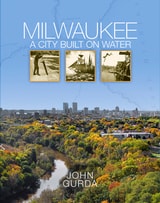
Milwaukee
A City Built on WaterJohn Gurda
Wisconsin Historical Society Press, 2026
The success and survival of Milwaukee lies in the rivers that meander through its streets and the great lake at its eastern boundary. The Indigenous peoples of the region recognized the value of an abundant, clean water supply for food and transportation. Generations of immigrants, entrepreneurs, innovators, and recreationists used the same waters to travel greater distances, power million-dollar industries, and even have a bit of fun.
In Milwaukee: A City Built on Water, celebrated historian John Gurda relates the history of the waters that gave Milwaukee life—and occasionally threatened the city through erosion, invasive species, and water-borne diseases. Telling tales of brewers, brickmakers, ecologists, and engineers, Gurda explores the city’s complicated connections with its most precious resource and greatest challenge. You’ll meet the generations of people, from a Potawatomi chief to fur traders and fishermen, who settled on the small spit of land known as Jones Island; learn how Milwaukee’s unique water composition creates its distinct cream-colored bricks; visit Wisconsin’s first waterparks; and see how city leaders transformed the Milwaukee River—once described as a “vast sewer” with an “odorous tide”—into today’s lively and lovely Riverwalk.
Now available in paperback, Milwaukee: A City Built on Water is the sweeping chronicle of a critical natural resource that has weathered heavy use and flagrant abuse to emerge as a focal point of both celebration and concern in the twenty-first century.
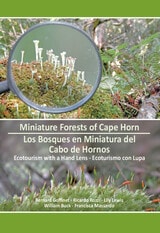
Miniature Forests of Cape Horn
Ecotourism with a Hand LensBernard Goffinet
University of North Texas Press, 2012
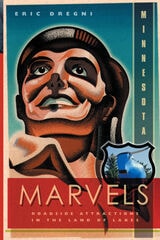
Minnesota Marvels
Roadside Attractions in the Land of LakesEric Dregni
University of Minnesota Press, 2001
Only in Minnesota can you snap a Polaroid of a fifty-five-foot-tall grinning green man with a size seventy-eight shoe or marvel at the spunk of a Swede who dedicated his life to spinning a gigantic ball of twine. The world’s largest hockey stick, as well as the biggest pelican, prairie chicken, turkey, fish, otter, fox, and loon also make Minnesota their home. Where else can you ponder the mysterious "miracle meat" of Spam in a museum dedicated to pork products or have your head examined by the phrenology machines at the Museum of Questionable Medical Devices?
Minnesota Marvels is a tour of the inspired, bizarre, brilliant, scandalous, and funny sites around the state. Look up in wonder at the several Paul Bunyan statues, including the original (Bemidji), the tallest (Akeley), and the largest talking version (Brainerd). Ease on down the road to visit the first home of the heel-tapping native of Grand Rapids, Judy Garland, or walk the "main street" of Sauk Centre immortalized by native son Sinclair Lewis. See the birthplaces of Charles Lindbergh, the Mayo brothers, the Greyhound bus, the snowmobile, and the ice-cream sandwich.
Minnesota is also the home of such attractions as the Minneapolis Sculpture Garden and the world’s largest aerial lift bridge in Duluth, and architectural wonders such as Frank Lloyd Wright’s modernist gas station in Cloquet and Frank Gehry’s arresting Weisman Art Museum. Stunning mansions with histories of ghost sightings, the hangouts and lairs of infamous gangsters, and old-fashioned breweries dot the state.
Conveniently organized by town name and illustrated throughout, Minnesota Marvels is the perfect light-hearted guide for entertaining road trips all over the state.
Mirage-Land
Images of NevadaWilbur S. Shepperson
University of Nevada Press, 1996
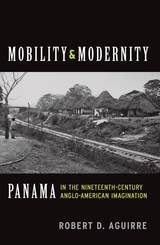
Mobility and Modernity
Panama in the Nineteenth-Century Anglo-American ImaginationRobert D. Aguirre
The Ohio State University Press, 2017
In this study, Robert D. Aguirre provides bold new interpretations of Anthony Trollope, John Lloyd Stephens, and Eadweard Muybridge and also recovers information about literary communities previously lost to history. Mobility and Modernity shows how Panama became defined as a site of incipient globalization and a crucial link of empire. Across this narrow strip of land people and things traveled, technology developed, and political forces erupted. The isthmus became a site of mobility that paradoxically produced varieties of immobility. Parting ways with histories that celebrate the canal as a mighty engineering feat, Mobility and Modernity reveals a more complex story of cultural conflict that began with the first gold rush news in the late 1840s and continued throughout the century.
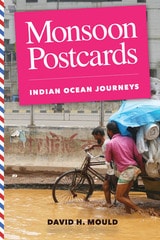
Monsoon Postcards
Indian Ocean JourneysDavid H. Mould
Ohio University Press, 2019
In Monsoon Postcards, journalist David H. Mould, notebook in hand, traverses the Indian Ocean—from Madagascar through India and Bangladesh to Indonesia. It’s an unpredictable journey on battered buses, bush taxis, auto-rickshaws, and crowded ferries. Mould travels from the traffic snarls of Delhi, Dhaka, and Jakarta to the rice paddies and ancestral tombs of Madagascar’s Central Highlands; from the ancient kingdom of Hyderabad to India’s so-called chicken neck—the ethnically diverse and underdeveloped northeast; and from the textile factories and rivers of Bangladesh to the beaches of Bali and the province of Aceh—ground zero for the 2004 tsunami.
Along the way, in markets, shops, roadside cafes, and classrooms, he meets journalists, professors, students, aid workers, cab drivers, and other everyday residents to learn how they view their past and future. Much like its predecessor, Mould’s Postcards from Stanland,Monsoon Postcards offers witty and insightful glimpses into countries linked by history, trade, migration, religion, and a colonial legacy. It explores how they confront the challenges of climate change, urban growth, economic development, land, water and natural resources, and national and ethnic identity.
Montana Ghost Dance
Essays on Land and LifeBy John B. Wright
University of Texas Press, 1998
Montana has been the "last best place" for so many people. A century ago, Native Americans gathered here to perform the Ghost Dance—a last, doomed attempt to make white settlers vanish and bring back the old ways of life. Today, people are still pouring into Montana, looking for the pristine wilderness they saw in A River Runs through It.
The reality of Montana—indeed, of all the West—has never matched the myths, but this book eloquently explores how the search for a perfect place is driving growth, development, and resource exploitation in Big Sky country. In ten personal essays, John Wright looks at such things as Montana myths; old-timers; immigrants; elk; ways of seeing the landscape; land conservation and land trusts; the fate of the Blackfoot, Bitterroot, and Paradise valleys; and some means of preserving the last, best places.
These reflections offer a way of understanding Montana that goes far beyond the headlines about militia groups and celebrities' ranches. Montana never was or will be a pristine wilderness, but Wright believes that much can be saved if natives and newcomers alike see what stands to be lost. His book is a wake-up call, not a ghost dance.
Moorings
Portuguese Expansion and the Writing of AfricaJosiah Blackmore
University of Minnesota Press, 2008
How Africa was perceived in the early modern imaginary
In this first book to study Portuguese texts about Africa, Moorings brings an important but little-known body of European writings to bear on contemporary colonial thought. Images of Africa as monstrous, dangerous, and lush were created in early Portuguese imperial writings and dominated its representation in European literature. Moorings establishes these key works in their proper place: foundational to Western imperial discourse.
Attentive to history as well as the nuances of language, Josiah Blackmore leads readers from the formation of the “Moor” in medieval Iberia to the construction of a full colonial imaginary, as found in the works of two writers: the royal chronicler Gomes Eanes de Zurara and the epic poet Luís de Camões. Blackmore’s original work helps to explain how concepts and myths—such as the “otherness” of Africa and Africans—originated, functioned, and were perpetuated.Delving into the Portuguese imperial experience, Moorings enriches our understanding of historical and literary imagination during a significant period of Western expansion.
More Curious
By Sean Wilsey
University of Texas Press, 2015
Mountaineering Essays
John Muir
University of Utah Press, 1997
One of the world’s foremost writers of the mountaineering essay—his writings are finely wrought expressions of the transcendental joy he found in the mountains—John Muir also founded the Sierra Club in 1892 as a way of supporting his belief that Americans must preserve national parks throughout the country in order that future generations might be spiritually inspired. Characterized by an iron endurance and an insatiable curiosity, Muir vowed to spend his days studying God’s unwritten Bible—nature—or what he termed the "University of the Wilderness." Muir early on learned to keep a journal in the manner of Emerson, but he is also considered one of America’s pioneer glaciologists, an interest he gained while wandering in Yosemite and the Sierra Nevada mountains. Whether frozen in a subzero blizzard on Mount Shasta, seemingly doomed on the unforgiving slopes of Mount Ritter, or exhilarated by the ice-shapes viewed from the summit of Mount Rainier, Muir reveled in the mountain experience.
This volume contains eleven mountain essays that include both adventurous narrative, joyful exultation, and descriptions of natural features such as alpine soil beds, ancient glaciers and living glaciers, and mountain sculpture. In each, Muir maintains a careful and subtle balance between the physical aspects of ascending and the more symbolic observations of the sublimity of his surroundings. Mountains are for him a source of discovery that provide an affirmation of the human spirit.
Moving Home
Gender, Place, and Travel Writing in the Early Black AtlanticSandra Gunning
Duke University Press, 2021
Musashino in Tuscany
Japanese Overseas Travel Literature, 1860–1912Susanna Fessler
University of Michigan Press, 2004
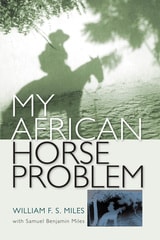
My African Horse Problem
William F. S. Miles
University of Massachusetts Press, 2008
My African Horse Problem recounts the intricacies of this unusual father-son expedition, a sometimes harrowing two-week trip that Samuel joined as "true heir" to the disputed stallion. It relates the circumstances leading up to the dispute and describes the intimacy of a relationship spanning a quarter century between William Miles and the custodians of his family horse—Islamic village friends eking out a precarious existence along the remote sub-Saharan borderline between Nigeria and Niger.
My African Horse Problem is a multi-layered narrative—part memoir, part ethnography—reaching back to Miles's days as a Peace Corps volunteer in Niger in the 1970s and a Fulbright scholar in the 1980s. At a deeper level, the story juxtaposes the idealistic and sometimes irresponsible tendencies of a young university graduate with the parental concerns of a middle-aged, tenured professor. Miles wonders if he was justified in exposing Sam to some of the worst health risks on earth, mainly to restore tenuous ties with long-ago friends in the African bush. Was it reckless to make his son illegally cross international boundaries, in a quixotic quest for justice and family honor? My African Horse Problem is more than an adventurer's tale with a unique story line: it is a father-son travel rumination, leavened by Sam's journal entries that help his father see Africa anew through a child's fresh eyes. In this era of religious and racial tensions, it is also a reaffirmation—within a black Muslim context—of the basic human imperative of trust.
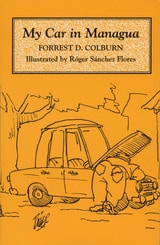
My Car in Managua
By Forrest D. Colburn
University of Texas Press, 1991
Histories of revolutions often focus on military, political, or economic upheavals but sometimes neglect to connect these larger events to the daily lives of "ordinary" people. Yet the peoples' perception that "things are worse than before" can topple revolutionary governments, as shown by the recent defeat of the Sandinista regime in Nicaragua and the governments of Eastern Europe. Providing the kind of prosaic, revealing details that more formal histories have excluded, My Car in Managua offers an objective, often humorous description of the great difficulties and occasional pleasures of life in Nicaragua during the Sandinista revolution.
During a year's work (1985-1986) at the Instituto Centroamericano de Administración de Empresas (INCAE), Forrest Colburn purchased a dilapidated car—and with it an introduction to everyday life in Nicaragua. His discoveries of the length of time required to register the car (approximately six weeks), the impossibility of finding spare parts (except when U.S. dollars were applied to the search), and the fact that "anyone getting into a car in Managua can be charged a small fee [for car watching] by anyone else" all suggest the difficulties most Nicaraguans faced living in a devastated economy.
Drawing on experiences from visits throughout the revolutionary period (1979-1989), Colburn also sheds light on how the Revolution affected social customs and language, gender roles and family relationships, equality and authority, the availability of goods and services, the status of ethnic minorities, and governmental and other institutions. Illustrations by Nicaragua's celebrated political cartoonist Róger Sánchez Flores enliven the lucid text.
My Life's Travels and Adventures
An Eighteenth-Century Oculist in the Ottoman Empire and the European HinterlandRegina Salomea Pilsztynowa
Iter Press, 2020
This edition brings the entirety of this personal and idiosyncratic memoir to English for the first time.