Results by title
10 books match the query 'Storytellers'
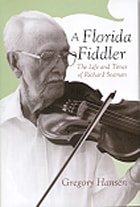
A Florida Fiddler
The Life and Times of Richard SeamanGregory Hansen
University of Alabama Press, 2007
Exploring Florida's cultural landscape through the life of a legendary fiddler.
This biography of 97-year-old Richard Seaman, who grew up in Kissimmee Park, Florida, relies on oral history and folklore research to define the place of musicianship and storytelling in the state's history from one artist's perspective. Gregory Hansen presents Seaman’s assessment of Florida’s changing cultural landscape through his tall tales, personal experience narratives, legends, fiddle tune repertory, and descriptions of daily life.
Seaman’s childhood memories of fiddling performances and rural dances explain the role such gatherings played in building and maintaining social order within the community. As an adult, Seaman moved to Jacksonville, Florida, where he worked as a machinist and performed with his family band. The evolution of his musical repertory from the early 1920s through the 1950s provides a resource for reconstructing social life in the rural south and for understanding how changes in musical style reflect the state's increasingly urban social structure. Hansen includes a set of Seaman's fiddle tunes, transcribed for the benefit of performer and researcher alike. The thirty tall tales included in the volume constitute a representative sample of Florida’s oral tradition in the early years of the 20th century.
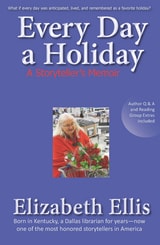
Every Day A Holiday
A storyteller's memoirElizabeth Ellis
Parkhurst Brothers, Inc., 2014
--Robin Bady, Storyteller, Arts Educator, Brooklyn, New York
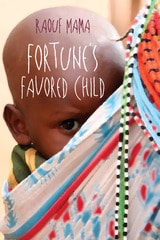
Fortune's Favored Child
Raouf Mama
Northwestern University Press, 2014
Raouf Mama is widely beloved by children and adults alike for his books and especially for his African and multicultural storytelling, which incorporates poetry, song, music, and dance.
In Fortune’s Favored Child, the master storyteller tells his own story, beginning in the West African country of Benin. Through a harrowing experience with sickness, an encounter with a clairvoyant traditional healer, and astonishing twists of fortune, the protagonist struggles to uncover his real identity, to get an education, and to make his own way in the world. His journey takes him to the shores of the United States to attend graduate school at the University of Michigan and begin a new chapter in his life.
.
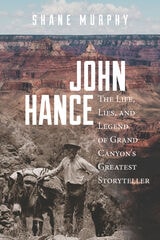
John Hance
The Life, Lies, and Legend of Grand Canyon's Greatest StorytellerShane Murphy
University of Utah Press, 2020
A legend in his own lifetime, John Hance (1837–1919) was synonymous with early Grand Canyon tourism. Between the late 1880s and early 1900s, to say “John Hance” was to say “Grand Canyon.” Hance was well known to travelers and visiting dignitaries alike, men such as William “Buffalo Bill” Cody and Theodore Roosevelt, the president who affectionately referred to him as “the greatest liar on earth.” It was said that Hance tried to jump the canyon on his horse Darby only to turn back when he was halfway over and realized he would never make it across.
The truth behind Hance’s life is remarkable even without embellishment. In this book, Shane Murphy chronicles Hance’s childhood in Tennessee and Missouri, his service in the Confederacy during the Civil War, his time in Union prisons as a POW, and his later adventures with the Hickok brothers crossing the plains. Settling in Arizona’s fruitful Verde Valley, Hance farmed and filled military contracts before taking up residence as Grand Canyon’s first permanent Euro-American settler, trail builder, guide, and renowned storyteller.
Hance left no correspondence, personal memoirs, or other writings. Only informal portraits from magazines and newspaper accounts remain. Murphy investigated assessors’ rolls, rare mercantile ledgers, and mining claims to create a full and compelling narrative of a man who was once an icon of the American West and should be remembered as the founding father of Grand Canyon tourism.
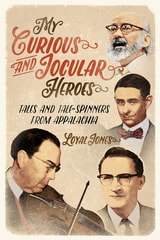
My Curious and Jocular Heroes
Tales and Tale-Spinners from AppalachiaLoyal Jones
University of Illinois Press, 2017
We stopped, and we heard the biggest racket you ever heard up in the house.
“What’s the matter, son?”
“Why, Maw and Paw are up there fightin’.”
“Who is your Paw, son?”
“Well, that’s what they are fightin’ over.”
Brimming with ballads, stories, riddles, tall tales, and great good humor, My Curious and Jocular Heroes pays homage to four people who guided and inspired Loyal Jones’s own study of Appalachian culture. His sharp-eyed portraits introduce a new generation to Bascom Lunsford, the pioneer behind the “memory collections” of song and story at Columbia University and the Library of Congress; the Sorbonne-educated collector and performer Josiah H. Combs; Cratis D. Williams, the legendary father of Appalachian studies; and the folklorist and master storyteller Leonard W. Roberts. Throughout, Jones highlights the tales, songs, jokes, and other collected nuggets that define the breadth of each man’s research and repertoire.

Storytellers of Art Histories
Living and Sustaining a Creative LifeEdited by Yasmeen Siddiqui and Alpesh Kantilal Patel
Intellect Books, 2021
With a focus on gender, race (including whiteness), class, sexuality, and transnationality—all of which are often marginalized in dominant art histories—each individual has provided short, often personal contributions detailing how they become passionate about their practice. The contributors’ offerings are varied and surprising, appealing equally to people enmeshed in the field through their work as well as those with a beginner’s interest. Their pieces take various forms—epistolary, children’s fable, interview, coauthored narrative, pastiche, memoir, manifesto, and apology—and a number of the essays perform in their structure or content the theories they explore about publishing, curating, and archival work.
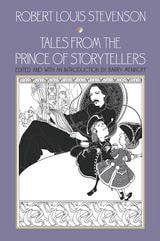
Tales from the Prince of Storytellers
Robert Louis Stevenson
Northwestern University Press, 1993
Included in this volume for the first time are versions of the stories "Markheim" and "The Isle of Voices" as they appear in Stevenson' s holograph manuscripts, plus his classics The Suicide Club, The Rajah's Diamond, "The Bottle Imp," "The Pavilion on the Links," "A Lodging for the Night," "The Merry Men," and "Thrawn Janet."
The Constructed Mennonite
History, Memory, and the Second World WarHans Werner
University of Manitoba Press, 2013
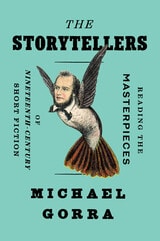
The Storytellers
Reading the Masterpieces of Nineteenth-Century Short FictionMichael Gorra
University of Chicago Press, 2026
Tracing the origins of the modern short story, Michael Gorra provides the first fully realized picture of a century’s worth of great tales.
The Storytellers offers a far-reaching account of the rich tradition of short narratives that flourished in nineteenth-century Europe and America, one that both prepared for and eventually gave way to the modern short story. Tracing unexpected resemblances across languages and decades, Michael Gorra restores a wide-angle view of the form in which works usually treated as stand-alone classics reveal themselves as parts of a single, lively conversation.
What unites these tales, Gorra argues, is their blend of novelty and unity. The book’s heart lies in a series of accessible readings of great tales by Herman Melville, Nikolai Gogol, Ivan Turgenev, E. T. A. Hoffmann, Guy de Maupassant, Nathaniel Hawthorne, Arthur Conan Doyle, Sarah Orne Jewett, Charles Chesnutt, and many more. Beyond its consideration of individual works, The Storytellers examines the formal and thematic concerns that bind the century together: the use of frame tales, accounts of social marginality, and an abundance of ghosts and uncanny coincidences. Over time, Gorra shows, these qualities yielded to a cooler realism, with Anton Chekhov as the key transitional figure. His compressed studies of ordinary lives inspired the modern short story and consigned the gothic flourishes of earlier tales to genre fiction.
What do we want from a story? What makes a tale worth telling? The nineteenth-century tale sought not the grand “meaning of life” promised by the novel, Gorra shows, but sudden revelations from singular events. The Storytellers gives readers an incomparable guide to a vast body of tales that still has the power to thrill and entertain.
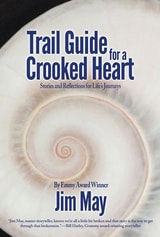
Trail Guide for a Crooked Heart
Stories and Reflections for Life's JourneyJim May
Parkhurst Brothers, Inc., 2016
"A brilliant mixture of story, philosophy, humor and wisdom, this book reminds us that---if we are open to story, dreams, imagination, and myth---we can open doors within our soul."
—Jay O’Callahan, author, storyteller, and NPR commentator
A lifetime collection of stories, wise words, assembled musings and quotations about overcoming hurdles, elusive enlightenment, personal evolution, persistence in the face of discouragement, this pastiche is designed to encourage the downhearted, lift up the strivers, and add wings to the heels of spiritual seekers.