Results by title
240 books match the query 'Diaries' and 8 start with m
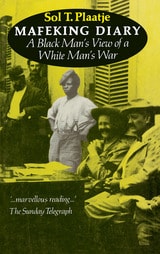
Mafeking Diary
A Black Man’s View of a White Man’s WarSol T. Plaatje
Ohio University Press, 1990
“Sol Plaatje’s Mafeking Diary is a document of enduring importance and fascination. The product of a young black South African court interpreter, just turned 23 years old when he started writing, it opens an entirely new vista on the famous Siege of Mafeking. By shedding light on the part played by the African population of the town, Plaatje explodes the myth, maintained by belligerents, and long perpetuated by both historians and the popular imagination, this this was a white man’s affair. One of the great epics of British imperial history, and perhaps the best remembered episode of the Anglo-Boer war of 1899–1902, is presented from a wholly novel perspective.
“At the same time, the diary provides an intriguing insight into the character of a young man who was to play a key role in South African political and literary history during the first three decades of this century. It reveals much of the perceptions and motives that shaped his own attitudes and intellectual development and, indeed, those of an early generation of African leaders who sought to build a society which did not determine the place of its citizens by the colour of their skin. The diary therefore illuminates the origins of a struggle which continues to this day.”
— John L. Comaroff (ed.) in his preface
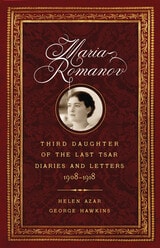
Maria Romanov
Third Daughter of the Last Tsar, Diaries and Letters, 1908–1918Helen Azar
Westholme Publishing, 2019
In the twilight of the nineteenth century, a third daughter was born to Tsar Nicholas II and his wife Alexandra. Grand Duchess Maria Nikolaevna—known to her family and friends simply as “Mashka”—grew into an empathetic, down-to-earth girl, unaffected by her imperial status. Often overshadowed by her two older sisters, Olga and Tatiana, and later, her brother Alexei and younger sister Anastasia, Maria ultimately proved to have a uniquely strong and solid personality.
In Maria Romanov: Third Daughter of the Last Tsar, Diaries and Letters, 1908–1918, by translator and researcher Helen Azar with George Hawkins, Mashka’s voice is heard again through her intimate writings, presented for the first time in English. The Grand Duchess was much more than a pretty princess wearing white dresses in hundreds of faded sepia photographs; Maria’s surviving diaries and letters offer a fascinating insight into the private life of a loving family—from festivals and faith, to Rasputin and the coming Revolution; it is clear why this middle child ultimately became a pillar of strength and hope for them all. Maria’s gentle character belied her incredible courage, which emerged in the darkest hours of her brief life. “The incarnation of modesty elevated by suffering,” as Maria was described during the last weeks of her life, she was able to maintain her kindness and optimism, even in the midst of violence and degradation.
On a stuffy summer night in 1918, only a few weeks after her nineteenth birthday, Maria was murdered along with the rest of her family in a cellar of a house chosen for this “special purpose.” Two sets of charred remains, confirmed to be Maria’s and her brother Alexei’s, were not discovered until almost ninety years later, separately from those of the other victims of the massacre. As the authors relate, it is still unknown if these remains will ever be allowed to be laid to rest.
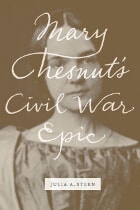
Mary Chesnut's Civil War Epic
Julia A. Stern
University of Chicago Press, 2009
A genteel southern intellectual, saloniste, and wife to a prominent colonel in Jefferson Davis’s inner circle, Mary Chesnut today is remembered best for her penetrating Civil War diary. Composed between 1861 and 1865 and revised thoroughly from the late 1870s until Chesnut’s death in 1886, the diary was published first in 1905, again in 1949, and later, to great acclaim, in 1981. This complicated literary history and the questions that attend it—which edition represents the real Chesnut? To what genre does this text belong?—may explain why the document largely has, until now, been overlooked in literary studies.
Julia A. Stern’s critical analysis returns Chesnut to her rightful place among American writers. In Mary Chesnut’s Civil War Epic, Stern argues that the revised diary offers the most trenchant literary account of race and slavery until the work of Faulkner and that, along with his Yoknapatawpha novels, it constitutes one of the two great Civil War epics of the American canon. By restoring Chesnut’s 1880s revision to its complex, multidecade cultural context, Stern argues both for Chesnut’s reinsertion into the pantheon of nineteenth-century American letters and for her centrality to the literary history of women’s writing as it evolved from sentimental to tragic to realist forms.
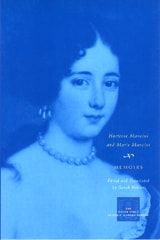
Memoirs
Marie Mancini and Hortense Mancini
University of Chicago Press, 2008
Through their writings, the Mancinis sought to rehabilitate their reputations and reclaim the right to define their public images themselves, rather than leave the stories of their lives to the intrigues of the court—and to their disgruntled ex-husbands. First translated in 1676 and 1678 and credited largely to male redactors, the two memoirs reemerge here in an accessible English translation that chronicles the beginnings of women’s rights to personal independence within the confines of an otherwise circumscribed early modern aristocratic society.
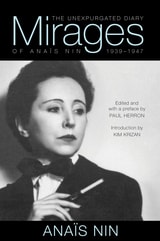
Mirages
The Unexpurgated Diary of Anaïs Nin, 1939–1947Anaïs Nin
Ohio University Press, 2013
Mirages collects, for the first time, the story that was cut from all of Nin’s other published diaries, particularly volumes 3 and 4 of The Diary of Anaïs Nin, which cover the same time period. It is the long-awaited successor to the previous unexpurgated diaries Henry and June, Incest, Fire, and Nearer the Moon. Mirages answers the questions Nin readers have been asking for decades: What led to the demise of Nin’s love affair with Henry Miller? Just how troubled was her marriage to Hugh Guiler? What is the story behind Nin’s “children,” the effeminate young men she seemed to collect at will? Mirages is a deeply personal story of heartbreak, despair, desperation, carnage, and deep mourning, but it is also one of courage, persistence, evolution, and redemption that reaches beyond the personal to the universal.
Mormon Midwife
edited by Donna Toland Smart
Utah State University Press, 1999
Mormon Vanguard Brigade Of 1847
Norton Jacob's Recordedited by Ronald O. Barney
Utah State University Press, 2005
My Life with Things
The Consumer DiariesElizabeth Chin
Duke University Press, 2016