Results by title
347 books match the query 'Early works to 1800' and 15 start with m
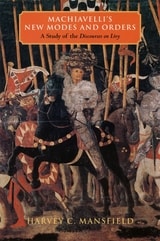
Machiavelli's New Modes and Orders
A Study of the Discourses on LivyHarvey C. Mansfield
University of Chicago Press, 2001
Mansfield's aim is to discern Machiavelli's intention in writing the book: he argues that Machiavelli wanted to introduce new modes and orders in political philosophy in order to make himself the founder of modern politics. Mansfield maintains that Machiavelli deliberately concealed part of his intentions so that only the most perceptive reader could see beneath the surface of the text and understand the whole of his book. Previously out of print, Mansfield's penetrating study brings to light the hidden thoughts lurking in the details of the Discourses on Livy to inform and challenge its readers at every step along the way.
Machiavelli
The Chief Works and Others, Vol. IAllan Gilbert, ed.
Duke University Press, 1989
Allan Gilbert is unquestionably the most accurate and reliable translator of Machiavelli into English; the publication of this edition is an altogether happy occasion. Students of the history of political thought owe a particular debt of gratitude to Allan Gilbert.”—Dante Germino, The Journal of Politics
“A most remarkable achievement.”—Felix Gilbert, Renaissance Quarterly
Machiavelli
The Chief Works and Others, Vol. IIAllan Gilbert, ed.
Duke University Press, 1989
Allan Gilbert is unquestionably the most accurate and reliable translator of Machiavelli into English; the publication of this edition is an altogether happy occasion. Students of the history of political thought owe a particular debt of gratitude to Allan Gilbert.”—Dante Germino, The Journal of Politics
“A most remarkable achievement.”—Felix Gilbert, Renaissance Quarterly
Machiavelli
The Chief Works and Others, Vol. IIIAllan Gilbert, ed.
Duke University Press, 1989
Allan Gilbert is unquestionably the most accurate and reliable translator of Machiavelli into English; the publication of this edition is an altogether happy occasion. Students of the history of political thought owe a particular debt of gratitude to Allan Gilbert.”—Dante Germino, The Journal of Politics
“A most remarkable achievement.”—Felix Gilbert, Renaissance Quarterly

Maimonides' "Guide of the Perplexed"
A Philosophical GuideAlfred L. Ivry
University of Chicago Press, 2016
Drawing on a lifetime of study, Alfred L. Ivry has written the definitive guide to the Guide—one that makes it comprehensible and exciting to even those relatively unacquainted with Maimonides’ thought, while also offering an original and provocative interpretation that will command the interest of scholars. Ivry offers a chapter-by-chapter exposition of the widely accepted Shlomo Pines translation of the text along with a clear paraphrase that clarifies the key terms and concepts. Corresponding analyses take readers more deeply into the text, exploring the philosophical issues it raises, many dealing with metaphysics in both its ontological and epistemic aspects.
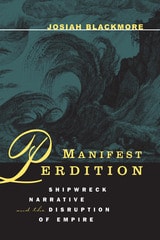
Manifest Perdition
Shipwreck Narrative And The Disruption Of EmpireJosiah Blackmore
University of Minnesota Press, 2002
A new take on a famous collection of shipwreck narratives that places them at the center of resistance to colonialism
Shipwreck, death, and survival; terror, hunger, and salvation—these are the experiences of the passengers onboard merchant Portuguese ships sailing the high seas in the sixteenth and seventeenth centuries. And this is the stuff of the stories committed to print by survivors upon their return to the homeland. These Portuguese shipwreck narratives, rescued for all time in the eighteenth century by Bernardo Gomes de Brito in História Trágico-Marítima (1735-36), or The Tragic History of the Sea, are the subject of Manifest Perdition, a work that reveals their important—and until now, largely ignored—place in literary history.
In this book we see how the dramatic, compelling, and often gory accounts of shipwreck, depicting a world out of control, challenge state-sponsored versions of events in the prevailing historiographic culture. Written during the heyday of Iberian maritime expansion and colonialism, the shipwreck narrative builds an alternative historical record to the vision and reality of empire elaborated by the official chroniclers of the realm. Manifest Perdition presents both theoretical considerations this genre and close readings of several texts, readings that disclose a poetics of the shipwreck text, of how survivors characteristically yet multifariously narrated their world. Included is a study of the medieval Iberian poetic predecessors of the shipwreck tale, as well as an exploration of the Portuguese Inquisition’s attempt to commandeer and steer the reading of the unruly narratives. The book engages issues of literary theory, historiography, and colonialism to portray the Portuguese shipwreck narrative for the first time as both a product of and a resistance to the prolific culture of sixteenth- and seventeenth-century expansionist history.
Maps in Tudor England
P. D. A. Harvey
University of Chicago Press, 1993
In Maps in Tudor England, P. D. A. Harvey traces this revolution of production, understanding, and use of maps in England from 1485 to 1603. By the mid-sixteenth century, mapmapers had begun to draw maps to a consistent scale, reproducing the results of measured survey. By the end of the century, maps drawn to scale and showing features by conventional signs were commonly used throughout England.
In this survey Harvey focuses on maps of small areas, up to the size of a county, exploring their impact on the political and social life of England in the spheres of the military, government, towns, landed estates, buildings, and the law. Richly illustrated with thirty color and fifty black and white reproductions of rare maps, his account is an informative and accessible introduction to this revolutionary period in the history of cartography, as well as a unique visual history of Tudor England.

Marsilio Ficino, Three Books on Life
A Critical Edition and TranslationCarol V. Kaske
Arizona Center for Medieval and Renaissance Studies, 2019
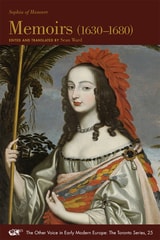
Memoirs (1630-1680)
Sophia of Hanover
Iter Press, 2013
Metaphysical Disputation I
On the Nature of First Philosophy or MetaphysicsFrancisco Suarez
Catholic University of America Press, 2021
Metaphysical Disputation II
On the Essential Concept or Concept of BeingFrancisco Suarez
Catholic University of America Press, 2022
Metaphysical Disputations III and IV
On Being's Passions in General and Its Principles and On Transcendental Unity in GeneralFrancisco Suarez
Catholic University of America Press, 2023

Midwife to the Queen of France
Diverse ObservationsLouise Bourgeois
Iter Press, 2017
Mother Juana de la Cruz, 1481–1534
Visionary SermonsJuana de la Cruz
Iter Press, 2016
Juana de la Cruz (1481–1534) is a unique figure in the history of the Catholic Church, thanks to her public visionary experiences during which she lost consciousness, while a deep voice, identifying itself as Christ, issued from her, narrating the feasts and pageants taking place in heaven. Juana’s so called “sermons,” collected in a manuscript called Libro del Conorte, form a fascinating window into Castilian religiosity in the early sixteenth century. There is much to reap from these sermons concerning Spanish Renaissance culture, theology, mysticism, gender roles, and interreligious interactions.
My Life's Travels and Adventures
An Eighteenth-Century Oculist in the Ottoman Empire and the European HinterlandRegina Salomea Pilsztynowa
Iter Press, 2020
This edition brings the entirety of this personal and idiosyncratic memoir to English for the first time.