154 books match the query 'East' and 8 start with m
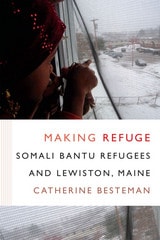
cover of Making Refuge: Somali Bantu Refugees and Lewiston, Maine

Making Refuge

Somali Bantu Refugees and Lewiston, Maine

Catherine Besteman

Duke University Press, 2016
How do people whose entire way of life has been destroyed and who witnessed horrible abuses against loved ones construct a new future? How do people who have survived the ravages of war and displacement rebuild their lives in a new country when their world has totally changed? In Making Refuge Catherine Besteman follows the trajectory of Somali Bantus from their homes in Somalia before the onset in 1991 of Somalia’s civil war, to their displacement to Kenyan refugee camps, to their relocation in cities across the United States, to their settlement in the struggling former mill town of Lewiston, Maine. Tracking their experiences as "secondary migrants" who grapple with the struggles of xenophobia, neoliberalism, and grief, Besteman asks what humanitarianism feels like to those who are its objects and what happens when refugees move in next door. As Lewiston's refugees and locals negotiate coresidence and find that assimilation goes both ways, their story demonstrates the efforts of diverse people to find ways to live together and create community. Besteman’s account illuminates the contemporary debates about economic and moral responsibility, security, and community that immigration provokes.
 
[more]
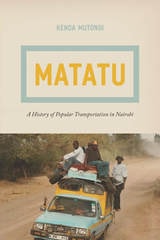
cover of Matatu: A History of Popular Transportation in Nairobi

Matatu

A History of Popular Transportation in Nairobi

Kenda Mutongi

University of Chicago Press, 2017

Drive the streets of Nairobi, and you are sure to see many matatus—colorful minibuses that transport huge numbers of people around the city. Once ramshackle affairs held together with duct tape and wire, matatus today are name-brand vehicles maxed out with aftermarket detailing. They can be stately black or extravagantly colored, sporting names, slogans, or entire tableaus, with airbrushed portraits of everyone from Kanye West to Barack Obama. In this richly interdisciplinary book, Kenda Mutongi explores the history of the matatu from the 1960s to the present.
           
As Mutongi shows, matatus offer a window onto the socioeconomic and political conditions of late-twentieth-century Africa. In their diversity of idiosyncratic designs, they reflect multiple and divergent aspects of Kenyan life—including, for example, rapid urbanization, organized crime, entrepreneurship, social insecurity, the transition to democracy, and popular culture—at once embodying Kenya’s staggering social problems as well as the bright promises of its future. Offering a shining model of interdisciplinary analysis, Mutongi mixes historical, ethnographic, literary, linguistic, and economic approaches to tell the story of the matatu and explore the entrepreneurial aesthetics of the postcolonial world.
 
[more]
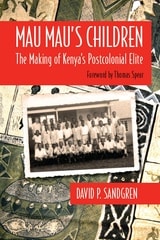
cover of Mau Mau’s Children: The Making of Kenya’s Postcolonial Elite

Mau Mau’s Children

The Making of Kenya’s Postcolonial Elite

David P. Sandgren; Foreword by Thomas Spear

University of Wisconsin Press, 2012

In 1963 David P. Sandgren went to Kenya to teach in a small, rural school for boys, where he remained for the next four years. These were heady times for Kenyans, as the nation gained its independence, approved a new constitution, and held its first elections. In the school where Sandgren taught, the sons of Gikuyu farmers rose to the challenges of this post colonial era and, in time, entered Kenyan society as adults, joining Kenya’s first generation of post colonial elites.
    In Mau Mau’s Children, Sandgren has reconnects with these former students. Drawing on more than one hundred interviews, he provides readers with a collective biography of the lives of Kenya’s first postcolonial elite, stretching from their 1940s childhood to the peak of their careers in the 1990s. Through these interviews, Mau Mau’s Children shows the trauma of growing up during the Mau Mau Rebellion, the nature of nationalism in Kenya, the new generational conflicts arising, and the significance of education and Gikuyu ethnicity on his students' path to success.
[more]
cover of Medicine in the Meantime: The Work of Care in Mozambique

Medicine in the Meantime

The Work of Care in Mozambique

Ramah McKay

Duke University Press, 2018

In Mozambique, where more than half of the national health care budget comes from foreign donors, NGOs and global health research projects have facilitated a dramatic expansion of medical services. At once temporary and unfolding over decades, these projects also enact deeply divergent understandings of what care means and who does it. In Medicine in the Meantime, Ramah McKay follows two medical projects in Mozambique through the day-to-day lives of patients and health care providers, showing how transnational medical resources and infrastructures give rise to diverse possibilities for work and care amid constraint. Paying careful attention to the specific postcolonial and postsocialist context of Mozambique, McKay considers how the presence of NGOs and the governing logics of the global health economy have transformed the relations—between and within bodies, medical technologies, friends, kin, and organizations—that care requires and how such transformations pose new challenges for ethnographic analysis and critique.
[more]
cover of Mobile Households: Indian Ocean Intimate Economies in the Age of Abolition

Mobile Households

Indian Ocean Intimate Economies in the Age of Abolition

Hollian Wint-Frederick

Duke University Press, 2027

In Mobile Households, Hollian Wint-Frederick rewrites the history of the Indian Ocean world by centering those who have been written out of it. Rather than the patriarchal family firms and trade networks standard to most Indian Ocean economic histories, Wint-Frederick foregrounds translocal households as the foundation of Indian Ocean commercial life. She argues that Indian Ocean economies were built through the labor of women, especially enslaved women in Indian and East African households, whose bodies, kinship, and work were fundamental to commercial operations. British imperial expansion and abolitionism did not simply dismantle this world—it reframed it, positioning East African slaves as domestic and Gujarati traders as outside Indian Ocean intimate life. Tracing fragmented and interconnected lives through multilingual archives spanning Zanzibar, Mumbai, and London, Wint-Frederick shows how even the most marginalized inhabitants of the Indian Ocean world remade their lives through daily transactions and household dramas. In so doing, Mobile Households locates the mechanics of racial othering and dispossession at the interface of Indian Ocean and imperial intimate economies.
[more]
cover of Mobile Secrets: Youth, Intimacy, and the Politics of Pretense in Mozambique

Mobile Secrets

Youth, Intimacy, and the Politics of Pretense in Mozambique

Julie Soleil Archambault

University of Chicago Press, 2017

Now part and parcel of everyday life almost everywhere, mobile phones have radically transformed how we acquire and exchange information. Many anticipated that in Africa, where most have gone from no phone to mobile phone, improved access to telecommunication would enhance everything from entrepreneurialism to democratization to service delivery, ushering in socio-economic development.
 
With Mobile Secrets, Julie Soleil Archambault offers a complete rethinking of how we understand uncertainty, truth, and ignorance by revealing how better access to information may in fact be anything but desirable. By engaging with young adults in a Mozambique suburb, Archambault shows how, in their efforts to create fulfilling lives, young men and women rely on mobile communication not only to mitigate everyday uncertainty but also to juggle the demands of intimacy by courting, producing, and sustaining uncertainty. In their hands, the phone has become a necessary tool in a wider arsenal of pretense—a means of creating the open-endedness on which harmonious social relations depend in postwar postsocialist Mozambique. As Mobile Secrets shows, Mozambicans have harnessed the technology not only to acquire information but also to subvert regimes of truth and preserve public secrets, allowing everyone to feign ignorance about the workings of the postwar intimate economy.
[more]
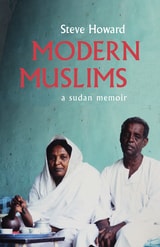
cover of Modern Muslims: A Sudan Memoir

Modern Muslims

A Sudan Memoir

Steve Howard

Ohio University Press, 2016
Steve Howard departed for the Sudan in the early 1980s as an American graduate student beginning a three-year journey in which he would join and live with the Republican Brotherhood, the Sufi Muslim group led by the visionary Mahmoud Mohamed Taha. Taha was a religious intellectual who participated in the early days of Sudan’s anticolonial struggle, but quickly turned his movement into a religious reform effort based on his radical reading of the Qur’an. He was executed in 1985 for apostasy. Decades after returning to the life of an academic in the United States, Howard brings us this memoir of his time with the Republican Brotherhood, who advocated, among other things, equality for women. Modern Muslims describes Howard’s path to learning not only about Islam and Sufism but also about Sudan’s history and culture. When the Brotherhood was thrust into confrontation with Sudan’s then-president Jaafar Nimeiry, Howard had a front-line perspective on the difficult choices communities make as they try to reform and practice their faith freely. As well as a story of personal transformation, the book offers an insider’s perspective on a modernist nonviolent Islamic movement that thrived and was brutally suppressed. An important book for our times, Modern Muslims yields significant insights for our understanding of modern Islam, African history, and contemporary geopolitics.
[more]
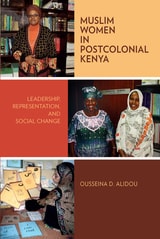
cover of Muslim Women in Postcolonial Kenya: Leadership, Representation, and Social Change

Muslim Women in Postcolonial Kenya

Leadership, Representation, and Social Change

Ousseina D. Alidou

University of Wisconsin Press, 2013

In education, journalism, legislative politics, social justice, health, law, and other arenas, Muslim women across Kenya are emerging as leaders in local, national, and international contexts, advancing reforms through their activism. Muslim Women in Postcolonial Kenya draws on extensive interviews with six such women, revealing how their religious and moral beliefs shape reform movements that bridge ethnic divides and foster alliances in service of creating a just, multicultural, multiethnic, and multireligious democratic citizenship.
            Mwalim Azara Mudira opened a school of theology for Muslim women. Nazlin Omar Rajput of The Nur magazine was a pioneer in reporting on HIV/AIDS in the Muslim community. Amina Abubakar, host of a women's radio show, has publicly addressed the sensitive subject of sexual crimes against Muslim women. Two women who are members of parliament are creating new socioeconomic and political opportunities for girls and women, within a framework that still embraces traditional values of marriage and motherhood.
            Examining the interplay of gender, agency, and autonomy, Ousseina D. Alidou shows how these Muslim women have effected change in the home, the school, the mosque, the media, and more—and she illuminates their determination as actors to challenge the oppressive influences of male-dominated power structures. In looking at differences as opportunities rather than obstacles, these women reflect a new sensibility among Muslim women and an effort to redefine the meaning of women's citizenship within their own community of faith and within the nation.
[more]