Results by title
374 books match the query 'Economic History' and 19 start with m
MIT and the Transformation of American Economics
E. Roy Weintraub
Duke University Press, 0
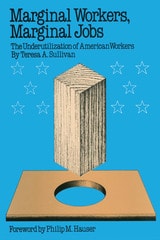
Marginal Workers, Marginal Jobs
The Underutilization of American WorkersBy Teresa A. Sullivan
University of Texas Press, 1978
Unemployment levels have received a great deal of attention and discussion in recent years. However, another labor category—underemployment—has virtually been ignored. Underutilized or underemployed workers are those who are experiencing inadequate hours of work, insufficient levels of income, and mismatch of occupation and skills. Marginal Workers, Marginal Jobs addresses two principal issues: how can we measure underemployment, and how can we explain its prevalence?
To answer the first question, Teresa Sullivan examines yardsticks in use, demonstrates their inadequacy, and develops a different measure that is easy to interpret and is usable by both demographers and economists. In answering the second, she analyzes 1960 and 1970 census data to determine the relative effects of population composition and job structure on levels of employment.
One of the important contributions of Sullivan's study is to distinguish between marginal workers and marginal jobs in explaining underutilization. Previous explanations, including the widely used dual market theory, have not stressed this analytic distinction. In addition, her work accounts separately for the various types of marginality and seeks to show the condition of workers who are marginal on more than one count—for example, those who are both young and black, or old and female.
A provocative study based on large samples of the U.S. population, this book raises important questions about a critical subject and makes a significant contribution to the theory of underutilization.

Marketable Values
Inventing the Property Market in Modern BritainDesmond Fitz-Gibbon
University of Chicago Press, 2018
In Marketable Values, Desmond Fitz-Gibbon seeks to answer that question. He tells the story of how Britons imagined, organized, and debated the buying and selling of land from the mid-eighteenth to the early twentieth century. In a society organized around the prestige of property, the desire to commodify land required making it newly visible through such spectacles as public auctions, novel professions like auctioneering, and real estate journalism. As Fitz-Gibbon shows, these innovations sparked impassioned debates on where, when, and how to demarcate the limits of a market society. As a result of these collective efforts, the real estate business became legible to an increasingly attentive public and a lynchpin of modern economic life.
Drawing on an eclectic range of sources—from personal archives and estate correspondence to building designs, auction handbills, and newspapers—Marketable Values explores the development of the British property market and the seminal role it played in shaping the relationship we have to property around the world today.
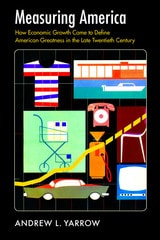
Measuring America
How Economic Growth Came to Define American Greatness in the Late Twentieth CenturyAndrew L. Yarrow
University of Massachusetts Press, 2010
The United States has always fancied itself a nation apart—"exceptional" in its values, traditions, and way of life. For most of the country's history, ideas about what made America distinctive generally were framed in terms of a liberal idealism rooted in the thought of John Locke and articulated by Jefferson, Madison, and other Founders. While some commentators also observed that the United States was a land of plenty, it wasn't until the mid-twentieth century that material abundance emerged as the principal standard of American “greatness,” as measured by a host of new economic indicators.
Beginning in earnest in the wake of World War II, opinion-shapers in politics, business, academia, the media, the schools, and public diplomacy gloried in the nation's booming economy. Where “plenty” had once been a largely abstract concept, it was now quantifiable, thanks to new national income accounting and other economic data collection and analysis techniques. One could tally up production and consumption of an ever-expanding cornucopia of goods and services that made up the gross national product (GNP), the king of postwar statistics. American preeminence and American identity were increasingly linked with this measurable prosperity, presented in the language of a newly influential economics profession.
In Measuring America, Andrew L. Yarrow explores this history, telling two parallel, interlocking stories—of how economic ideas came to have vastly greater influence on American culture after World War II, and how those ideas dovetailed with a growing belief that the meaning and value of the United States resided in its material output. How and why this new way of “measuring America” developed, how it was expressed, and what it has meant and means for Americans today are the subject of this well-researched and insightful book.
Measuring Entrepreneurial Businesses
Current Knowledge and ChallengesEdited by John Haltiwanger, Erik Hurst, Javier Miranda, and Antoinette Schoar
University of Chicago Press, 2017
Measuring Entrepreneurial Businesses brings together economists and data analysts to discuss the most recent research covering three broad themes. The first chapters isolate high- and low-performing entrepreneurial ventures and analyze their roles in creating jobs and driving innovation and productivity. The next chapters turn the focus on specific challenges entrepreneurs face and how they have varied over time, including over business cycles. The final chapters explore core measurement issues, with a focus on new data projects under development that may improve our understanding of this dynamic part of the economy.
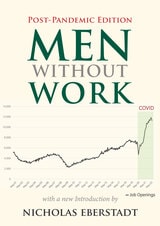
Men without Work
Post-Pandemic Edition (2022)Eberstadt, Nicholas
Templeton Press, 2022
The grim truth: over six million prime-age men were neither working nor looking for work. Conventional unemployment measures ignored these labor force dropouts, but their ranks had been rising relentlessly for half a century. Eberstadt’s unflinching analysis was, in the words of The New York Times, “an unsettling portrait not just of male unemployment, but also of lives deeply alienated from civil society.”
The famed American work ethic was once near universal: men of sound mind and body took pride in contributing to their communities and families. No longer, warned Eberstadt. And now—six years and one catastrophic pandemic later—the problem has not only worsened: it has seemingly been spreading among prime-age women and workers over fifty-five.
In a brand new introduction, Eberstadt explains how the government’s response to Covid-19 inadvertently exacerbated the flight from work in America. From indiscriminate pandemic shutdowns to almost unconditional “unemployment” benefits, Americans were essentially paid not to work.
Thus today, despite the vaccine rollouts, inexplicable numbers of working age men and women are sitting on the sidelines while over 11 million jobs go unfilled. Current low rates of unemployment, touted by pundits and politicians, are grievously misleading. The truth is that fewer prime-age American men are looking for readily available work than at any previous juncture in our history. And others may be catching the “Men Without Work” virus too.
Given the devastating economic impact of the Covid calamity and the unforeseen aftershocks yet to come, this reissue of Eberstadt’s groundbreaking work is timelier than ever.
Metropolitan Resilience in a Time of Economic Turmoil
Edited by Michael A. Pagano
University of Illinois Press, 2013
Cities, counties, school districts and other local governments have suffered a long-lasting period of fiscal challenges since the beginning of the Great Recession. Metropolitan governments continue to adjust to the "new normal" of sharply lower property values, consumer sales, and personal income. Contributors to this volume include elected officials, academics, key people in city administrations, and other nationally recognized experts who discuss solutions to the urban problems created by the Great Recession.
Metropolitan Resilience in a Time of Economic Turmoil looks at the capacity of local governments to mobilize resources efficiently and effectively, as well as the overall effects of the long-term economic downturn on quality of life. Introducing the reader to the fiscal effects of the Great Recession on cities, the book examines the initial fraying and subsequent mending of the social safety net, the opportunities for pursuing economic development strategies, the challenges of inter-jurisdictional cooperation, and the legacy costs of pension liabilities and infrastructure decay.
Contributors are Phil Ashton, Raphael Bostic, Richard Feiock, Rachel A. Gordon, Rebecca Hendrick, Geoffrey J.D. Hewings, David Merriman, Richard Nathan, Michael A. Pagano, Breeze Richardson, Annette Steinacker, Nik Theodore, Rachel Weber, and Margaret Weir.

Mexico's Merchant Elite, 1590-1660
Silver, State, and SocietyLouisa Schell Hoberman
Duke University Press, 1991
Through extensive archival research, Hoberman brings to light new data that illuminate the formation, behavior, and power of the merchant class in New Spain. She documents sources and uses of merchant wealth, tracing the relative importance of mining, agriculture, trade, and public office. By delving into biographical information on prominent families, Hoberman also reveals much about the longevity of the first generation’s social and economic achievements.
The author’s broad analysis situates her study in the overall environment in which the merchants thrived. Among the topics discussed are the mining and operation of the mint, Mexico’s political position vis-a-vis Spain, and the question of an economic depression in the seventeenth century.
Mexico, Interrupted
Labor, Idleness, and the Economic Imaginary of IndependenceSergio Gutiérrez Negrón
Vanderbilt University Press, 2023
Mexican independence was, in a sense, an economic event. Through economic concerns, elites created a common ground with non-elites in their demands against foreign domination, and independence was imagined by the lettered men of Mexico as a feat that would nationalize a rich and productive economic apparatus.
Mexico, Interrupted investigates these economic hopes during the difficult decades between 1821, the year of the country’s definite separation from Spain, and 1852, a period of political polarization after the US-Mexico War that led the country to the brink of another armed conflict. Drawing on political and popular media, this book studies the Mexican intelligentsia’s obsession with labor and idleness in their attempts to create a wealthy, independent nation.
Focusing on figures of work and its opposites, Mexico, Interrupted reconstructs these decades’ “economic imaginaries of independence”: the political and cultural discourses that structured understandings, beliefs, and fantasies of the relationship between “the economy” and the life of an independent polity. By bringing together intellectual history, critical theory, and cultural studies, Gutiérrez Negrón offers a new account of the Mexican nineteenth century and complicates the history of the “spirit of capitalism” in the Americas.
Milton Friedman and Economic Debate in the United States, 1932–1972, Volume 1
Edward Nelson
University of Chicago Press, 2020
This two-volume account provides a foundational introduction to Friedman’s role in several major economic debates that took place in the United States between 1932 and 1972. The first volume, which takes the story through 1960, covers the period in which Friedman began and developed his research on monetary policy. It traces Friedman’s thinking from his professional beginnings in the 1930s as a combative young microeconomist, to his wartime years on the staff of the US Treasury, and his emergence in the postwar period as a leading proponent of monetary policy. The second volume covers the years between 1960 and 1972— years that saw the publication of Friedman and Anna Schwartz’s Monetary History of the United States. The book also covers Friedman’s involvement in a number of debates in the 1960s and 1970s, on topics such as unemployment, inflation, consumer protection, and the environment.
As a fellow monetary economist, Nelson writes from a unique vantage point, drawing on both his own expertise in monetary analysis and his deep familiarity with Friedman’s writings. Using extensive documentation, the book weaves together Friedman’s research contributions and his engagement in public debate, providing an unparalleled analysis of Friedman’s views on the economic developments of his day.
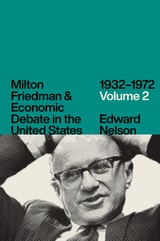
Milton Friedman and Economic Debate in the United States, 1932–1972, Volume 2
Edward Nelson
University of Chicago Press, 2020
This two-volume account provides a foundational introduction to Friedman’s role in several major economic debates that took place in the United States between 1932 and 1972. The first volume, which takes the story through 1960, covers the period in which Friedman began and developed his research on monetary policy. It traces Friedman’s thinking from his professional beginnings in the 1930s as a combative young microeconomist, to his wartime years on the staff of the US Treasury, and his emergence in the postwar period as a leading proponent of monetary policy. The second volume covers the years between 1960 and 1972— years that saw the publication of Friedman and Anna Schwartz’s Monetary History of the United States. The book also covers Friedman’s involvement in a number of debates in the 1960s and 1970s, on topics such as unemployment, inflation, consumer protection, and the environment.
As a fellow monetary economist, Nelson writes from a unique vantage point, drawing on both his own expertise in monetary analysis and his deep familiarity with Friedman’s writings. Using extensive documentation, the book weaves together Friedman’s research contributions and his engagement in public debate, providing an unparalleled analysis of Friedman’s views on the economic developments of his day.

Milton Friedman and Economic Debate in the United States, 1973–1976, Vol. 3
Edward Nelson
University of Chicago Press, 2027
The third installment in the definitive account of the famed economist's role in economic debate—and his lasting influence on economic policy.
Milton Friedman is widely recognized as one of the most significant contributors to economics in the modern age. Yet no previous study has distilled Friedman’s vast body of writings into an authoritative account of his research, his policy views, and his interventions in public debate. Through his sweeping series on the most influential economist of the second half of the twentieth century, Edward Nelson closes this gap: Milton Friedman and EconomicDebate in the United States is the defining narrative on the famed public intellectual—the first to grapple comprehensively with Friedman’s research output, economic framework, and legacy.
Volume 3 chronicles Friedman’s activities from 1973 to 1976, encompassing his final years at the University of Chicago and a period that saw his further ascension in national prominence. In the mid-1970s, economic news dominated American political discourse as the nation endured double-digit inflation and recession. It was during this time that Friedman’s views became a center of economic debate in both the research world and public debate, while his explanation for “stagflation” formed part of the critique of stabilization policy that would lead to his 1976 Nobel Prize. Nelson details the controversies that Friedman faced in the media—including his contrarian stances on inflation’s cure, the economic implications of oil price shocks, and the social responsibility of business—and how Friedman concluded that the world needed a “new Adam Smith” to press the case for free markets. Drawing upon a large body of documentary sources, interviews with dozens of the people closest to Friedman, and his own expertise in Friedman’s research area of monetary analysis, Nelson provides the definitive account of the formative (and uneven) events in Friedman’s foray into life as a public intellectual and how his research permanently shifted economic thinking.
Milton Friedman and Economic Debate in the United States, 1977–1979, Vol. 4
Edward Nelson
University of Chicago Press, 0
The fourth installment of the sweeping account of the most influential economist in modern times, focusing on his crossover into the public sphere.
Milton Friedman is widely recognized as one of the most significant contributors to economics in the modern age. Yet no previous study has distilled Friedman’s vast body of writings into an authoritative account of his research, his policy views, and his interventions in public debate. Through his sweeping series on the most influential economist of the second half of the twentieth century, Edward Nelson closes this gap: Milton Friedman and EconomicDebate in the United States is the defining narrative on the famed public intellectual—the first to grapple comprehensively with Friedman’s research output, economic framework, and legacy.
Volume 4 of Nelson’s intellectual and policy biography offers an exacting portrait of Friedman’s career following his departure from the University of Chicago. Spanning 1977 to 1979, Nelson’s narrative details Friedman’s move to California and his greater immersion in public policy, including his project with Rose Friedman and television professionals to create a TV series giving his viewpoint. Nelson details the successes and failures of Friedman’s years of extraordinary influence, including:
- His warnings about US inflation returning to double digits in 1979;
- The changes in professional thinking in the US economics profession and policymaking toward acceptance of Friedman's view that inflation is a monetary phenomenon;
- The rise of Paul Volcker to head of the Federal Reserve and his integration of monetarist ideas into US monetary policy;
- Friedman's proposal to phase in a zero-tariff arrangement in the United States;
- His role in the tax revolt of the 1970s—including his break with the emerging supply-side economics movement on the effects of tax cuts;
- The second oil-price shock and Friedman's critique of the Carter Administration's energy policy;
- The resilience after 1976 of Ronald Reagan's presidential ambitions and Friedman's 1979 endorsement of Reagan for president in the 1980 election.
Drawing upon a large body of documentary sources, interviews with dozens of the people closest to Friedman, and his own expertise in Friedman’s research area of monetary analysis, Nelson offers the definitive account of what proved to be pivotal years for Friedman and the field of economics.
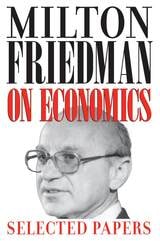
Milton Friedman on Economics
Selected PapersMilton Friedman
University of Chicago Press, 2007
Milton Friedman on Economics: Selected Papers collects a variety of Friedman’s papers on topics in economics that were originally published in the Journal of Political Economy. Opening with Friedman’s 1977 Nobel Lecture, the volume spans nearly the whole of his career, incorporating papers from as early as 1948 and as late as 1990. An excellent introduction to Friedman’s economic thought, Milton Friedman will be essential for anyone tracing the course of twentieth-century economics and politics.
Milton Friedman
Economics in Theory and PracticeAbraham Hirsch and Neil de Marchi
University of Michigan Press, 1991
Mind and Labor on the Farm in Black-Earth Russia, 1861-1914
David Kerans
Central European University Press, 2001
Monetary Interpretations of the Great Depression
Frank G. Steindl
University of Michigan Press, 1996
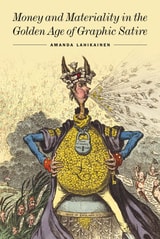
Money and Materiality in the Golden Age of Graphic Satire
Amanda Lahikainen
University of Delaware Press, 2022
This book examines the entwined and simultaneous rise of graphic satire and cultures of paper money in late eighteenth- and early nineteenth-century Britain. Asking how Britons learned to value both graphic art and money, the book makes surprising connections between two types of engraved images that grew in popularity and influence during this time. Graphic satire grew in visual risk-taking, while paper money became a more standard carrier of financial value, courting controversy as a medium, moral problem, and factor in inflation. Through analysis of satirical prints, as well as case studies of monetary satires beyond London, this book demonstrates several key ways that cultures attach value to printed paper, accepting it as social reality and institutional fact. Thus, satirical banknotes were objects that broke down the distinction between paper money and graphic satire altogether.
Money, History, and International Finance
Essays in Honor of Anna J. SchwartzEdited by Michael D. Bordo
University of Chicago Press, 1989