Results by title
78 books match the query 'Editors, Journalists, Publishers' and 4 start with m

Media Marathon
A Twentieth-Century MemoirErik Barnouw
Duke University Press, 1996
Born in Holland in 1908 and an immigrant to the United States at the age of eleven, Barnouw spent his early working years in an astounding array of occupations—actor and stage manager, lyricist, translator, director, producer, teacher, and union official. This varied background, described here in rich detail, informs his writings about the world in which he moved, specifically regarding the shifting channels of twentieth-century mass communication. Telling his story through a series of personal profiles of the famous, the infamous, and the little known but powerfully influential, Barnouw recounts the events that took him from the vaudeville stage to the Library of Congress, where he became the first chief of its newly formed Motion Picture, Broadcasting, and Recording Sound Division. Thornton Wilder, Pearl S. Buck, Joshua Logan, Dwight Eisenhower, Lynn Fontanne, Tallulah Bankhead, and Akira Iwasaki—these are among the featured characters in the drama of American media, rendered here in striking close-ups.
From The Hague to retirement in Vermont, with stops in India, Japan, and Russia, Barnouw’s remarkable story gives readers the chance to relive crucial chapters of modern media history—and to relive them with one of that history’s masters as an incomparable guide. A book for those interested in the “mass media,” its evolution, and role in society, Media Marathon will appeal to students, scholars, and general readers alike.
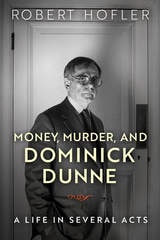
Money, Murder, and Dominick Dunne
A Life in Several ActsRobert Hofler
University of Wisconsin Press, 2019
Dunne admitted to inventing himself, and it was that public persona he wrote about in his own memoir, The Way We Lived Then. Left out of that account, but brought to light here, were his intense rivalry with his brother John Gregory, the gay affairs and relationships he had throughout his marriage and beyond, and his fights with editors at Vanity Fair. Robert Hofler also reveals the painful rift in the family after the murder of Dominick's daughter, Dominique—compounded by his coverage of her killer's trial, which launched his career as a reporter.

Moritz Gottlieb Saphir
Nineteenth-Century Pioneer of Journalism and Food WritingAndrás Koerner
Central European University Press, 2027
His literary and journalistic innovations included publishing the first modern newspapers in Berlin, Munich and Vienna, developing a new style of humorous writing, introducing the journalistic genre of the feuilleton to Austria, authoring the first extended prose poem in the German language and writing the first study of vernacular Ashkenazi Jewish cuisine, as well as the first review of a Jewish cookbook and restaurant. Although due to censorship he had to largely eschew political subjects, he courageously fought for press freedom and against anti-Jewish prejudice. Although perhaps not a great writer, he was an important and intriguing figure of European cultural history who certainly doesn’t deserve the neglect his work has suffered since the early 20th century.
András Koerner’s book is the first modern monograph of him, which in addition to a detailed presentation of his eventful, interesting life and an examination of his personality, identity and work also includes the first-ever extensive annotated anthology of him in English.
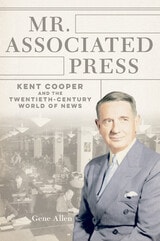
Mr. Associated Press
Kent Cooper and the Twentieth-Century World of NewsGene Allen
University of Illinois Press, 2023
- Finalist for the AEJMC Tankard Book Award
Allen critically assesses the many new approaches and causes that Cooper championed: introducing celebrity news and colorful features to a service previously known for stodgy reliability, pushing through disruptive technological innovations like the instantaneous transmission of news photos, and leading a crusade to bring American-style press freedom--inseparable from private ownership, in Cooper’s view--to every country. His insistence on truthfulness and impartiality presents a sharp contrast to much of today’s fractured journalistic landscape.
Deeply researched and engagingly written, Mr. Associated Press traces Cooper’s career as he built a new foundation for the modern AP and shaped the twentieth-century world of news.