Results by title
2728 books match the query 'Education' and 106 start with m
MOOCs and Their Afterlives
Experiments in Scale and Access in Higher EducationEdited by Elizabeth Losh
University of Chicago Press, 2017
Elizabeth Losh has gathered experts from across disciplines—education, rhetoric, philosophy, literary studies, history, computer science, and journalism—to tease out lessons and chart a course into the future of open, online education. Instructors talk about what worked and what didn’t. Students share their experiences as participants. And scholars consider the ethics of this education. The collection goes beyond MOOCs to cover variants such as hybrid or blended courses, SPOCs (Small Personalized Online Courses), and DOCCs (Distributed Open Collaborative Course). Together, these essays provide a unique, even-handed look at the MOOC movement and will serve as a thoughtful guide to those shaping the next steps for open education.
MOOCs
What Every ESL Teacher Needs to KnowPamela S.H. Bogart
University of Michigan Press, 2019

Macbeth
A Visual CompanionWendy Beth Hyman
Arizona Center for Medieval and Renaissance Studies, 2026
A collaboration between experienced Shakespeare scholar-educator Wendy Beth Hyman and her former student, emerging queer illustrator and animator Clair Wang, that seeks to visualize the literary language of Macbeth.
Macbeth: A Visual Companion offers a unique resource to readers, teachers, and performers of Shakespeare: an illustrated guide to those literary features of Shakespeare’s texts that can’t be represented on stage. How do you unravel a complex metaphor, an antiquated pun, an embedded allegory? What if allusions and images and similes could appear before the reader’s eyes? What if we could learn to read as Renaissance readers did: with fewer footnotes, but greater capacity to “see” literary language like chiasmus or equivocation? This is the aim of this creative collaboration.
Designed to be read alongside the free online editions provided by the Folger Shakespeare Library, Macbeth: A Visual Companion illuminates the most obscure features of a very complex play, empowering readers to unpack Shakespeare without reliance on watered-down modernizations or even staged productions. Hyman and Wang present a two-part strategy. One, illustrations that, rather than counterfeiting the action of drama, provide a visual representation of the inner worlds of language. And two, scholarly commentary that, rather than inertly explain or obtusely theorize difficulty, shows how literary devices themselves generate meaning. They thus model for readers how to access metaphors, allusions, and images in real time—just like Shakespeare’s original audience did. In the process, they aim to empower students and non-specialist teachers not only to understand Macbeth or Shakespeare more generally, but also to showcase a model for more confidently grappling with challenging literary texts of all kinds.
Machine Scoring of Student Essays
Truth and Consequencesedited by Patricia Freitag Ericsson & Rich Haswell
Utah State University Press, 2006
The current trend toward machine-scoring of student work, Ericsson and Haswell argue, has created an emerging issue with implications for higher education across the disciplines, but with particular importance for those in English departments and in administration. The academic community has been silent on the issue—some would say excluded from it—while the commercial entities who develop essay-scoring software have been very active.
Machine Scoring of Student Essays is the first volume to seriously consider the educational mechanisms and consequences of this trend, and it offers important discussions from some of the leading scholars in writing assessment.
Reading and evaluating student writing is a time-consuming process, yet it is a vital part of both student placement and coursework at post-secondary institutions. In recent years, commercial computer-evaluation programs have been developed to score student essays in both of these contexts. Two-year colleges have been especially drawn to these programs, but four-year institutions are moving to them as well, because of the cost-savings they promise. Unfortunately, to a large extent, the programs have been written, and institutions are installing them, without attention to their instructional validity or adequacy.
Since the education software companies are moving so rapidly into what they perceive as a promising new market, a wider discussion of machine-scoring is vital if scholars hope to influence development and/or implementation of the programs being created. What is needed, then, is a critical resource to help teachers and administrators evaluate programs they might be considering, and to more fully envision the instructional consequences of adopting them. And this is the resource that Ericsson and Haswell are providing here.
Macroanalysis
Digital Methods and Literary HistoryMatthew L. Jockers
University of Illinois Press, 2013
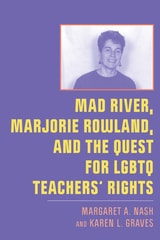
Mad River, Marjorie Rowland, and the Quest for LGBTQ Teachers’ Rights
Margaret A. Nash
Rutgers University Press, 2022
In the first in-depth treatment of this foundational legal case, authors Margaret A. Nash and Karen L. Graves tell the story of that case and of Marjorie Rowland, the pioneer who fought for employment rights for LGBTQ educators and who paid a heavy price for that fight. It brings the story of LGBTQ educators’ rights to the present, including commentary on Bostock v Clayton County, the 2020 Supreme Court case that struck down employment discrimination against LGBT workers.

Madison in the Sixties
Stuart D. Levitan
Wisconsin Historical Society Press, 2018
Landmark civil rights laws were passed. Pivotal campus protests were waged. A spring block party turned into a three-night riot. Factor in urban renewal troubles, a bitter battle over efforts to build Frank Lloyd Wright’s Monona Terrace, and the expanding influence of the University of Wisconsin, and the decade assumes legendary status.
In this first-ever comprehensive narrative of these issues—plus accounts of everything from politics to public schools, construction to crime, and more—Madison historian Stuart D. Levitan chronicles the birth of modern Madison with style and well-researched substance. This heavily illustrated book also features annotated photographs that document the dramatic changes occurring downtown, on campus, and to the Greenbush neighborhood throughout the decade. Madison in the Sixties is an absorbing account of ten years that changed the city forever.
Major Trade-Offs
The Surprising Truths about College Majors and Entry-Level JobsCorey Moss-Pech
University of Chicago Press, 2025
Humanities majors are used to answering the question, “So, what are you going to do with that degree?” The common misconception is that students in humanities programs don’t learn any useful skills for the real world. In Major Trade-Offs, sociologist Corey Moss-Pech argues that not only do humanities majors learn real-world skills, but they actually use them when they graduate. Despite this discrepancy, graduates with so-called practical degrees like business and engineering are much more likely to find employment, and they earn higher salaries. Why do we belittle a liberal arts education despite the valuable skills that students acquire during their studies?
Major Trade-Offs addresses this question by following students from different majors as they enter the workforce. To understand the relationship between majors and entry-level jobs, Moss-Pech conducted nearly 200 interviews with roughly ninety students from four majors at a large Midwestern university: engineering, business, English, and communications. He follows these students through their senior years, chronicling their internships and the support their universities provide in helping them pursue their career paths. He found that graduates from practical majors entered the labor market successfully, typically through structured internship programs. However, many ended up in entry-level jobs that, while well-paid, were largely clerical and didn’t necessarily require a degree to perform. On the other hand, liberal arts majors rarely accessed structured internships and were largely left to carve out their own paths, but did use their degree skills once they secured a job. These results challenge popular myths about the “marketability” of these different majors and offer a new vision for the future of higher education. Liberal arts skills are essential in the labor market, and yet educators and policymakers still push resources into the practical arts, perpetuating the myth that those majors are more valuable while depriving students of a well-rounded education and leaving them no better prepared for the workforce than liberal arts students.
Of interest to students, educators, and employers, Major Trade-Offs calls on colleges and universities to advocate for liberal arts majors, leveling the playing field for students as they plan for entry-level work.

Major Trade-Offs
The Surprising Truths about College Majors and Entry-Level JobsCorey Moss-Pech
University of Chicago Press, 2025
This is an auto-narrated audiobook version of this book.
An eye-opening look at the relationship between students’ majors and their entry-level jobs.
Humanities majors are used to answering the question, “So, what are you going to do with that degree?” The common misconception is that students in humanities programs don’t learn any useful skills for the real world. In Major Trade-Offs, sociologist Corey Moss-Pech argues that not only do humanities majors learn real-world skills, but they actually use them when they graduate. Despite this discrepancy, graduates with so-called practical degrees like business and engineering are much more likely to find employment, and they earn higher salaries. Why do we belittle a liberal arts education despite the valuable skills that students acquire during their studies?
Major Trade-Offs addresses this question by following students from different majors as they enter the workforce. To understand the relationship between majors and entry-level jobs, Moss-Pech conducted nearly 200 interviews with roughly ninety students from four majors at a large Midwestern university: engineering, business, English, and communications. He follows these students through their senior years, chronicling their internships and the support their universities provide in helping them pursue their career paths. He found that graduates from practical majors entered the labor market successfully, typically through structured internship programs. However, many ended up in entry-level jobs that, while well-paid, were largely clerical and didn’t necessarily require a degree to perform. On the other hand, liberal arts majors rarely accessed structured internships and were largely left to carve out their own paths, but did use their degree skills once they secured a job. These results challenge popular myths about the “marketability” of these different majors and offer a new vision for the future of higher education. Liberal arts skills are essential in the labor market, and yet educators and policymakers still push resources into the practical arts, perpetuating the myth that those majors are more valuable while depriving students of a well-rounded education and leaving them no better prepared for the workforce than liberal arts students.
Of interest to students, educators, and employers, Major Trade-Offs calls on colleges and universities to advocate for liberal arts majors, leveling the playing field for students as they plan for entry-level work.
Making Academic Presentations
What Every University Student Needs to KnowRobyn Brinks Lockwood
University of Michigan Press, 2023
The book includes a variety of tasks that will help students practice developing and analyzing presentations as well as practice projects for applying these lessons. In addition, rubrics and evaluation forms are included for instructors to adapt and use for evaluation purposes.
Making Administrative Work Visible
Data-Driven Advocacy for Understanding the Labor of Writing Program AdministrationLeigh Graziano
Utah State University Press, 2023
The collection has three parts, each of which focuses on the most confounding challenges facing WPAs as well as the most compelling sites of their contributions to administration, labor in higher education, and the discipline’s collective obligation to forwarding the goals of social justice and advocacy: Advocating through Representations of WPA Labor, Advocating by Accounting for Time and Labor, and Advocating in and through Complex Institutional Contexts. The chapters use data to share and track the work functions, job titles, grand narratives, program assessments, tenure and promotion, email practices, and more undertaken by WPAs in their administrative capacities. Chapters also surface narratives for future data and studies to be done by other scholars.
By taking up and answering questions about the range of WPA work—and the invisibility of much of that work—Making Administrative Work Visible creates avenues toward accounting for and acknowledging the complex activity systems in which WPAs lead the work of the university and advocate for data-driven strategies needed to sustain this foundational area of higher education.
Contributors: Kamila Albert, Brooke Anderson, Sheila Carter-Tod, Amy Cicchino, Ana Cortés Lagos, Kristi Murray Costello, Jennifer Cunningham, Ryan Dippre, Kimberly Emmons, Genevieve García de Müeller, Jill Gladstein, Caleb González, Michael Healy, Lyra Hilliard, Kristine Johnson, Seth Kahn, Rita Malenczyk, Troy Mikanovich, Lilian Mina, Angela Mitchell, Greer Murphy, Kate Navickas, Michael Neal, Patti Poblete, Jan Rieman, Heather Robinson, Katelyn Stark, Mary Stewart, Natalie Stillman-Webb, Lizbett Tinoco, Lisa Tremain, Martha Wilson Schaffer
Making Failure Pay
For-Profit Tutoring, High-Stakes Testing, and Public SchoolsJill P. Koyama
University of Chicago Press, 2010
A little-discussed aspect of the No Child Left Behind Act (NCLB) is a mandate that requires failing schools to hire after-school tutoring companies—the largest of which are private, for-profit corporations—and to pay them with federal funds. Making Failure Pay takes a hard look at the implications of this new blurring of the boundaries between government, schools, and commerce in New York City, the country’s largest school district.
As Jill P. Koyama explains in this revelatory book, NCLB—a federally legislated, state-regulated, district-administered, and school-applied policy—explicitly legitimizes giving private organizations significant roles in public education. Based on her three years of ethnographic fieldwork, Koyama finds that the results are political, problematic, and highly profitable. Bringing to light these unproven, unregulated private companies’ almost invisible partnership with the government, Making Failure Pay lays bare the unintended consequences of federal efforts to eliminate school failure—not the least of which is more failure.
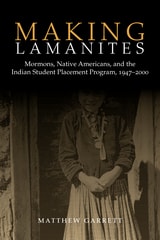
Making Lamanites
Mormons, Native Americans, and the Indian Student Placement Program, 1947-2000Matthew Garrett
University of Utah Press, 2016
Winner of the Juanita Brooks Prize in Mormon Studies
From 1947 to 2000, some 50,000 Native American children left the reservations to live with Mormon foster families. While some dropped out of the Indian Student Placement Program (ISPP), for others the months spent living with LDS families often proved more penetrating than expected.
The ISPP emerged in the mid-twentieth century, championed by Apostle Spencer W. Kimball, aligned with the then national preferences to terminate tribal entities and assimilate indigenous people. But as the paradigm shifted to self-determination, critics labeled the program as crudely assimilationist. Some ISPP students like Navajo George P. Lee fiercely defended the LDS Church before native peers and Congress, contending that it empowered Native people and instilled the true Indian identity; meanwhile Red Power activists organized protests in Salt Lake City, denouncing LDS colonization. As a new generation of church leaders quietly undercut the Indian programs, many of its former participants felt a sense of confusion and abandonment as Mormon distinctions for Native people faded in the late twentieth century.
Making Lamanites traces this student experience within contested cultural and institutional landscapes to reveal how and why many of these Native youth adopted a new notion of Indianness.
Winner of the Francis Armstrong Madsen Best Book Award from the Utah Division of State History.
Making Mark Twain Work in the Classroom
James S. Leonard, ed.
Duke University Press, 1999
The essays in Making Mark Twain Work in the Classroom reaffirm the importance of Twain in the American literature curriculum from high school through graduate study. Addressing slavery and race, gender, class, religion, language and ebonics, Americanism, and textual issues of interest to instructors and their students, the contributors offer guidance derived from their own demographically diverse classroom experiences. Although some essays focus on such works as A Connecticut Yankee in King Arthur’s Court and The Innocents Abroad, most discuss the hotly debated Adventures of Huckleberry Finn, viewed alternately in this volume as a comic masterpiece or as evidence of Twain’s growing pessimism—but always as an effective teaching tool.
By placing Twain’s work within the context of nineteenth-century American literature and culture, Making Mark Twain Work in the Classroom will interest all instructors of American literature. It will also provoke debate among Americanists and those concerned with issues of race, class, and gender as they are represented in literature.
Contributors. Joseph A. Alvarez, Lawrence I. Berkove, Anthony J. Berret, S.J., Wesley Britton, Louis J. Budd, James E. Caron, Everett Carter, Jocelyn Chadwick-Joshua, Pascal Covici Jr., Beverly R. David, Victor Doyno, Dennis W. Eddings, Shelley Fisher Fishkin, S. D. Kapoor, Michael J. Kiskis, James S. Leonard, Victoria Thorpe Miller, Stan Poole, Tom Reigstad, David E. E. Sloane, David Tomlinson
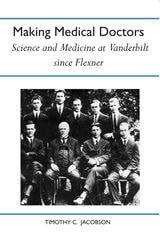
Making Medical Doctors
Science and Medicine at Vanderbilt since FlexnerTimothy C. Jacobson
University of Alabama Press, 1987
Making Medical Doctors is not a conventional institutional history, but rather a study of the union of science and medicine in a particularly illustrative institutional setting. Its general subject is the institution where science and medicine most dramatically came together: the modern medical school and medical center. Its particular subject is the medical school and center of Vanderbilt University, which was rebuilt in the 1920s as a model for medical education and research. Making Medical Doctors also explores the intellectual and financial sources of institutional development: the worlds of Abraham Flexner, Frederick T. Gates, and Henry S. Pritchett, three foundation masters of the early 20th century. It examines closely the vanished medical world of that generation of doctors who reached the height of their influence in the period between the two world wars and describes how they actually did medicine, surgery, and science.
The convergence of science and medicine in the 19th and 20th centuries produced what we know today as modern medicine. The balance of power and interdependence between science and medicine have changed vastly from the 1920s and 1930s, as Vanderbilt’s story clearly illustrates.
Making Politics Work
Practical Lessons on Politics for Would-Be Education ReformersPaul T. Hill and Ashley E. Jochim
University of Chicago Press, 2025
The education reform project has always been about making America’s schools more effective for the children who attend them. In Making Politics Work, authors Paul T. Hill and Ashley E. Jochim show that this project cannot succeed without mastering what is the single largest constraint on its success: politics.
Drawing upon more than a decade of work with dozens of school systems, Hill and Jochim show how failures to secure political support or mitigate inevitable opposition dooms the education reform project from the start. But this outcome is not inevitable. By tracing the evolution of the “portfolio strategy” across 27 localities that implemented it, they uncover practical lessons that superintendents, state leaders, and foundation officials can use to increase the likelihood that their ideas for improving public education don’t join the list of once-promising initiatives that could not be sustained in the face of intractable political conflict.
Making Politics Work
Practical Lessons on Politics for Would-Be Education ReformersPaul T. Hill and Ashley E. Jochim
University of Chicago Press, 2025
An expansive study shows how politics can work for, not just against, efforts to improve America’s schools.
The education reform project has always been about making America’s schools more effective for the children who attend them. In Making Politics Work, authors Paul T. Hill and Ashley E. Jochim show that this project cannot succeed without mastering what is the single largest constraint on its success: politics.
Drawing upon more than a decade of work with dozens of school systems, Hill and Jochim show how failures to secure political support or mitigate inevitable opposition dooms the education reform project from the start. But this outcome is not inevitable. By tracing the evolution of the “portfolio strategy” across 27 localities that implemented it, they uncover practical lessons that superintendents, state leaders, and foundation officials can use to increase the likelihood that their ideas for improving public education don’t join the list of once-promising initiatives that could not be sustained in the face of intractable political conflict.
Making Reform Work
The Case for Transforming American Higher EducationZemsky, Robert
Rutgers University Press, 2009
Robert Zemsky, one of a select group of scholars who participated in Secretary of Education Margaret Spellings' 2005 Commission on the Future of Higher Education, signed off on the commission's report with reluctance. In Making Reform Work he presents the ideas he believes should have come from that group to forge a practical agenda for change. Zemsky argues that improving higher education will require enlisting faculty leadership, on the one hand, and, on the other, a strategy for changing the higher education system writ large.
Directing his attention from what can't be done to what can be done, Zemsky provides numerous suggestions. These include a renewed effort to help students' performance in high schools and a stronger focus on the science of active learning, not just teaching methods. He concludes by suggesting a series of dislodging events, for example, making a three-year baccalaureate the standard undergraduate degree, congressional rethinking of student aid in the wake of the loan scandal, and a change in the rules governing endowments that could break the gridlock that today holds higher education reform captive.
Making Reform Work offers three rules for successful college and university transformation: don't vilify, don't play games, and come to the table with a well-thought-out strategy rather than a sharply worded lamentation.
Making Sense of the College Curriculum
Faculty Stories of Change, Conflict, and AccommodationZemsky, Robert
Rutgers University Press, 2018
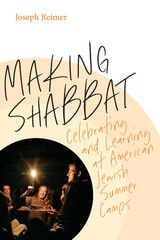
Making Shabbat
Celebrating and Learning at American Jewish Summer CampsJoseph Reimer
Brandeis University Press, 2022
This book tells the story of how Jewish camps have emerged as creators of positive spiritual experiences for Jewish youth in North America. When Jewish camps began at the dawn of the twentieth century, their leaders had little interest in creating Jewish spiritual experiences for their campers. Yet over the course of the past century, Jewish camps have gradually moved into providing primal Jewish experiences that diverse campers can enjoy, parents appreciate, and alumni fondly recall. Making Shabbat Real explores how Shabbat at camp became the focal point for these primal Jewish experiences, providing an interesting perspective on changing approaches to Jewish education and identity in North America.
Making Up Our Mind
What School Choice Is Really AboutSigal R. Ben-Porath and Michael C. Johanek
University of Chicago Press, 2019
Those are not only the wrong questions—they’re the wrong premises, argue philosopher Sigal R. Ben-Porath and historian Michael C. Johanek in Making Up Our Mind. Market-driven school choices aren’t new. They predate the republic, and for generations parents have chosen to educate their children through an evolving mix of publicly supported, private, charitable, and entrepreneurial enterprises. The question is not whether to have school choice. It is how we will regulate who has which choices in our mixed market for schooling—and what we, as a nation, hope to accomplish with that mix of choices. Looking beyond the simplistic divide between those who oppose government intervention and those who support public education, the authors make the case for a structured landscape of choice in schooling, one that protects the interests of children and of society, while also identifying key shared values on which a broadly acceptable policy could rest.
Making Workers
Radical Geographies of EducationKatharyne Mitchell
Pluto Press, 2017
Making a Mass Institution
Indianapolis and the American High SchoolKyle P. Steele
Rutgers University Press, 2020
Making the Grade
The Economic Evolution of American School DistrictsWilliam A. Fischel
University of Chicago Press, 2009
A significant factor for many people deciding where to live is the quality of the local school district, with superior schools creating a price premium for housing. The result is a “race to the top,” as all school districts attempt to improve their performance in order to attract homebuyers. Given the importance of school districts to the daily lives of children and families, it is surprising that their evolution has not received much attention.
In this provocative book, William Fischel argues that the historical development of school districts reflects Americans’ desire to make their communities attractive to outsiders. The result has been a standardized, interchangeable system of education not overly demanding for either students or teachers, one that involved parents and local voters in its governance and finance. Innovative in its focus on bottom-up processes generated by individual behaviors rather than top-down decisions by bureaucrats, Making the Grade provides a new perspective on education reform that emphasizes how public schools form the basis for the localized social capital in American towns and cities.
Making the Radical University
Identity and Politics on the American College Campus, 1966–1991Elizabeth M. Kalbfleisch
University of Massachusetts Press, 2024
In the 1960s, professors, students, and activists on the political Left viewed college curricula as useful sites for political transformation. They coordinated efforts to alter general education requirements at the college level to foster change in American thought, with greater openness toward people who had previously been excluded, including women, people of color, the poor and working classes, people with disabilities, and members of the LGBTQ community. Their work reshaped American culture and politics, while prompting a significant backlash from conservatives attempting to, in their view, protect classical education from modern encroachment.
Elizabeth M. Kalbfleisch details how American universities became a battleground for identity politics from the 1960s through the 1980s. Focusing on two case studies at Stanford University and the University of Texas at Austin, Making the Radical University examines how curricular changes led to polarizing discussions nationwide around academic standards and identity politics, including the so-called canon wars. Today, these debates have only become more politically charged, complex, and barbed.
Making the Transition to Classroom Success
Culturally Responsive Teaching for Struggling Language LearnersHelaine W. Marshall and Andrea DeCapua
University of Michigan Press, 2013
Features a chapter on flipped classrooms!
Learners with no, minimal, or limited exposure to formal education generally do not share the expectations and assumptions of their new setting; as a result, they are likely to find themselves confounded by the ways in which the language and content are presented, practiced, and assessed in Western-style educational settings. Institutions and teachers must tailor therefore their instruction to this population. Making the Transition to Classroom Success: Culturally Responsive Teaching for Struggling Language Learners examines how understanding secondary and adult L2 learners’ educational paradigm, rooted deeply in their past experiences and cultural orientations, provides a key to the solution to a lack of progress.
Making the Transition to Classroom Success builds on and expands on two earlier books, Meeting the Needs of Students with Limited or Interrupted Formal Schooling and Breaking New Ground: Teaching Students with Limited or Interrupted Formal Education in U.S. Secondary Schools. These previous books focused specifically on a subset of struggling L2 learners--those with limited or interrupted formal education (SLIFE) in U.S. secondary schools—and detailed the instructional model (MALP). Making the Transition broadens the applications of the MALP model to include academic thinking tasks, flipped classrooms, project design, and rubrics.
Making the Unequal Metropolis
School Desegregation and Its LimitsAnsley T. Erickson
University of Chicago Press, 2016
Taking Nashville as her focus, Erickson uncovers the hidden policy choices that have until now been missing from popular and legal narratives of inequality. In her account, inequality emerges not only from individual racism and white communities’ resistance to desegregation, but as the result of long-standing linkages between schooling, property markets, labor markets, and the pursuit of economic growth. By making visible the full scope of the forces invested in and reinforcing inequality, Erickson reveals the complex history of, and broad culpability for, ongoing struggles in our schools.
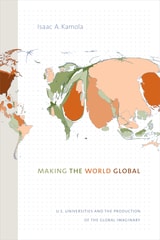
Making the World Global
U.S. Universities and the Production of the Global ImaginaryIsaac A. Kamola
Duke University Press, 2019
Making, Keeping, and Losing Friends
How Campuses Shape College Students' NetworksJanice M. McCabe
University of Chicago Press, 2025
We’re all familiar with the sentiment that “college is the best time of your life.” Along with a newfound sense of freedom, students have a unique opportunity to forge lifelong friendships at a point in life when friendship is particularly important. Why is it, then, that so many college students are falling victim to what the US Surgeon General termed an “epidemic of loneliness and isolation”? How do different aspects of college life help or hinder students’ ability to form deep connections?
In Making, Keeping, and Losing Friends: How Campuses Shape College Students’ Networks, sociologist Janice M. McCabe shows that the way a college is structured—whether students live in dorms or commute, study abroad or stay close to campus, have plentiful common areas for clubs to meet or not—can either encourage or hinder the making of meaningful friendships. Based on interviews with 95 students on three distinct campuses—a small private college (Dartmouth College), a large public university (University of New Hampshire), and a non-residential community college (Manchester Community College)—McCabe captures a wide range of experiences and discovers how features of the campuses make it easier or harder for students to make and keep friends. She shows how and why, across all three institutions, some students thrive in deep and lasting friendships with their peers.
As McCabe’s research reveals, we need to look at the structures of students’ networks, the institutions they attend, and the importance of their identities in these places if we are to truly uncover and address the loneliness epidemic facing today’s young adults.
Mama, PhD
Women Write about Motherhood and Academic LifeEvans, Elrena
Rutgers University Press, 2008
Amid these disadvantages, what is a Mama, PhD to do? This literary anthology brings together a selection of deeply felt personal narratives by smart, interesting women who explore the continued inequality of the sexes in higher education and suggest changes that could make universities more family-friendly workplaces.
The contributors hail from a wide array of disciplines and bring with them a variety of perspectives, including those of single and adoptive parents. They address topics that range from the level of policy to practical day-to-day concerns, including caring for a child with special needs, breastfeeding on campus, negotiating viable maternity and family leave policies, job-sharing and telecommuting options, and fitting into desk/chair combinations while eight months pregnant.
Candid, provocative, and sometimes with a wry sense of humor, the thirty-five essays in this anthology speak to and offer support for any woman attempting to combine work and family, as well as anyone who is interested in improving the university's ability to live up to its reputation to be among the most progressive of American institutions.
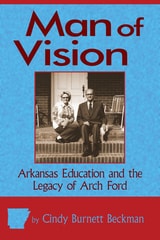
Man of Vision
Arkansas Education and the Legacy of Arch FordCindy Burnett Beckman
Butler Center for Arkansas Studies, 2016
As commissioner of the Arkansas Department of Education from 1953 to 1978, Arch Ford served under five governors. His vision was to expand educational opportunities because he believed education was the foundation for improving people’s lives. Throughout his career, he campaigned for increased educational funding, better-qualified teachers, and higher teachers’ salaries. Ford helped lead the state in peacefully integrating its schools and established twenty-three vocational-technical schools across the state. During Ford’s tenure, the Arkansas Children’s Colony was established to provide educational services to the developmentally disabled, and the Arkansas Educational Television Network was set up to provide instructional programming across the state.
The state also expanded educational opportunities to include kindergarten, special education, community colleges, and adult education. His leadership left Arkansas with a strong educational system that continued to advance. This was his legacy.
Manifesto for the Humanities
Transforming Doctoral Education in Good Enough TimesSidonie Smith
University of Michigan Press, 2015
Grounding this manifesto in background factors contributing to current “crises” in the humanities, Smith advocates for a 21st century doctoral education responsive to the changing ecology of humanistic scholarship and teaching. She elaborates a more expansive conceptualization of coursework and dissertation, a more robust, engaged public humanities, and a more diverse, collaborative, and networked sociality.
Manual Communication
Implications for EducationHarry Bornstein
Gallaudet University Press, 1990
Manual Communication: Implications for Education offers the first authoritative examination of sign systems used in the education of deaf students. Professionals, teachers, and parents will appreciate the individual, expert explanations of:
American Sign Language
Pidgin Sign (Contact Sign)
Signed English
Signing Exact English
Cued Speech.
The descriptions by the acknowledged designer, administrator, or scholar of each system ensures the highest accuracy and thoroughness, distinguishing Manual Communication as a significant, important resource.
The first chapter recounts the history of sign language, particularly American Sign Language (ASL), including foreign influences and conflicts about its use. An overview follows, describing factors that affect manual communication, such as learner characteristics. Also, an analysis of a nationwide survey of teachers shows the results of their use of the various forms of manual communication in different settings.
Manufacturing Morals
The Values of Silence in Business School EducationMichel Anteby
University of Chicago Press, 2013
In an era when many organizations are focused on principles of responsibility, Harvard Business School has long tried to promote better business standards. Anteby’s rich account reveals the surprising role of silence and ambiguity in HBS’s process of codifying morals and business values. As Anteby describes, at HBS specifics are often left unspoken; for example, teaching notes given to faculty provide much guidance on how to teach but are largely silent on what to teach. Manufacturing Morals demonstrates how faculty and students are exposed to a system that operates on open-ended directives that require significant decision-making on the part of those involved, with little overt guidance from the hierarchy. Anteby suggests that this model—which tolerates moral complexity—is perhaps one of the few that can adapt and endure over time.
Manufacturing Morals is a perceptive must-read for anyone looking for insight into the moral decision-making of today’s business leaders and those influenced by and working for them.
Mapping Racial Literacies
College Students Write about Race and SegregationSophie R. Bell
Utah State University Press, 2020
This textual ethnography embeds early college students’ writing in deep historical and theoretical contexts and looks for new ways that their writing contributes to and reshapes contemporary understandings of how US and global citizens are thinking about race. The book is a teaching narrative, tracing a teaching journey that considers student writing not only in the moments it is assigned but also in continual revisions of the course, making it a useful tool in helping college-age students see, explore, and articulate the role of race in determining their life experiences and opportunities.
Sophie Bell’s work narrates the experiences of a white teacher making mistakes in teaching about race and moving forward through those mistakes, considering that process valuable and, in fact, necessary. Providing a model for future scholars on how to carve out a pedagogically responsive identity as a teacher, Mapping Racial Literacies contributes to the scholarship on race and writing pedagogy and encourages teachers of early college classes to bring these issues front and center on the page, in the classroom, and on campus.
Mapping the Way from Teacher Preparation to edTPA® Completion
A Guide for Secondary Education CandidatesJason C. Fitzgerald
Rutgers University Press, 2021
This book is here to help teacher candidates not only survive the challenge of the edTPA®, but also thrive. It maps out precisely what steps aspiring secondary education teachers should take to ensure successful completion of the edTPA®. Demystifying the language used in the assessment, it uniquely connects edTPA® requirements with what teacher candidates learn within their teacher preparation programs, showing them how the assessment relates to what they are already doing in their classrooms. The strategies in this book draw on both academic research and practical experience to guide student teachers as they plan for their edTPA® portfolios and for their teaching careers beyond.
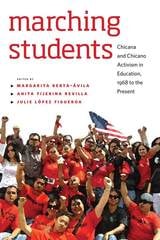
Marching Students
Chicana and Chicano Activism in Education, 1968 to the PresentMargarita Berta-Avila
University of Nevada Press, 2011
Contributors: Alejandro Covarrubias, Xico González, Eracleo Guevara, Adriana Katzew, Lilia R. De Katzew, Rita Kohli, Edward M. Olivos, Alejo Padilla, Carmen E. Quintana, Evelyn M. Rangel-Medina, Marianna Rivera, Daniel G. Solórzano, Carlos Tejeda

Margins in the Classroom
Teaching LiteratureKostas Myrsiades and Linda S. Myrsiades, Editors
University of Minnesota Press, 1994
Margins in the Classroom was first published in 1994. Minnesota Archive Editions uses digital technology to make long-unavailable books once again accessible, and are published unaltered from the original University of Minnesota Press editions.
For today's teacher of literature, facing a minefield of politics and theory, this book arrives as a much needed guide through the multiplying cultural anxieties of the college classroom. Margins in the Classroom brings together established scholars and emerging voices from diverse backgrounds to show how politics and theory can and do affect the most pressing problems confronting the contemporary teacher of literature. The essays in this volume go beyond questioning and examining existing practices to suggest fresh approaches to teaching the expanding literary canon within the context of the politics of the educational institution.
Grounded in literary criticism, psychoanalysis, feminist theory, political economy, sociology, and philosophy, these essays apply new theoretical models to the traditional canon, identify new bodies of literature, and show how theory can be used to analyze these new literatures. Focusing on the politics of teaching and theory in the classroom, the authors explore the present practice and future implications of changing textual analysis, literary theory, and pedagogy. Their essays address the politics of literature as it affects the classroom, the design of courses, and the creation of new courses. They mold theory to the variety of classroom populations and materials the teacher of literature encounters today. The resulting volume bridges the differences between the languages of the classroom instructor and the contemporary theorist. Margins in the Classroom is unique in both the breadth and the depth of its concern over the disturbing, if electric, impact of changes in criticism, theory, and pedagogy in college literature classes as we approach the next century of academic instruction.Kostas Myrsiades is professor of comparative literature, and Linda S. Myrsiades is professor of English, both at West Chester University. Kostas Myrsiades is editor of College Literature, where Linda S. Myrsiades is an associate editor.
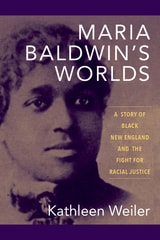
Maria Baldwin's Worlds
A Story of Black New England and the Fight for Racial JusticeKathleen Weiler
University of Massachusetts Press, 2019
Maria Baldwin (1856–1922) held a special place in the racially divided society of her time, as a highly respected educator at a largely white New England school and an activist who carried on the radical spirit of the Boston area's internationally renowned abolitionists from a generation earlier.
African American sociologist Adelaide Cromwell called Baldwin “the lone symbol of Negro progress in education in the greater Boston area” during her lifetime. Baldwin used her respectable position to fight alongside more radical activists like William Monroe Trotter for full citizenship for fellow members of the black community. And, in her professional and personal life, she negotiated and challenged dominant white ideas about black womanhood. In Maria Baldwin's Worlds, Kathleen Weiler reveals both Baldwin's victories and what fellow activist W. E. B. Du Bois called her “quiet courage” in everyday life, in the context of the wider black freedom struggle in New England.
Marketing Schools, Marketing Cities
Who Wins and Who Loses When Schools Become Urban AmenitiesMaia Bloomfield Cucchiara
University of Chicago Press, 2013
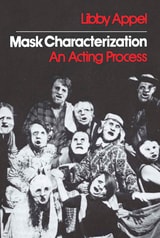
Mask Characterization
An Acting ProcessLibby Appel
Southern Illinois University Press, 1982
Behind the mask, Appel notes, the student is free to create a personality; paradoxically, because the mask hides the self, it enables the student to probe more deeply into himself.
“This book describes, defines, and discusses the mask characterization process, providing the theory behind the exercises and the step-by-step procedure in the organic development of the character from the masks,” Appel notes. The manual is divided into two parts: “The Instructor’s Guide” and “The Actor’s Guide.” There is also an introductory chapter, “The Class Structure,” which explains mask characterization procedures in the classroom, and a sample class schedule may be found in the back of the manual.
This book adds a new dimension to actor training and learning. It is essential to aspiring actors seeking new ways to create honest dramatic characterizations.

Masters of Theory
Cambridge and the Rise of Mathematical PhysicsAndrew Warwick
University of Chicago Press, 2003
When Isaac Newton published the Principia three centuries ago, only a few scholars were capable of understanding his conceptually demanding work. Yet this esoteric knowledge quickly became accessible in the nineteenth and early twentieth centuries when Britain produced many leading mathematical physicists. In this book, Andrew Warwick shows how the education of these "masters of theory" led them to transform our understanding of everything from the flight of a boomerang to the structure of the universe.
Warwick focuses on Cambridge University, where many of the best physicists trained. He begins by tracing the dramatic changes in undergraduate education there since the eighteenth century, especially the gradual emergence of the private tutor as the most important teacher of mathematics. Next he explores the material culture of mathematics instruction, showing how the humble pen and paper so crucial to this study transformed everything from classroom teaching to final examinations. Balancing their intense intellectual work with strenuous physical exercise, the students themselves—known as the "Wranglers"—helped foster the competitive spirit that drove them in the classroom and informed the Victorian ideal of a manly student. Finally, by investigating several historical "cases," such as the reception of Albert Einstein's special and general theories of relativity, Warwick shows how the production, transmission, and reception of new knowledge was profoundly shaped by the skills taught to Cambridge undergraduates.
Drawing on a wealth of new archival evidence and illustrations, Masters of Theory examines the origins of a cultural tradition within which the complex world of theoretical physics was made commonplace.
Matters of Significance
Replication, Translation and Academic Freedom in developmental scienceMarinus H. van IJzendoorn and Marian J. Bakermans-Kranenburg
University College London, 2024
Application of scientific findings to effective practice and informed policymaking is an aspiration for much research in the biomedical, behavioral, and developmental sciences. But too often translations of science to practice are conceptually narrow and developed quickly as salves to an urgent problem. For developmental science, widely implemented parenting interventions are prime examples of technical translations from knowledge about the causes of children’s mental distress. Aiming to support family relationships and facilitate adaptive child development, these programs are rushed through when the scientific findings on which they are based remain contested and without enough evidence of success from randomized controlled trials.
In Matters of Significance, the authors draw on forty years of experience with theoretical, empirical, meta-analytic, and translational work in child development research to highlight the complex relations between replication, translation, and academic freedom. They argue that challenging fake facts promulgated by under-replicated and underpowered studies is also a method of translation. Such a challenge can, in the highlighted field of attachment and emotion regulation research, bust popular myths about the decisive role of genes, hormones, or the brain on parenting and child development, with a balancing impact on practice and policy making. The authors argue that academic freedom from interference by pressure groups, stakeholders, funders, or university administrators in the core stages of research is a necessary but besieged condition for adversarial research and myth-busting.
Maximum Security
The Culture of Violence in Inner-City SchoolsJohn Devine
University of Chicago Press, 1996
Based on years of frontline experience in New York's inner-city schools, Maximum Security demonstrates that such policing strategies are not only ineffectual, they divorce students and teachers from their ethical and behavioral responsibilities. Exploring the culture of violence from within, John Devine argues that the security system, with its uniformed officers and invasive high-tech surveillance, has assumed presumptive authority over students' bodies and behavior, negating the traditional roles of teachers as guardians and agents of moral instruction. The teacher is reduced to an information bureaucrat, a purveyor of technical knowledge, while the student's physical well-being and ethical actions are left to the suspect scrutiny of electronic devices and security specialists with no pedagogical mission, training, or interest. The result is not a security system at all, but an insidious institutional disengagement from the caring supervision of the student body.
With uncompromising honesty, Devine provides a powerful portrayal of an educational system in crisis and bold new insight into the malignant culture of school violence.
Mayors and Schools
Minority Voices and Democratic Tensions in Urban EducationStefanie Chambers
Temple University Press, 2006
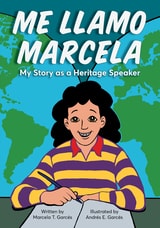
Me llamo Marcela
My Story as a Heritage SpeakerWritten by Marcela T. Garcés and illustrated by Andrés E. Garcés
The Ohio State University Press, 2024
Meaningful Grading
A Guide for Faculty in the ArtsHoag Holmgren
West Virginia University Press, 2018
College and university faculty in the arts (visual, studio, language, music, design, and others) regularly grade and assess undergraduate student work but often with little guidance or support. As a result, many arts faculty, especially new faculty, adjunct faculty, and graduate student instructors, feel bewildered and must “reinvent the wheel” when grappling with the challenges and responsibilities of grading and assessing student work.
Meaningful Grading: A Guide for Faculty in the Arts enables faculty to create and implement effective assessment methodologies—research based and field tested—in traditional and online classrooms. In doing so, the book reveals how the daunting challenges of grading in the arts can be turned into opportunities for deeper student learning, increased student engagement, and an enlivened pedagogy.
Meanings of Mobility
Family, Education, and Immigration in the Lives of Latino YouthLeah Schmalzbauer
Russell Sage Foundation, 2023
To better understand these experiences, Schmalzbauer draws on interviews with 60 low-income Latino youth who graduated or were set to graduate from Amherst College, one of the most selective private colleges in the United States. The vast majority of these students were the first in their immigrant families to go to college in the U.S. She finds that while most of the students believed attending Amherst provided them with previously unimaginable opportunities, adjusting to life on campus came with significant challenges. Many of the students Schmalzbauer spoke with had difficulties adapting to the cultural norms at Amherst as well as with relating to their non-Latino, non-low-income peers. The challenges these students faced were not limited to life on campus. As they attempted to adapt to Amherst, many felt distanced from the family and friends they left behind who could not understand the new challenges they faced.
The students credit their elite education for access to extraordinary educational and employment opportunities. However, their experiences while in college and afterward reveal that the relationship between educational and social mobility is much more complicated and less secure than popular conversations about the “American Dream” suggest. Many students found that their educational attainment was not enough to erase the core challenges of growing up in a marginalized immigrant family: many were still poor, faced racism, and those who were undocumented or had undocumented family members still feared deportation.
Schmalzbeauer suggests ways elite colleges can better support low-income Latino students and lower the emotional price of educational mobility, including the creation of immigration offices on campus to provide programming and support for undocumented students and their families. She recommends educating staff to better understand the centrality of family for these students and the challenges they face, as well as educating more privileged students about inequality and the life experiences of their marginalized peers.
Meanings of Mobility provides compelling insights into the difficulties faced by low-income Latinos pursuing educational and social mobility in America’s elite institutions.
Media Work
Language Teaching Through Media LiteracyCarla R. Chamberlin
University of Michigan Press, 2025
Media Work offers a practical, hands-on approach to illustrate how language, imagery, and media platforms convey meaning. With almost 100 illustrations for use in teaching and many valuable sample lessons, the book brings to life the processes of observing, interrogating, interpreting, reflecting, and responding to a wide variety of media. Drawing upon critical perspectives from applied linguistics, communication, and media studies (e.g., semiotics, critical discourse analysis, media ecology), it develops a conceptual model that can be adapted for a range of ages and contexts. Chamberlin’s approach enables students to investigate the origins, purposes, and implications of messages that surround them in their everyday lives. With sample topics that range from pets and food to identity and discrimination, teachers can give students opportunities to learn more about their own communities and reflect on their reactions to media messages. By addressing the disinformation and propaganda that are prevalent in today’s media, teachers can also help students confront messages about social issues in order to gain knowledge, confidence, and agency.
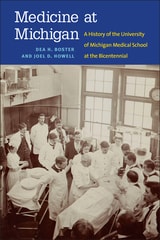
Medicine at Michigan
A History of the University of Michigan Medical School at the BicentennialDea H. Boster and Joel D. Howell
University of Michigan Press, 2017