Results by title
240 books match the query 'English as a Second Language' and 8 start with m
MOOCs
What Every ESL Teacher Needs to KnowPamela S.H. Bogart
University of Michigan Press, 2019

Make a Wish
Judy Soloway Kay
University of Michigan Press, 2005
Genre: Romance
Length: about 15,000 words
Level: 4th grade
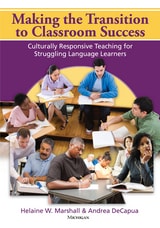
Making the Transition to Classroom Success
Culturally Responsive Teaching for Struggling Language LearnersHelaine W. Marshall and Andrea DeCapua
University of Michigan Press, 2013
Features a chapter on flipped classrooms!
Learners with no, minimal, or limited exposure to formal education generally do not share the expectations and assumptions of their new setting; as a result, they are likely to find themselves confounded by the ways in which the language and content are presented, practiced, and assessed in Western-style educational settings. Institutions and teachers must tailor therefore their instruction to this population. Making the Transition to Classroom Success: Culturally Responsive Teaching for Struggling Language Learners examines how understanding secondary and adult L2 learners’ educational paradigm, rooted deeply in their past experiences and cultural orientations, provides a key to the solution to a lack of progress.
Making the Transition to Classroom Success builds on and expands on two earlier books, Meeting the Needs of Students with Limited or Interrupted Formal Schooling and Breaking New Ground: Teaching Students with Limited or Interrupted Formal Education in U.S. Secondary Schools. These previous books focused specifically on a subset of struggling L2 learners--those with limited or interrupted formal education (SLIFE) in U.S. secondary schools—and detailed the instructional model (MALP). Making the Transition broadens the applications of the MALP model to include academic thinking tasks, flipped classrooms, project design, and rubrics.
Mastering Academic Reading
Lawrence J. Zwier with contributions by Matthew S. Weltig
University of Michigan Press, 2010
Mastering Academic Reading is meant to challenge advanced academically oriented students of English. The units and the readings within them are long. The comprehension and expansion exercises after them are demanding. The hoped-for outcome is that students trained using this textbook will be able to better hold their own in university classes where the reading volume across disciplines and vocabulary demands are high.
Almost every reading is taken, in minimally adapted form, from a book or academic / professional journal. Two introductory passages have been composed expressly for this book in order to provide narrowly focused background material. Beyond these pieces, readers are in the hands of “real-world” authors and their difficult, lexically diffuse, and allusion-filled creations. Journal articles and book excerpts predominate, but Mastering Academic Reading also offers a book review and a government pamphlet as well.
Since one aspect of reading practice builds on others, the units are laid out in tiers, not in sections. Each unit has been organized into three tiers. In general, there is one reading per tier, although the first tier in Unit 3 contains two passages (both necessary to provide conceptual background for the other two tiers). Each reading is 3,500-5,000 words. The book focuses on the three primary goals of academic reading: reading to learn; reading to integrate, write, and critique texts; and reading for basic comprehension.
Media Work
Language Teaching Through Media LiteracyCarla R. Chamberlin
University of Michigan Press, 2025
Media Work offers a practical, hands-on approach to illustrate how language, imagery, and media platforms convey meaning. With almost 100 illustrations for use in teaching and many valuable sample lessons, the book brings to life the processes of observing, interrogating, interpreting, reflecting, and responding to a wide variety of media. Drawing upon critical perspectives from applied linguistics, communication, and media studies (e.g., semiotics, critical discourse analysis, media ecology), it develops a conceptual model that can be adapted for a range of ages and contexts. Chamberlin’s approach enables students to investigate the origins, purposes, and implications of messages that surround them in their everyday lives. With sample topics that range from pets and food to identity and discrimination, teachers can give students opportunities to learn more about their own communities and reflect on their reactions to media messages. By addressing the disinformation and propaganda that are prevalent in today’s media, teachers can also help students confront messages about social issues in order to gain knowledge, confidence, and agency.
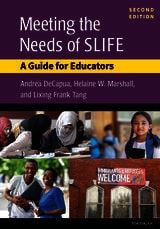
Meeting the Needs of SLIFE, Second Ed.
A Guide for EducatorsAndrea DeCapua, Helaine W. Marshall, and Lixing Frank Tang
University of Michigan Press, 2020
Like its predecessor, this book is grounded in research and is designed to be an accessible and practical resource for teachers, staff, and administrators who work with students with limited or interrupted formal education. Chapters 3-5 focus on classroom instruction, but others address issues of concern to administrators and staff too. For example, Chapter 6 explores different program models for SLIFE instruction, but the planning and commitment to creating a successful program require the involvement of many across the school community, not just teachers.
This edition features case studies, model programs, and teaching techniques and tips; also included is a new chapter focused on the Mutually Adaptive Learning Paradigm (MALP (R)). A major theme of this new edition is moving school personnel away from a deficit perspective, when it comes to teaching SLIFE, and toward one of difference. The goal is to help all stakeholders in the school community create and foster inclusion of, and equity for, a population that is all too often marginalized, ignored, and underserved.

Missing!
Judy Soloway Kay
University of Michigan Press, 2005
The MICHIGAN Reading Plus Readers are original fiction written for students who wish to improve their reading skills. The MICHIGAN Reading Plus Readers support the need for extensive reading on topics of interest to today's students. The Readers offer students books in the genres of mystery, science-fiction, and romance. Activities that practice vocabulary and reading skills are provided on the companion website.

Murder in Montauk
Judy Soloway Kay
University of Michigan Press, 2005
The MICHIGAN Reading Plus Readers are original fiction written for students who wish to improve their reading skills. The MICHIGAN Reading Plus Readers support the need for extensive reading on topics of interest to today's students. The Readers offer students books in the genres of mystery, science-fiction, and romance. Activities that practice vocabulary and reading skills are provided on the companion website.