Results by title
114 books match the query 'Enslaved persons' and 4 start with m
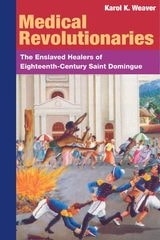
MEDICAL REVOLUTIONARIES
The Enslaved Healers of Eighteenth-Century Saint DomingueKarol K. Weaver
University of Illinois Press, 2006
[more]
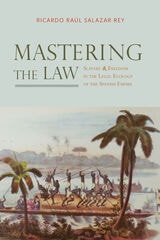
Mastering the Law
Slavery and Freedom in the Legal Ecology of the Spanish EmpireRicardo Raúl Salazar Rey
University of Alabama Press, 2020
Explores the legal relationships of enslaved people and their descendants during the sixteenth and seventeenth centuries in Spanish America
Atlantic slavery can be overwhelming in its immensity and brutality, as it involved more than 15 million souls forcibly displaced by European imperialism and consumed in building the global economy. Mastering the Law: Slavery and Freedom in the Legal Ecology of the Spanish Empire lays out the deep history of Iberian slavery, explores its role in the Spanish Indies, and shows how Africans and their descendants used and shaped the legal system as they established their place in Iberoamerican society during the seventeenth century.
Ricardo Raúl Salazar Rey places the institution of slavery and the people involved with it at the center of the creation story of Latin America. Iberoamerican customs and laws and the institutions that enforced them provided a common language and a forum to resolve disputes for Spanish subjects, including enslaved and freedpeople. The rules through which Iberian conquerors, settlers, and administrators incorporated Africans into the expanding Empire were developed out of the need of a distant crown to find an enforceable consensus. Africans and their mestizo descendants, in turn, used and therefore molded Spanish institutions to serve their interests.Salazar Rey mined extensively the archives of secular and religious courts, which are full of complex disputes, unexpected subversions, and tactical alliances among enslaved people, freedpeople, and the crown.
The narrative unfolds around vignettes that show Afroiberians building their lives while facing exploitation and inequality enforced through violence. Salazar Rey deals mostly with cases originating from Cartagena de Indias, a major Atlantic port city that supported the conquest and rule of the Indies. His work recovers the voices and indomitable ingenuity that enslaved people and their descendants displayed when engaging with the Spanish legal ecology. The social relationships animating the case studies represent the broader African experience in the Americas during the sixteenth and seventeenth centuries.
[more]
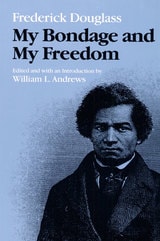
My Bondage and My Freedom
Frederick Douglass
University of Illinois Press, 1988
This is the first annotated edition of a work Eric J. Sundquist has called "a classic text of the American Renaissance." As Henry Louis Gates, Jr., has pointed out, My Bondage and My Freedom has been largely ignored by critics, in part because it is longer and less accessible than Narrative of the Life of Frederick Douglass but also because it has not up to now been "read" by a sensitive critic. "The latter reason is paramount and urgently needed to be addressed, and William Andrews is just the person to introduce Douglass's second autobiography to our generation of readers. He has few peers in nineteenth-century black criticism."
[more]
My Father's Name
A Black Virginia Family after the Civil WarLawrence P. Jackson
University of Chicago Press, 2012
Armed with only early boyhood memories, Lawrence P. Jackson begins his quest by setting out from his home in Baltimore for Pittsylvania County, Virginia, to try to find his late grandfather’s old home by the railroad tracks in Blairs. My Father’s Name tells the tale of the ensuing journey, at once a detective story and a moving historical memoir, uncovering the mixture of anguish and fulfillment that accompanies a venture into the ancestral past, specifically one tied to the history of slavery.
After asking around in Pittsylvania County and carefully putting the pieces together, Jackson finds himself in the house of distant relations. In the pages that follow, he becomes increasingly absorbed by the search for his ancestors and increasingly aware of how few generations an African American needs to map back in order to arrive at slavery, “a door of no return.” Ultimately, Jackson’s dogged research in libraries, census records, and courthouse registries enables him to trace his family to his grandfather’s grandfather, a man who was born or sold into slavery but who, when Federal troops abandoned the South in 1877, was able to buy forty acres of land. In this intimate study of a black Virginia family and neighborhood, Jackson vividly reconstructs moments in the lives of his father’s grandfather, Edward Jackson, and great-grandfather, Granville Hundley, and gives life to revealing narratives of Pittsylvania County, recalling both the horror of slavery and the later struggles of postbellum freedom.
My Father’s Name is a family story full of twists and turns—and one of haunting familiarity to many Americans, who may question whether the promises of emancipation have ever truly been fulfilled. It is also a resolute look at the duties that come with reclaiming and honoring Americans who survived slavery and a thoughtful meditation on its painful and enduring history.
My Father’s Name is a family story full of twists and turns—and one of haunting familiarity to many Americans, who may question whether the promises of emancipation have ever truly been fulfilled. It is also a resolute look at the duties that come with reclaiming and honoring Americans who survived slavery and a thoughtful meditation on its painful and enduring history.
[more]