Results by title
425 books match the query 'Ethics' and 27 start with m

Machiavelli's Virtue
Harvey C. Mansfield
University of Chicago Press, 1996
"The book brings together essays that have mapped [Mansfield's] paths of reflection over the past thirty years. . . . The ground, one would think, is ancient and familiar, but Mansfield manages to draw out some understandings, or recognitions, jarringly new."—Hadley Arkes, New Criterion
"Mansfield's book more than rewards the close reading it demands."—Colin Walters, Washington Times
"[A] masterly new book on the Renaissance courtier, statesman and political philosopher. . . . Mansfield seeks to rescue Machiavelli from liberalism's anodyne rehabilitation."—Roger Kimball, The Wall Street Journal

Maimonides' Ethics
The Encounter of Philosophic and Religious MoralityRaymond L. Weiss
University of Chicago Press, 1991
The gulf between classical philosophy and the Torah made the task of Maimonides extraordinarily difficult. Weiss shows that Maimonides subtly preserves the tension between those traditions while producing a practical accommodation between them. To explain how Maimonides was able to accomplish this twofold goal, Weiss takes seriously the multilevel character of Maimonides' works. Weiss interprets Maimonides as a heterodox thinker who, with utter integrity, faces the Law's encounter with philosophy and gives both the Torah and philosophy their due.
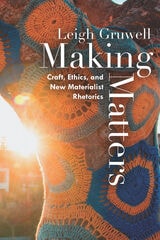
Making Matters
Craft, Ethics, and New Materialist RhetoricsLeigh Gruwell
Utah State University Press, 2022
To recast new materialist rhetorics as inherently crafty, Leigh Gruwell historicizes and locates the concept of craft both within rhetorical history as well as in the disciplinary history of writing studies. Her investigation centers on three specific case studies: craftivism, the fibercraft website Ravelry, and the 2017 Women’s March. These instances all highlight how a material, ecological understanding of rhetorical agency can enact political change.
Craft agency models how we humans might work with and alongside things—nonhuman, sometimes digital, sometimes material—to create more equitable relationships. Making Matters argues that craft is a useful starting point for addressing criticisms of new materialist rhetorics not only because doing so places rhetorical action as a product of complex relationships between a network of human and nonhuman actors, but also because it does so with an explicitly activist agenda that positions the body itself as a material interface.
Making Morality
Pragmatist Reconstruction in Ethical TheoryTodd Lekan
Vanderbilt University Press, 2003
Building on classical American philosophy to address current philosophical concerns, Lekan's theory revises our basic understanding of moral life and the place of theorizing within that life. Making Morality will prove of great interest to ethical theorists, as it enjoins them to measure theoretical inquiries by how well they produce intellectual tools for problem-solving in dynamic, complex communities.
Materia Medica
Black Women, White Doctors, and Spectacular GynecologyNicole N. Ivy
Duke University Press, 2026
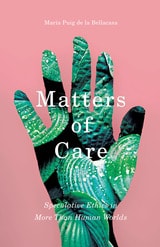
Matters of Care
Speculative Ethics in More than Human WorldsMaría Puig de la Bellacasa
University of Minnesota Press, 2017
To care can feel good, or it can feel bad. It can do good, it can oppress. But what is care? A moral obligation? A burden? A joy? Is it only human? In Matters of Care, María Puig de la Bellacasa presents a powerful challenge to conventional notions of care, exploring its significance as an ethical and political obligation for thinking in the more than human worlds of technoscience and naturecultures.
Matters of Care contests the view that care is something only humans do, and argues for extending to non-humans the consideration of agencies and communities that make the living web of care by considering how care circulates in the natural world. The first of the book’s two parts, “Knowledge Politics,” defines the motivations for expanding the ethico-political meanings of care, focusing on discussions in science and technology that engage with sociotechnical assemblages and objects as lively, politically charged “things.” The second part, “Speculative Ethics in Antiecological Times,” considers everyday ecologies of sustaining and perpetuating life for their potential to transform our entrenched relations to natural worlds as “resources.”
From the ethics and politics of care to experiential research on care to feminist science and technology studies, Matters of Care is a singular contribution to an emerging interdisciplinary debate that expands agency beyond the human to ask how our understandings of care must shift if we broaden the world.
Medical Malpractice
Law, Tactics, and EthicsFrank M. McClellan
Temple University Press, 1993
From practical to philosophical considerations, this succinct, clear presentation of medical malpractice issues is a valuable resource for the classroom and the reference shelf. Frank M. McClellan illustrates the multitude of considerations that impact the merit of each case, never losing sight of the importance of preserving human dignity in malpractice lawsuits.
Early chapters urge the evaluation of legal, medical, and ethical standards, especially the Standard of Care. Part II focuses on assessing and proving compensatory and punitive damages, Part III sets out guidelines for intelligence gathering, medical research, choosing expert witnesses, and preparing for trial.
Students of law, medicine, and public health, as well as lawyers and health care professionals, will find in Medical Malpractice a valuable text or reference book. "Problems" in twelve of the thirteen chapters illustrate the range of issues that can arise in malpractice suits. An appendix lists leading cases that have shaped medical malpractice law.
Medical Necessity
Health Care Access and the Politics of Decision MakingDaniel Skinner
University of Minnesota Press, 2019
How the politics of “medical necessity” complicates American health care
The definition of medical necessity has morphed over the years, from a singular physician’s determination to a complex and dynamic political contest involving patients, medical companies, insurance companies, and government agencies. In this book, Daniel Skinner constructs a comprehensive understanding of the politics of defining this concept, arguing that sustained political engagement with medical necessity is essential to developing a health care system that meets basic public health objectives.
From medical marijuana to mental health to reproductive politics, the concept of medical necessity underscores many of the most divisive and contentious debates in American health care. Skinner’s close reading of medical necessity’s production illuminates the divides between perceptions of medical need as well as how the gatekeeper concept of medical necessity tends to frame medical objectives. He questions the wisdom of continuing to use medical necessity when thinking critically about vexing health care challenges, exploring the possibility that contracts, rights, and technology may resolve the contentious politics of medical necessity.
Skinner ultimately contends that a major shift is needed, one in which health care administrators, doctors, and patients admit that medical necessity is, at its base, a contestable political concept.
Medicating Race
Heart Disease and Durable Preoccupations with DifferenceAnne Pollock
Duke University Press, 2012

Medicine, Health Care, & Ethics
Catholic VoicesJohn F. Morris
Catholic University of America Press, 2007

Minimal Ethics for the Anthropocene
Joanna Zylinska
Michigan Publishing Services, 2014

Modern Jewish Ethics since 1970
Writings on Methods, Sources, and IssuesEdited by Jonathan K. Crane, Emily A. Filler, and Mira Beth Wasserman
Brandeis University Press, 2025
These deliberate juxtapositions are to encourage scholars and students to develop similar meta-ethical analyses on Jewish ethics, broadly construed. Jewish ethics is not just a set of propositions or principles; nor can it be reduced to a single trajectory of thought or abstracted as an elaborate system of ideas. Jewish ethics is the field of study that engages Jewish texts, ideas, history, and experience in conversations about values and virtues, justice and good judgment, human relations and responsibilities. This volume presents some of those conversations to spark many more.
Modern Social Imaginaries
Charles Taylor
Duke University Press, 2004
Retelling the history of Western modernity, Taylor traces the development of a distinct social imaginary. Animated by the idea of a moral order based on the mutual benefit of equal participants, the Western social imaginary is characterized by three key cultural forms—the economy, the public sphere, and self-governance. Taylor’s account of these cultural formations provides a fresh perspective on how to read the specifics of Western modernity: how we came to imagine society primarily as an economy for exchanging goods and services to promote mutual prosperity, how we began to imagine the public sphere as a metaphorical place for deliberation and discussion among strangers on issues of mutual concern, and how we invented the idea of a self-governing people capable of secular “founding” acts without recourse to transcendent principles. Accessible in length and style, Modern Social Imaginaries offers a clear and concise framework for understanding the structure of modern life in the West and the different forms modernity has taken around the world.
Moral Emotions
Reclaiming the Evidence of the HeartAnthony J. Steinbock
Northwestern University Press, 2014
Moral Emotions builds upon the philosophical theory of persons begun in Phenomenology and Mysticism and marks a new stage of phenomenology. Author Anthony J. Steinbock finds personhood analyzing key emotions, called moral emotions. Moral Emotions offers a systematic account of the moral emotions, described here as pride, shame, and guilt as emotions of self-givenness; repentance, hope, and despair as emotions of possibility; and trusting, loving, and humility as emotions of otherness.

Moral Entanglements
Conserving Birds in Britain and GermanyStefan Bargheer
University of Chicago Press, 2018
Moral Imagination
Implications of Cognitive Science for EthicsMark Johnson
University of Chicago Press, 1993
Expanding his innovative studies of human reason in Metaphors We Live By and The Body in the Mind, Johnson provides the tools for more practical, realistic, and constructive moral reflection.

Moral Philosophy Of Moore
Robert Peter Sylvester, edited by Ray Perkins, Jr. and R. W. Sleeper, foreword by Tom Regan
Temple University Press, 1990
This study of G. E. Moore’s work in moral philosophy draws upon a close examination of the early essays that preceded the writing of Principia Ethica in order to ground the author’s view that Moore’s famous "naturalistic fallacy argument" of Principia has been widely misunderstood. At the time of his death in 1986, Robert Peter Sylvester was in the process of preparing this book for publication. That process has been brought to completion by Ray Perkins, Jr., and R. W. Sleeper. Sylvester’s reappraisal of the moral philosophy of G. E. Moore argues that criticism of the work of this major twentieth-century British philosopher has been based on misinterpretation of his unified position. He treats Moore’s ideas about "What is Good?", "What things are Good?" and "What ought we to do?" as forming a coherent system.
To bring this work up to date since the author’s death, the editors have provided a bibliographic essay following each chapter in which recent scholarship is discussed.
Moral Resistance and Spiritual Authority
Our Jewish Obligation to Social JusticeRabbi Seth M. Limmer, DHL and Rabbi Jonah Dov Pesner
Central Conference of American Rabbis, 2019
Moral Spaces
Rethinking Ethics And World PoliticsDavid Campbell
University of Minnesota Press, 1999
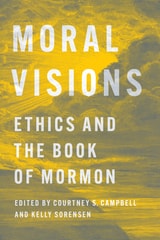
Moral Visions
Ethics and the Book of MormonEdited by Courtney S. Campbell and Kelly Sorensen
University of Illinois Press, 2025
Contributors in the first section discuss foundational issues such as the Book of Mormon’s moral psychology, its minimalist and covenantal moralities, the nature of the good and how the good is known, the question of whether value depends on a certain kind of future, the Book of Mormon's strategy for moral persuasion, and God’s participation in human choices. In the second section, the essayists turn to everyday ethical questions concerning resistance to forced cultural assimilation, clothing and dress, authority, and memory. The final chapter further explores practical moral visions.
A rich and thought-provoking analysis, Moral Visions examines the Book of Mormon through a variety of methods while aiming to deepen understanding of both the text’s messages and its potential place in future discussions of ethics. Contributors: Daniel Becerra, Courtney S. Campbell, Ryan Davis, Michael D. K. Ing, Ariel Bybee Laughton, Kimberly Matheson, Rachel Esplin Odell, Kelly Sorensen, Joseph M. Spencer
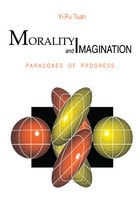
Morality & Imagination
Yi-Fu Tuan
University of Wisconsin Press, 1989
Morality and Human Nature
A New Route to Ethical TheoryRobert J. McShea
Temple University Press, 1990
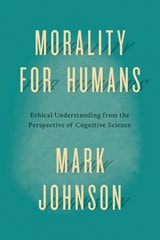
Morality for Humans
Ethical Understanding from the Perspective of Cognitive ScienceMark Johnson
University of Chicago Press, 2014
Ethical naturalism is not just a revamped form of relativism. Indeed, Johnson attempts to overcome the absolutist-versus-relativist impasse that has been one of the most intractable problems in the history of philosophy. He does so through a careful and inclusive look at the many ways we reason about right and wrong. Much of our moral thought, he shows, is automatic and intuitive, gut feelings that we follow up and attempt to justify with rational analysis and argument. However, good moral deliberation is not limited merely to intuitive judgments supported after the fact by reasoning. Johnson points out a crucial third element: we imagine how our decisions will play out, how we or the world would change with each action we might take. Plumbing this imaginative dimension of moral reasoning, he provides a psychologically sophisticated view of moral problem solving, one perfectly suited for the embodied, culturally embedded, and ever-developing human creatures that we are.
Morality within the Limits of Reason
Russell Hardin
University of Chicago Press, 1988
Morality
The Catholic ViewServais O.P. Pinckaers
St. Augustine's Press, 2003
Fr. Servais Pinckaers’s work is well on its way to being accepted as the work on Catholic moral thinking for the coming generation of laymen and students. Pinckaers sharply distinguishes this view of morality from modern “moralities of obligation,” which regard the moral life primarily as obedience to rules that limit human freedom and curb human desires. Pinckaers sees moralities of obligation as the logical outcome of a new understanding of human freedom. Instead of regarding freedom as the capacity to engage in excellent acts of virtue (freedom for excellence), the modern view understands freedom as the radical ability to do good or evil indifferently (freedom of indifference). Pinckaers argues convincingly that this view of freedom and the morality of obligation that flows from it have impoverished the Catholic understanding of the moral life. This work offers the reader a compelling itinerary of moral development, rooted in the theology of St. Paul and the morality of the Gospels.
Now, for a new generation of students, the book is made available in an ebook version.
In addition, under the direction of Fr. Michael Sherwin, a teacher’s edition of the work is to be published, which will greatly aid the teacher in high school or home school to help his or her students to gain the most from this seminal work.
“As Alasdair MacIntyre notes in the preface, the work of Pinckaers attracted strong and fully justified notice in this country with the publication in English of his The Sources of Christian Ethics. As Pinckaers himself notes in the text, excellently translated by Michael Sherwin, the interest should in no way be limited to Roman Catholics. Morality recasts the earlier book in an argument that is both lower and upper case ‘catholic,’ and is accessible to readers and teachers outside the limited circle of moral theologians and academic ethicists. Pinckaers contends that Christian morality is not first of all about obligations but about happiness, understanding that the happiness of union with God is our natural destiny made possible by grace. The Sermon on the Mount is at the center of an approach to morality that turns on the distinction between ‘freedom for excellence’ and ‘freedom of indifference,’ the former understood as human flourishing and the latter as a ‘neutral’ capacity to choose between controversies. The proposal of Morality is thoroughly Christ-centered, humanistic, and faithful to the magisterial teaching of the Church. Warmly recommended.” - First Things
“If you want to have the experience of reflecting on Catholic morality as though you were reading about it for the first time, treat yourself to Father Servais Pinckaers’ Morality: The Catholic View. He has recovered the classical view of the moral life as the quest for happiness and has presented it with disarming simplicity. Bringing us back to the Sermon on the Mount and Romans 12–15, the writings of Augustine and Aquinas, and the theme of natural law, he has freed those texts from the layers of legalism which has hidden their liberating, spiritual powers for moral living. By distinguishing freedom of indifference from freedom for excellence, he has restored a wise vision of freedom. No one has shown better the role of virtues as building blocks for morality. Catechists need to read this book.” Rev. Alfred McBride, O.Praem., Professor of Homilectics and Catechetics at Blessed Pope John XXIII Seminary, Weston, Massachusetts
“Father Pinckaers has given us a masterful exposition of Christian living. The clarity and brevity of his presentation – captured well by the translator – make this book ideal for classroom and parish use. “Readers will find the historical and systematic observations very informative.” Romanus Cessario, St. John’s Seminary, Brighton, Massachusetts
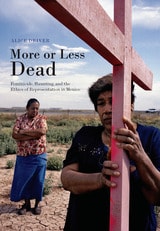
More or Less Dead
Feminicide, Haunting, and the Ethics of Representation in MexicoAlice Driver
University of Arizona Press, 2015
More or Less Dead analyzes how such violence against women has been represented in news media, books, films, photography, and art. Alice Driver argues that the various cultural reports often express anxiety or criticism about how women traverse and inhabit the geography of Ciudad Juárez and further the idea of the public female body as hypersexualized. Rather than searching for justice, the various media—art, photography, and even graffiti—often reuse victimized bodies in sensationalist, attention-grabbing ways. In order to counteract such views, local activists mark the city with graffiti and memorials that create a living memory of the violence and try to humanize the victims of these crimes.
The phrase “more or less dead” was coined by Chilean author Roberto Bolaño in his novel 2666, a penetrating fictional study of Juárez. Driver explains that victims are “more or less dead” because their bodies are never found or aren’t properly identified, leaving families with an uncertainty lasting for decades—or forever.
The author’s clear, precise journalistic style tackles the ethics of representing feminicide victims in Ciudad Juárez. Making a distinction between the words “femicide” (the murder of girls or women) and “feminicide” (murder as a gender-driven event), one of her interviewees says, “Women are killed for being women, and they are victims of masculine violence because they are women. It is a crime of hate against the female gender. These are crimes of power.”
Mortality and Morality
A Search for Good After AuschwitzHans Jonas
Northwestern University Press, 1996