Results by title
135 books match the query 'Faith' and 6 start with m
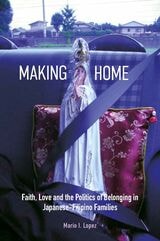
Making Home
Faith, Love and the Politics of Belonging in Japanese-Filipino FamiliesMario Ivan Lopez
National University of Singapore Press, 2026
How do faith, family, and migration intersect in the intimate lives of transnational couples? This ethnography examines Japanese-Filipino marriages in contemporary Japan to reveal how gendered Catholic practices, cultural negotiation, and the politics of belonging shape everyday life. Set in Northern Kyushu, Making Home explores the often tense dynamics of these relationships—how love, faith, and social expectations are navigated across multiple domains. Through long-term fieldwork, it shows how Filipino migrants and their Japanese partners create “contact zones” where faith becomes both a resource for connection and a site of struggle.
Religion, far from being a private matter, becomes a powerful tool for migrants to sustain family ties, negotiate identities, and transform the intimate spaces they live in. Centering religious practices within migration studies, this book offers fresh insights into the evolving landscape of transnational families in Japan.
Master Suffering
CM Burroughs
Tupelo Press, 2021
Modes of Faith
Secular Surrogates for Lost Religious BeliefTheodore Ziolkowski
University of Chicago Press, 2007
In the decades surrounding World War I, religious belief receded in the face of radical new ideas such as Marxism, modern science, Nietzschean philosophy, and critical theology. Modes of Faith addresses both this decline of religious belief and the new modes of secular faith that took religion’s place in the minds of many writers and poets.
Theodore Ziolkowski here examines the motives for this embrace of the secular, locating new modes of faith in art, escapist travel, socialism, politicized myth, and utopian visions. James Joyce, he reveals, turned to art as an escape while Hermann Hesse made a pilgrimage to India in search of enlightenment. Other writers, such as Roger Martin du Gard and Thomas Mann, sought temporary solace in communism or myth. And H. G. Wells, Ziolkowski argues, took refuge in utopian dreams projected in another dimension altogether.
Rooted in innovative and careful comparative reading of the work of writers from France, England, Germany, Italy, and Russia, Modes of Faith is a critical masterpiece by a distinguished literary scholar that offers an abundance of insight to anyone interested in the human compulsion to believe in forces that transcend the individual.

Monuments to Faith
Ukrainian Churches in ManitobaBasil Rotoff
University of Manitoba Press, 1990
Mystery Of Being Vol 1
Reflection & MysteryGabriel Marcel
St. Augustine's Press, 2001
These volumes deal with almost all of the major themes of Marcel's thought: the nature of philosophy, our broken world, man's deep ontological need for being, i.e., for permanent eternal values, our incarnate bodily existence, primary and secondary reflection, participation, being in situation, the identity of the human self, intersubjectivity, mystery and problem, faith, hope, and the reality of God, and immortality.
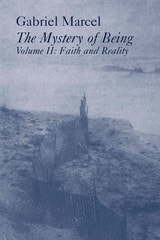
Mystery Of Being Vol 2
Faith & RealityGabriel Marcel
St. Augustine's Press, 2001
The Mystery of Being contains the most systematic exposition of the philosophical thought of Gabriel Marcel, a convert to Catholicism and the most distinguished twentieth-century exponent of Christian existentialism. Its two volumes are the Gifford lectures which Marcel delivered in Aberdeen, Scotland, in 1949 and 1950. Marcel's work fundamentally challenges most of the major positions of the atheistic existentialists (Sartre, Beauvoir, Camus), especially their belief in an absurd, meaningless, godless universe.
These volumes deal with almost all of the major themes of Marcel's thought: the nature of philosophy, our broken world, man's deep ontological need for being, i.e., for permanent eternal values, our incarnate bodily existence, primary and secondary reflection, participation, being in situation, the identity of the human self, intersubjectivity, mystery and problem, faith, hope, and the reality of God, and immortality.