Results by title
377 books match the query 'French' and 15 start with m
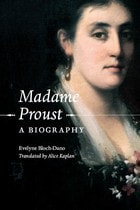
Madame Proust
A BiographyEvelyne E. Bloch-Dano
University of Chicago Press, 2007
Now Evelyne Bloch-Dano’s touching biography acquaints Proust fans with the real Jeanne Weil Proust. Written with the imaginative force of a novel, but firmly grounded in Jeanne and Marcel Proust’s writings, Madame Proust skillfully captures the life and times of Proust’s mother, from her German-Jewish background and her marriage to a Catholic grocer’s son to her lifelong worries about her son’s sexuality, health problems, and talent. As well as offering intimate glimpses of the Prousts’ daily life, Madame Proust also uses the family as a way to explore the larger culture of fin-de-siècle France, including high society, spa culture, Jewish assimilation, and the Dreyfus affair. Throughout, Bloch-Dano offers sensitive readings of Proust’s work, drawing out the countless interconnections between his mother, his life, and his magnum opus.
Those coming to In Search of Lost Time for the first time will find in Madame Proust a delightful primer on Marcel Proust’s life and times. For those already steeped in the pleasures of Proust, this gem of a biography will give them a fresh understanding of the rich, fascinating background of the writer and his art.

Making Jazz French
Music and Modern Life in Interwar ParisJeffrey H. Jackson
Duke University Press, 2003
Drawing on memoirs, press accounts, and cultural criticism, Jackson uses the history of jazz in Paris to illuminate the challenges confounding French national identity during the interwar years. As he explains, many French people initially regarded jazz as alien because of its associations with America and Africa. Some reveled in its explosive energy and the exoticism of its racial connotations, while others saw it as a dangerous reversal of France’s most cherished notions of "civilization." At the same time, many French musicians, though not threatened by jazz as a musical style, feared their jobs would vanish with the arrival of American performers. By the 1930s, however, a core group of French fans, critics, and musicians had incorporated jazz into the French entertainment tradition. Today it is an integral part of Parisian musical performance. In showing how jazz became French, Jackson reveals some of the ways a musical form created in the United States became an international phenomenon and acquired new meanings unique to the places where it was heard and performed.

Making the News
Modernity and the Mass Press in Nineteenth-Century FranceDean de la Motte
University of Massachusetts Press, 1999
Much recent writing on print culture has focused on the social and political implications of the transition from “elite” to “mass” culture in the 1800s. The essays in this volume add significantly to our understanding of the role of the nineteenth-century French press in producing the commodities, consumers, and ideological frameworks that are the hallmarks of this shift. The book also offers an opportunity for useful comparisons with recent scholarship on the rise on the popular press in the United States, Great Britain, and Germany.
The essays address a wide range of topics, from the emergence of commercial daily newspapers during the July Monarchy to the photographic representation of women in the Paris Commune. Together they demonstrate that the French mass press was far more heterogeneous than previously supposed, tapping into an expanding readership composed of a variety of publics—from affluent bourgeois to disaffected workers to disenfranchised women. It was also relentlessly innovative, using caricature, argot, advertisements, and other attention-grabbing techniques that blurred the lines separating art, politics, and the news.

Marguerite Yourcenar
Inventing a LifeJosyane Savigneau
University of Chicago Press, 1993
Here, in its intricate and often contradictory detail, is Marguerite Yourcenar's story, one in which loss and learning intertwined almost from the first and in which love assumed a strangely paradoxical place. Drawing on letters, diaries, and interviews with Yourcenar's friends, colleagues, and lovers, Josyane Savigneau's biography paints an intimate portrait of an artist who lived according to her own, occasionally contrary, terms: a Frenchwoman ardently in love with her native tongue, yet who lived half her life in New England; an avid seductress of women, who spent nearly forty years with one woman, yet fell in love early and late in her life with two young men; a powerful female writer whose most memorable protagonists were male, from Alexis of her first novel to the later historical characters Hadrian and Zeno. Savigneau weaves these and other contraries of Yourcenar's life into a vibrant and engrossing pattern.
Editor of "Le Monde des Livres," the literary pages of France's most influential newspaper, Savigneau first met Marguerite Yourcenar on assignment in 1984. What began as a professional relationship gradually turned into a friendship. Her personal insights into that life enrich this exhaustively documented text. Following the lead set by Yourcenar in her memoir Dear Departed, the biographer found herself "searching for a truth that is multiple, unstable, evasive, sometimes saddening, and at first glance scandalous but that one cannot approach without often feeling for human beings in all their frailty a certain measure of kinship and, always, a sense of pity." Yourcenar's profound intelligence and sympathy, her foibles and obsessions, her accomplishments and trials: all are revealed here in an uncompromising portrait of an incomparable artist.
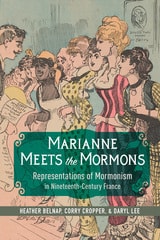
Marianne Meets the Mormons
Representations of Mormonism in Nineteenth-Century FranceHeather Belnap, Corry Cropper, and Daryl Lee
University of Illinois Press, 2022
Surprising and innovative, Marianne Meets the Mormons looks at how nineteenth-century French observers engaged with the idea of Mormonism in order to reframe their own cultural preoccupations.

Marie de France and the Poetics of Memory
Logan E. Whalen
Catholic University of America Press, 2008

Masked Inversion in French
Paul M. Postal
University of Chicago Press, 1989
This analysis has significant consequences for contemporary syntactic theories. First, the arguments support the view that a sentence's superficial structure cannot be identified with its syntactic structure, even though such an identification is a fundamental assumption of several currently influential grammatical frameworks. Second, even certain theories that do posit abstract aspects of grammatical form fail to allow for the needed Inversion structures. Postal's study supports theories based on the notion of arc and stratification into levels which provide a natural treatment consistent with the factual requirements.
Masked Inversion in French is the first systematic account of this puzzling French syntactic anomaly, and its findings will stimulate research in many areas of natural language grammatical structure.

Maternal Fictions
Stendahl, Sand, Rachilde, and BatailleMaryline Lukacher
Duke University Press, 1994
Through readings of Armance, Le Rouge et le noir, La Vie de Henry Brulard, and Les Cenci, Lukacher exposes Stendhal's preoccupation with his dead mother, who is obsessively retrieved throughout his work. George Sand's identity is, in effect, divided between two mothers, her biological mother and her grandmother, and in Histoire de ma vie, Indiana, and Mauprat, we see the writer's efforts to break the impasse created by this divided identity. In the extraordinary but too little known work of Rachilde (Marguerite Eymery), Lukacher finds the maternal figure identified as the secret inner force of patriarchal oppression. This resistance to feminism continues in the pseudonymous work of Georges Bataille. In Ma mère, Le coupable, and L’Expérience intérieure Lukacher traces Bataille’s representation of the mother as a menacing, ever subversive figure who threatens basic social configurations.
Maternal Fictions establishes a new pseudonymous genealogy in modern French writing that will inform and advance our understanding of the act of self-creation that occurs in fiction.

Measuring the New World
Enlightenment Science and South AmericaNeil Safier
University of Chicago Press, 2008

Memoirs of the Count of Comminge and The Misfortunes of Love
Claudine-Alexandrine Guérin de Tencin
Iter Press, 2016

Midwife to the Queen of France
Diverse ObservationsLouise Bourgeois
Iter Press, 2017

Modes of Play in Eighteenth-Century France
Fayçal Falaky
Bucknell University Press, 2022

Moot Plays of Corneille
Lacy Lockert
Vanderbilt University Press, 1959
In an earlier book, The Chief Plays of Corneille, Dr. Lockert translated the six most famous (but not necessarily the best) tragedies of that dramatist. The present volume makes available to English readers all his other plays, comedies aside, for which high claims have been or could be made. Some recent critics have pronounced some of them superior to everything else of Corneille but the Cid and Polyeucte.
A brief introduction is prefixed to each play, giving examples of the diverse opinions held by representative critics in the last eighty-five years.

More Plays by Rivals of Corneille and Racine
Lacy Lockert
Vanderbilt University Press, 0
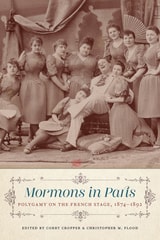
Mormons in Paris
Polygamy on the French Stage, 1874-1892Corry Cropper
Bucknell University Press, 2021
In the late nineteenth century, numerous French plays, novels, cartoons, and works of art focused on Mormons. Unlike American authors who portrayed Mormons as malevolent “others,” however, French dramatists used Mormonism to point out hypocrisy in their own culture. Aren't Mormon women, because of their numbers in a household, more liberated than French women who can't divorce? What is polygamy but another name for multiple mistresses? This new critical edition presents translations of four musical comedies staged or published in France in the late 1800s: Mormons in Paris (1874), Berthelier Meets the Mormons (1875), Japheth’s Twelve Wives (1890), and Stephana’s Jewel (1892). Each is accompanied by a short contextualizing introduction with details about the music, playwrights, and staging. Humorous and largely unknown, these plays use Mormonism to explore and mock changing French mentalities during the Third Republic, lampooning shifting attitudes and evolving laws about marriage, divorce, and gender roles.
Published by Bucknell University Press. Distributed worldwide by Rutgers University Press.