Results by title
252 books match the query 'Future' and 10 start with m

Malaysia's Original People
Past, Present and Future of the Orang AsliEdited by Kirk Endicott
National University of Singapore Press, 2015
The chapters in the present volume provide a comprehensive survey of current understandings of Malaysia’s Orang Asli communities, covering their origins and history, cultural similarities and differences, and they ways they are responding to the challenges posed by a rapidly changing world. The authors, a distinguished group of Malaysian (including Orang Asli) and international scholars with expertise in anthropology, archaeology, biology, education, therapy, geography and law, also show the importance of Orang Asli studies for the anthropological understanding of small-scale indigenous societies in general.
Managing Crises in the Academic Library
Past, Present, and FutureDoris Van Kampen-Breit
Assoc of College & Research Libraries, 2023
In 29 chapters from authors in all institution types and sizes, Managing Crises in the Academic Library can help library workers learn from the crises of the past and prepare for the next unexpected event. Chapters cover lessons from the COVID-19 pandemic, perpetual budget uncertainty, dealing with downsizing, merging departments, mold mitigation, and mental health issues, but also offer strategies applicable during any crisis, including:
- Responsive decision-making in academic library collections
- Managing stakeholder expectations
- Effective communication strategies
- Continuity of operations planning
- Utilizing library storage facilities
- Documentation and cross-training
- Mediating student technology needs
- Setting boundaries
Libraries and library workers are deeply sustaining lifelines for many students and faculty. Managing Crises in the Academic Library collects stories that demonstrate the tenacity, creativity, and ingenuity of academic library workers as they maintain this vital community lifeline and offers actionable ideas and approaches for planning for and sustaining the resources, services, and people in the library during difficult times.
Mandates, Parties, and Voters
How Elections Shape the FutureJames H Fowler and Oleg Smirnov
Temple University Press, 2007
Most research on two-party elections has considered the outcome as a single, dichotomous event: either one or the other party wins. In this groundbreaking book, James Fowler and Oleg Smirnov investigate not just who wins, but by how much, and they marshal compelling evidence that mandates-in the form of margin of victory-matter. Using theoretical models, computer simulation, carefully designed experiments, and empirical data, the authors show that after an election the policy positions of both parties move in the direction preferred by the winning party-and they move even more if the victory is large. In addition, Fowler and Smirnov not only show that the divergence between the policy positions of the parties is greatest when the previous election was close, but also that policy positions are further influenced by electoral volatility and ideological polarization.
This pioneering book will be of particular interest to political scientists, game theoreticians, and other scholars who study voting behavior and its short-term and long-range effects on public policy.

Megawatts and Megatons
The Future of Nuclear Power and Nuclear WeaponsRichard L. Garwin and Georges Charpak
University of Chicago Press, 2002
Menace to the Future
A Disability and Queer History of Carceral EugenicsJess Whatcott
Duke University Press, 2024
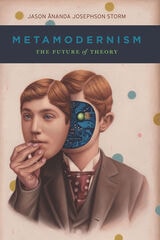
Metamodernism
The Future of TheoryJason Ananda Josephson Storm
University of Chicago Press, 2021
Metamodernism works through the postmodern critiques and uncovers the mechanisms that produce and maintain concepts and social categories. In so doing, Storm provides a new, radical account of society’s ever-changing nature—what he calls a “Process Social Ontology”—and its materialization in temporary zones of stability or “social kinds.” Storm then formulates a fresh approach to philosophy of language by looking beyond the typical theorizing that focuses solely on human language production, showing us instead how our own sign-making is actually on a continuum with animal and plant communication.
Storm also considers fundamental issues of the relationship between knowledge and value, promoting a turn toward humble, emancipatory knowledge that recognizes the existence of multiple modes of the real. Metamodernism is a revolutionary manifesto for research in the human sciences that offers a new way through postmodern skepticism to envision a more inclusive future of theory in which new forms of both progress and knowledge can be realized.
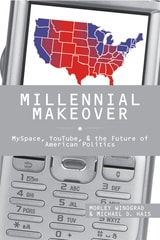
Millennial Makeover
MySpace, YouTube, and the Future of American PoliticsWinograd, Morley
Rutgers University Press, 2008
A 2008 New York Times Notable Book of the Year
It happens in America every four decades and it is about to happen again. America’s demand for change in the 2008 election will cause another of our country’s periodic political makeovers. This realignment, like all others before it, will result from the coming of age of a new generation of young Americans—the Millennial Generation—and the full emergence of the Internet-based communications technology that this generation uses so well. Beginning in 2008, almost everything about American politics and government will transform—voting patterns, the fortunes of the two political parties, the issues that engage the nation, and our government and its public policy.
Building on the seminal work of previous generational theorists,Morley Winograd and Michael D. Hais demonstrate and describe, for the first time, the two types of realignments—“idealist” and “civic”—that have alternated with one another throughout the nation’s history. Based on these patterns, Winograd and Hais predict that the next realignment will be very different from the last one that occurred in 1968. “Idealist” realignments, like the one put into motion forty years ago by the Baby Boomer Generation, produce, among other things, a political emphasis on divisive social issues and governmental gridlock. “Civic” realignments, like the one that is coming, and the one produced by the famous GI or “Greatest” Generation in the 1930s, by contrast, tend to produce societal unity, increased attention to and successful resolution of basic economic and foreign policy issues, and institution-building.
The authors detail the contours and causes of the country’s five previous political makeovers, before delving deeply into the generational and technological trends that will shape the next. The book’s final section forecasts the impact of the Millennial Makeover on the elections, issues, and public policies that will characterize America’s politics in the decades ahead.
For additional information go to:
Millennial Makeover website.
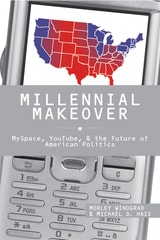
Millennial Makeover
MySpace, YouTube, and the Future of American PoliticsWinograd, Morley
Rutgers University Press, 2008
A 2008 New York Times Notable Book of the Year
It happens in America every four decades and it is about to happen again. America’s demand for change in the 2008 election will cause another of our country’s periodic political makeovers. This realignment, like all others before it, will result from the coming of age of a new generation of young Americans—the Millennial Generation—and the full emergence of the Internet-based communications technology that this generation uses so well. Beginning in 2008, almost everything about American politics and government will transform—voting patterns, the fortunes of the two political parties, the issues that engage the nation, and our government and its public policy.
Building on the seminal work of previous generational theorists,Morley Winograd and Michael D. Hais demonstrate and describe, for the first time, the two types of realignments—“idealist” and “civic”—that have alternated with one another throughout the nation’s history. Based on these patterns, Winograd and Hais predict that the next realignment will be very different from the last one that occurred in 1968. “Idealist” realignments, like the one put into motion forty years ago by the Baby Boomer Generation, produce, among other things, a political emphasis on divisive social issues and governmental gridlock. “Civic” realignments, like the one that is coming, and the one produced by the famous GI or “Greatest” Generation in the 1930s, by contrast, tend to produce societal unity, increased attention to and successful resolution of basic economic and foreign policy issues, and institution-building.
The authors detail the contours and causes of the country’s five previous political makeovers, before delving deeply into the generational and technological trends that will shape the next. The book’s final section forecasts the impact of the Millennial Makeover on the elections, issues, and public policies that will characterize America’s politics in the decades ahead.
For additional information go to:
Millennial Makeover website.
Mobility as a Service
Its development, deployment, and futureBeate Kubitz
The Institution of Engineering and Technology, 2024
More than a Moment
Contextualizing the Past, Present, and FutureSteven D. Krause
Utah State University Press, 2019
Krause writes about his own experiences as a participant in several MOOCs and the experiences of faculty who developed and taught MOOCs. Contrary to many early claims from educational entrepreneurs, they were never entirely “new,” and MOOCs and their aftermath are still at the heart of the tensions between nonprofit universities and for-profit entities, particularly online program management firms, in delivering distance education.
While MOOCs are no longer a threat to education in the United States, they are part of the ongoing corporatization of education and remain part of conversations about experienced-based credit, corporate training, and open education. Presenting historical, student, teacher, and administrative perspectives, More than a Moment is a well-rounded treatment that will be of interest to academics and entrepreneurs interested in distance education, online pedagogy, online program management, and public-private partnerships in higher education.