Results by title
59 books match the query 'Gay' and 3 start with m

Manfred Macmillan
Book One of the Three Magicians TrilogyBy Jirí Karásek ze Lvovic, translated from the Czech and annotated by Carleton Bulkin with an introduction co-authored by Brian James Baer
Amherst College Press, 2024
Decadence meets gothic in Manfred Macmillan (1907), a carefully constructed tale of doppelgangers, magical intrigue, and the rootless scion of a noble house. This annotated, first-ever English translation presents an early queer novel long unavailable except in the original Czech. Author Jiří Karásek ze Lvovic (1871–1951) was a major cultural figure in his native Bohemia and cultivated ties with fellow artists from across Central Europe. In their extensive scholarly introduction, translator Carleton Bulkin and translation scholar Brian James Baer situate the novel within longer histories of gay literature, fascinations with the occult, and the cultural and linguistic politics of so-called peripheral European nations. They persuasively frame Karásek as a queer author and cultural disruptor in the fin de siècle Habsburg space.
Karasék rejected Czech translations of ancient Greek writers that bowdlerized gay themes, and he personally and vigorously defended Oscar Wilde in print, both on the grounds of artistic freedom and of private morality. He also published a cycle of homoerotic poems under the title Sodom, confiscated by the Austrian authorities but republished in 1905 and repeatedly afterward. A colonized subject, a literary decadent, and a sexual outlaw, Karasék’s complex responses to his own marginalization can be traced through his fantastically strange novel trilogy Three Magicians. As the first volume in that series, Manfred Macmillan is a gorgeous, compelling, and important addition to expanding canons of LGBTQI+ literature.
Karasék rejected Czech translations of ancient Greek writers that bowdlerized gay themes, and he personally and vigorously defended Oscar Wilde in print, both on the grounds of artistic freedom and of private morality. He also published a cycle of homoerotic poems under the title Sodom, confiscated by the Austrian authorities but republished in 1905 and repeatedly afterward. A colonized subject, a literary decadent, and a sexual outlaw, Karasék’s complex responses to his own marginalization can be traced through his fantastically strange novel trilogy Three Magicians. As the first volume in that series, Manfred Macmillan is a gorgeous, compelling, and important addition to expanding canons of LGBTQI+ literature.
[more]
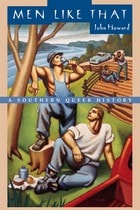
Men Like That
A Southern Queer HistoryJohn Howard
University of Chicago Press, 1999
We don't usually associate thriving queer culture with rural America, but John Howard's unparalleled history of queer life in the South persuasively debunks the myth that same-sex desires can't find expression outside the big city. In fact, this book shows that the nominally conservative institutions of small-town life—home, church, school, and workplace—were the very sites where queer sexuality flourished. As Howard recounts the life stories of the ordinary and the famous, often in their own words, he also locates the material traces of queer sexuality in the landscape: from the farmhouse to the church social, from sports facilities to roadside rest areas.
Spanning four decades, Men Like That complicates traditional notions of a post-WWII conformist wave in America. Howard argues that the 1950s, for example, were a period of vibrant queer networking in Mississippi, while during the so-called "free love" 1960s homosexuals faced aggressive oppression. When queer sex was linked to racial agitation and when key civil rights leaders were implicated in homosexual acts, authorities cracked down and literally ran the accused out of town.
In addition to firsthand accounts, Men Like That finds representations of homosexuality in regional pulp fiction and artwork, as well as in the number one pop song about a suicidal youth who jumps off the Tallahatchie Bridge. And Howard offers frank, unprecedented assessments of outrageous public scandals: a conservative U.S. congressman caught in the act in Washington, and a white candidate for governor accused of patronizing black transgender sex workers.
The first book-length history of the queer South, Men Like That completely reorients our presuppositions about gay identity and about the dynamics of country life.
"Men Like That goes a long way towards redressing the urban bias in American lesbian and gay-history writing. . . . Howard's rigorous scholarship, which is based both on oral history and traditional historical documents . . . is enhanced by a disarmingly personal touch. . . . His insights into queerness and the mentality of the American South should be of great interest both to the professional gay historian and the general reader."—Madeleine Minson, Times Higher Education Supplement
"Howard creates a history remarkable in its complexity yet intimate in its portraiture. At long last an intimate and full vision of queer lives in America that did not unfold in San Francisco's discos."—Kirkus Reviews
"In this groundbreaking and engrossing analysis of gay male life in postwar Mississippi, Howard . . . boldly demonstrates that gay culture and sex not only existed but flourished in small towns."—Publishers Weekly, starred review
[more]
Mourning Light
Richard Goodkin
University of Wisconsin Press, 2022
Set in Madison, Wisconsin, and New Haven, Connecticut, in the early days of the AIDS epidemic, Mourning Light is a semi-autobiographical love story. Our narrator, Reb (so named by his mother because of her love of the Daphne du Maurier novel Rebecca), is hounded by guilt over the death of his lover, Anthony, which took place on the same day Reb first met the handsome yet enigmatic Eric. Once Reb becomes convinced that Anthony has sent him a cryptic message from beyond the grave, he becomes obsessed with figuring out what it could mean.
Told in a series of flashbacks and remembrances, the novel concludes with a whirlwind of revelations that both complicate and resolve Reb’s view of his world and his lover.
Told in a series of flashbacks and remembrances, the novel concludes with a whirlwind of revelations that both complicate and resolve Reb’s view of his world and his lover.
[more]