Results by title
93 books match the query 'Gay people' and 4 start with m
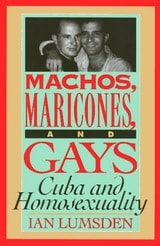
Machos Maricones & Gays
Cuba and HomosexualityIan Lumsden
Temple University Press, 1996
This remarkable account of gays in Cuba links the treatment of male homosexuality under Castro with prejudices and preconceptions prevalent in Cuban society before the Revolution. Ian Lumsden argues that much of the present discussion does not acknowledge the significant improvements that have occurred in the last decade. As an antidote to what he considers wide-spread misinformation, Lumsden locates the current issues surrounding homosexual identity within the broad context of Cuban culture, history, and social policy and makes revealing comparisons to the experience of homosexuals in other Latin American countries.
Lumsden explores the historic roots of the oppression of homosexuals through such issues as race, religion, and gender. He considers the cultural history and current erosion of traditional "machismo," the correlation between traditional women's roles and the relationships between gay men, and homosexuality as defined by the law and as presented in typical sexual education. He addresses the international controversy over state-imposed sanatoriums for HIV/AIDS patients, and details the social scene, the varying ideals among different generations of gay Cubans, gay life and family ties, and the difference between being publicly and privately gay in Cuba.
Lumsden's involvement over the years in gay culture in Cuba, his interviews with gay Cuban men, and his formidable scholarship produce a strikingly honest, accurate portrayal of the changes in homosexual life.
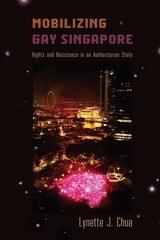
Mobilizing Gay Singapore
Rights and Resistance in an Authoritarian StateLynette J Chua
Temple University Press, 2015
For decades, Singapore's gay activists have sought equality and justice in a state where law is used to stifle basic civil and political liberties. In her groundbreaking book, Mobilizing Gay Singapore, Lynette Chua asks, what does a social movement look like in an authoritarian state? She takes an expansive view of the gay movement to examine its emergence, development, strategies, and tactics, as well as the roles of law and rights in social processes.
Chua tells this important story using in-depth interviews with gay activists, observations of the movement's activities-including "Pink Dot" events, where thousands of Singaporeans gather in annual celebrations of gay pride-movement documents, government statements, and media reports. She shows how activists deploy "pragmatic resistance" to gain visibility and support, tackle political norms that suppress dissent, and deal with police harassment, while avoiding direct confrontations with the law.
Mobilizing Gay Singapore also addresses how these brave, locally engaged citizens come out into the open as gay activists and expand and diversify their efforts in the global queer political movement.
Modern American Queer History
Allida Black
Temple University Press, 2001
Whether the subject is an individual life story, a community study, or an aspect of public policy, these essays illuminate the ways in which individuals in various locales understood the nature of their desires and the possibilities of resisting dominant views of normality and deviance. Theoretically informed, but accessible, the essays shed light too on the difficulties of writing history when documentary evidence is sparse or "coded." Taken together these essays suggest that while some individuals and social networks might never emerge from the shadows, the persistent exploration of the past for their traces is an integral part of the on-going struggle for queer rights.
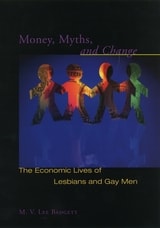
Money, Myths, and Change
The Economic Lives of Lesbians and Gay MenM.V. Lee Badgett
University of Chicago Press, 2001
Money, Myths, and Change provides new answers to these complex questions. This is the first comprehensive work to explore the economic lives of gays and lesbians in the United States. M. V. Lee Badgett weaves through and debunks common stereotypes about gay privilege, income, and consumer behavior. Studying the ends and means of gay life from an economic perspective, she disproves the assumption that gay men and lesbians are more affluent than heterosexuals, that they inspire discrimination when they come out of the closet, that they consume more conspicuously, that they enjoy a more self-indulgent, even hedonistic lifestyle. Badgett gets to the heart of these misconceptions through an analysis of the crucial issues that affect the livelihood of gay men and lesbians: discrimination in the workplace, denial of health care benefits to domestic partners and children, lack of access to legal institutions such as marriage, the corporate wooing of gay consumer dollars, and the use of gay economic clout to inspire social and political change.
Both timely and readable, Money, Myths, and Change stands as a much-needed corrective to the assumptions that inhibit gay economic equality. It is a definitive work that sheds new light on just what it means to be gay or lesbian in the United States.