Results by title
932 books match the query 'Genres & Styles' and 67 start with m

Macbeth
Melodramma in Four Acts. Libretto by Francesco Maria PiaveGiuseppe Verdi
University of Chicago Press, 2005
Published in three volumes, this critical edition of Macbeth is the only one based entirely on autograph sources. Containing the later version as the principal score, it is the first edition to consult the composer's manuscripts of the revised pieces, preserved at the Bibliothèque Nationale in Paris. An appendix contains the earlier movements, and David Lawton provides a wide-ranging introduction to the opera's complex history. This critical edition of Macbeth includes here for the first time Verdi's preferred text—the version he set to music—as well as his own stage directions and thus offers the most vivid and dramatic reading to date.
Mad Music
Charles Ives, the Nostalgic RebelStephen Budiansky
University Press of New England, 2014
Made in NuYoRico
Fania Records, Latin Music, and Salsa’s Nuyorican MeaningsMarisol Negrón
Duke University Press, 2024
Magic Flutes and Enchanted Forests
The Supernatural in Eighteenth-Century Musical TheaterDavid J. Buch
University of Chicago Press, 2008
David J. Buch reveals that despite—and perhaps even because of—their fundamental irrationality, fantastic and exotic themes acquired extraordinary force and popularity during the period, pervading theatrical works with music in the French, German, and Italian mainstream. Considering prominent compositions by Gluck, Rameau, and Haydn, as well as many seminal contributions by lesser-known artists, Buch locates the origins of these magical elements in such historical sources as ancient mythology, European fairy tales, the Arabian Nights, and the occult. He concludes with a brilliant excavation of the supernatural roots of Mozart’s The Magic Flute and Don Giovanni, building a new foundation for our understanding of the magical themes that proliferated in Mozart’s wake.
Mahler's Symphonic World
Music for the Age of UncertaintyKarol Berger
University of Chicago Press, 2025
Between 1888 and 1909 Gustav Mahler completed nine symphonies and the orchestral song cycle Das Lied von der Erde; his tenth symphony was left incomplete at his death in 1911. Mahler’s Symphonic World provocatively suggests that over his lifetime, the composer pursued a single vision and a single, ideal symphony that strived to capture his personal outlook on human existence. Writing at the turn of the twentieth century, when all trust in firm philosophical and spiritual foundations had evaporated, Mahler’s music reflected a deep preoccupation with human suffering and transience and a search for sources of possible consolation.
In Karol Berger’s reading, each of the symphonies follows a similar trajectory, with an opening quest leading to the final unveiling of a transcendent, consolatory vision. By juxtaposing single movements—the opening Allegros, the middle movements, the Finales—across different works, Berger traces recurring plotlines and imagery and discloses the works’ multiple interrelationships as well as their cohesiveness around a central idea. Ultimately, Mahler’s Symphonic World locates Mahler’s music within the matrix of intellectual currents that defined his epoch and offers a revelatory picture of his musical way of being in the world.
Make It New
Reshaping Jazz in the 21st CenturyBill Beuttler
Lever Press, 2019
Making Jazz French
Music and Modern Life in Interwar ParisJeffrey H. Jackson
Duke University Press, 2003
Drawing on memoirs, press accounts, and cultural criticism, Jackson uses the history of jazz in Paris to illuminate the challenges confounding French national identity during the interwar years. As he explains, many French people initially regarded jazz as alien because of its associations with America and Africa. Some reveled in its explosive energy and the exoticism of its racial connotations, while others saw it as a dangerous reversal of France’s most cherished notions of "civilization." At the same time, many French musicians, though not threatened by jazz as a musical style, feared their jobs would vanish with the arrival of American performers. By the 1930s, however, a core group of French fans, critics, and musicians had incorporated jazz into the French entertainment tradition. Today it is an integral part of Parisian musical performance. In showing how jazz became French, Jackson reveals some of the ways a musical form created in the United States became an international phenomenon and acquired new meanings unique to the places where it was heard and performed.
Making Light
Haydn, Musical Camp, and the Long Shadow of German IdealismRaymond Knapp
Duke University Press, 2018
Making Mexican Rock
Censorship, Journalism, and Popular Music after AvándaroAndrew J. Green
Vanderbilt University Press, 2024
Yet in light of the failures of successive democratically elected governments in Mexico, these histories are worth critically revisiting and updating. What stories about music censorship can be told after Mexico’s transition to multi-party democracy? Placing history and ethnography into dialogue, Making Mexican Rock explores historical and recent experiences of censorship and repression against popular music, focusing on the independent rock scene (or “escena independiente”) in Mexico City.
Informed by the so-called new censorship theory, ethnomusicologist Andrew J. Green challenges historical accounts that equate acts of censorship with state activity. The open-ended account of censorship assumed here helps us to understand, instead, how conceptions of censorship and expressive freedom transformed toward the end of single-party rule; how practices of policing live rock adapted to neoliberal securitization; and how histories of rock censorship have been invoked by those seeking to construct and protect emergent music scenes. Making Mexican Rock thus both decenters histories of music censorship from the state, and extends them into the country’s recent history.
Making Music Indigenous
Popular Music in the Peruvian AndesJoshua Tucker
University of Chicago Press, 2019
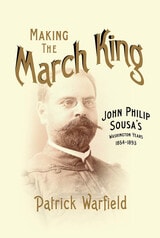
Making the March King
John Philip Sousa's Washington Years, 1854-1893Patrick Warfiled
University of Illinois Press, 2013
Warfield examines Sousa's wide-ranging experience composing, conducting, and performing in the theater, opera house, concert hall, and salons, as well as his leadership of the United States Marine Band and the later Sousa Band, early twentieth-century America's most famous and successful ensemble. Sousa composed not only marches during this period but also parlor, minstrel, and art songs; parade, concert, and medley marches; schottisches, waltzes, and polkas; and incidental music, operettas, and descriptive pieces. Warfield's examination of Sousa's output reveals a versatile composer much broader in stylistic range than the bandmaster extraordinaire remembered as the March King.
In particular, Making the March King demonstrates how Sousa used his theatrical training to create the character of the March King. The exuberant bandmaster who pleased audiences was both a skilled and charismatic conductor and a theatrical character whose past and very identity suggested drama, spectacle, and excitement. Sousa's success was also the result of perseverance and lessons learned from older colleagues on how to court, win, and keep an audience. Warfield presents the story of Sousa as a self-made business success, a gifted performer and composer who deftly capitalized on his talents to create one of the most entertaining, enduring figures in American music.
Making the Scene in the Garden State
Popular Music in New Jersey from Edison to Springsteen and BeyondDewar MacLeod
Rutgers University Press, 2020

Mandolin Man
The Bluegrass Life of Roland WhiteBob Black
University of Illinois Press, 2022
Roland White’s long career has taken him from membership in Bill Monroe’s Blue Grass Boys and Lester Flatt’s Nashville Grass to success with his own Roland White Band. A master of the mandolin and acclaimed multi-instrumentalist, White has mentored a host of bluegrass musicians and inspired countless others.
Bob Black draws on extensive interviews with White and his peers and friends to provide the first in-depth biography of the pioneering bluegrass figure. Born into a musical family, White found early success with the Kentucky Colonels during the 1960s folk revival. The many stops and collaborations that marked White's subsequent musical journey trace the history of modern bluegrass. But Black also delves into the seldom-told tale of White's life as a working musician, one who endured professional and music industry ups-and-downs to become a legendary artist and beloved teacher.
An entertaining merger of memories and music history, Mandolin Man tells the overdue story of a bluegrass icon and his times.
Manifest Technique
Hip Hop, Empire, and Visionary Filipino American CultureMark R. Villegas
University of Illinois Press, 2021
Filipino Americans have been innovators and collaborators in hip hop since the culture’s early days. But despite the success of artists like Apl.de.Ap of the Black Eyed Peas and superstar producer Chad Hugo, the genre’s significance in Filipino American communities is often overlooked. Mark R. Villegas considers sprawling coast-to-coast hip hop networks to reveal how Filipino Americans have used music, dance, and visual art to create their worlds. Filipino Americans have been exploring their racial position in the world in embracing hip hop’s connections to memories of colonial and racial violence. Villegas scrutinizes practitioners’ language of defiance, placing the cultural grammar of hip hop within a larger legacy of decolonization.
An important investigation of hip hop as a movement of racial consciousness, Manifest Technique shows how the genre has inspired Filipino Americans to envision and enact new ideas of their bodies, their history, and their dignity.
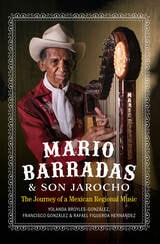
Mario Barradas and Son Jarocho
The Journey of a Mexican Regional MusicYolanda Broyles-González, Rafael Figueroa Hernández, and Francisco González
University of Texas Press, 2022
Son Jarocho was born as the regional sound of Veracruz but over time became a Mexican national genre, even transnational, genre—a touchstone of Chicano identity in the United States. Mario Barradas and Son Jarocho traces a musical journey from the Gulf Coast to interior Mexico and across the border, describing the transformations of Son Jarocho along the way.
This comprehensive cultural study pairs ethnographic and musicological insights with an oral history of the late Mario Barradas, one of Son Jarocho’s preeminent modern musicians. Chicano musician Francisco González offers an insider’s account of Barradas’s influence and Son Jarocho’s musical qualities, while Rafael Figueroa Hernández delves into Barradas’s recordings and films. Yolanda Broyles-González examines the interplay between Son Jarocho’s indigenous roots and contemporary role in Mexican and US society. The result is a nuanced portrait of a vital and evolving musical tradition.
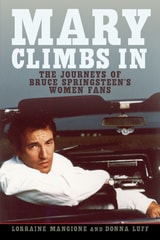
Mary Climbs In
The Journeys of Bruce Springsteen's Women FansLorraine Mangione
Rutgers University Press, 2023
Mary Climbs In illuminates this once overlooked but increasingly important and multi-faceted conversation about female audiences for Springsteen’s music. Drawing on unique surveys of fans themselves, the study offers insight into women’s experiences in their own voices. Authors Lorraine Mangione and Donna Luff explore the depth of women fans’ connection to Springsteen and the profound ways this connection has shaped their lives. Reflections from fans enliven each page as readers journey through the camaraderie and joy of concerts, the sorrow and confusion of personal loss and suffering, the love and closeness of community, and the search for meaning and for the self. Viewed through a psychological lens, women fans’ relationship with Springsteen is revealed in all its complexity as never before. Mary Climbs In is an important interdisciplinary contribution to the growing field of Springsteen studies and a must-read for any fan.
Masters of Contemporary Brazilian Song
MPB, 1965-1985By Charles A. Perrone
University of Texas Press, 1993
Masters of Contemporary Brazilian Song is a critical study of MPB (música popular brasileira), a term that refers to varieties of urban popular music of the 1960s and 1970s, incorporating samba, Bossa Nova, and new materials.

Masterworks of the Orchestral Repertoire
A Guide for ListenersDonald N. Ferguson
University of Minnesota Press, 1968
Masterworks of the Orchestral Repertoire was first published in 1968. Minnesota Archive Editions uses digital technology to make long-unavailable books once again accessible, and are published unaltered from the original University of Minnesota Press editions.
The fullest enjoyment of an orchestral performance or a record concert comes with a background of knowledge about the music itself. This handbook is designed to help music lovers get the ultimate pleasure from their listening by providing them with that background about a large portion of the orchestral repertoire.
Professor Ferguson analyzes and interprets the most important classical symphonies, overtures, and concertos, as well as selected orchestral works of modern composers. He goes beyond a conventional analysis of structure since he believes (with a majority of the music-loving public) that great music is actually a communication -- that it expresses significant emotions. The great composers, on their own testimony, have striven not merely to create perfect forms but to interpret human experience. Mingled with the analyses, then, the reader will find comments on the expressive purport of the music.
For twenty-five years Professor Ferguson has supplied the program notes for the subscription concerts of the Minneapolis Symphony Orchestra, and this volume is an outgrowth of that activity. In preparing the material for book publication, however, he studied the musical compositions anew, and the resulting chapters provide a much deeper exploration of the musical subjects than did the program notes. The themes of important works are illustrated by musical notations, and a brief glossary explains technical terms.
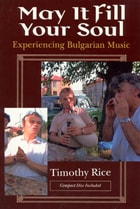
May It Fill Your Soul
Experiencing Bulgarian MusicTimothy Rice
University of Chicago Press, 1994
In the context of this history, Rice brings Bulgarian folk music to life by focusing on the biography of the Varimezov family, including the musician Kostadin and his wife Todora, a singer. Combining interviews with his own experiences of learning how to play, sing and dance Bulgarian folk music, Rice presents one of the most detailed accounts of traditional, aural learning processes in the ethnomusicological literature.
Using a combination of traditionally dichotomous musicological and ethnographic approaches, Rice tells the story of how individual musicians learned their tradition, how they lived it during the pre-Communist era of family farming, how the tradition changed with industrialization brought under Communism, and finally, how it flourished and evolved in the recent, unstable political climate.
This work—complete with a compact disc and numerous illustrations and musical examples—contributes not only to ethnomusicological theory and method, but also to our understanding of Slavic folklore, Eastern European anthropology, and cultural processes in Socialist states.

Messa da Requiem for the Anniversary of the Death of Manzoni, 22 May 1874
Giuseppe Verdi Edited by David Rosen
University of Chicago Press, 1990
Messa da Requiem
Critical Edition Study ScoreGiuseppe Verdi
University of Chicago Press, 2016
This edition of Messa da Requiem is based on Verdi’s autograph score and other original sources. The appendices include two pieces from the compositional history of the Requiem: an early version of the Libera me, composed in 1869 as part of a collaborative work planned as a memorial to Rossini; and the Liber scriptus, which in the original score of the Manzoni memorial Requiem was composed as a fugue for chorus. The introduction to the score traces the complex compositional and performance histories of the Requiem and discusses the work’s problems of instrumentation and notation, while the critical commentary gives a full description of the sources and an account of all editorial decisions.
Message to Our Folks
The Art Ensemble of ChicagoPaul Steinbeck
University of Chicago Press, 2017
In Message to Our Folks, Paul Steinbeck combines musical analysis and historical inquiry to give us the definitive study of the Art Ensemble. In the book, he proposes a new theory of group improvisation that explains how the band members were able to improvise together in so many different styles while also drawing on an extensive repertoire of notated compositions. Steinbeck examines the multimedia dimensions of the Art Ensemble’s performances and the ways in which their distinctive model of social relations kept the group performing together for four decades. Message to Our Folks is a striking and valuable contribution to our understanding of one of the world’s premier musical groups.
Metal Rules the Globe
Heavy Metal Music around the WorldJeremy Wallach, Harris M. Berger, and Paul D. Greene, eds.
Duke University Press, 2012
Contributors. Idelber Avelar, Albert Bell, Dan Bendrups, Harris M. Berger, Paul D. Greene, Ross Hagen, Sharon Hochhauser, Shuhei Hosokawa, Keith Kahn-Harris, Kei Kawano, Rajko Muršič,Steve Waksman, Jeremy Wallach, Robert Walser, Deena Weinstein, Cynthia P. Wong
Mexican American Mojo
Popular Music, Dance, and Urban Culture in Los Angeles, 1935–1968Anthony Macías
Duke University Press, 2008
Macías conducted numerous interviews for Mexican American Mojo, and the voices of little-known artists and fans fill its pages. In addition, more famous musicians such as Ritchie Valens and Lalo Guerrero are considered anew in relation to their contemporaries and the city. Macías examines language, fashion, and subcultures to trace the history of hip and cool in Los Angeles as well as the Chicano influence on urban culture. He argues that a grass-roots “multicultural urban civility” that challenged the attempted containment of Mexican Americans and African Americans emerged in the neighborhoods, schools, nightclubs, dance halls, and auditoriums of mid-twentieth-century Los Angeles. So take a little trip with Macías, via streetcar or freeway, to a time when Los Angeles had advanced public high school music programs, segregated musicians’ union locals, a highbrow municipal Bureau of Music, independent R & B labels, and robust rock and roll and Latin music scenes.
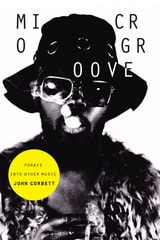
Microgroove
Forays into Other MusicJohn Corbett
Duke University Press, 2015
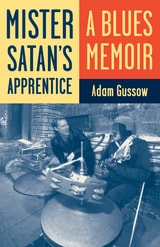
Mister Satan's Apprentice
A Blues MemoirAdam Gussow
University of Minnesota Press, 1998
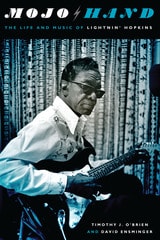
Mojo Hand
The Life and Music of Lightnin' HopkinsBy Timothy J. O'Brien and David Ensminger
University of Texas Press, 2013
In a career that took him from the cotton fields of East Texas to the concert stage at Carnegie Hall and beyond, Lightnin’ Hopkins became one of America’s greatest bluesmen, renowned for songs whose topics effortlessly ranged from his African American roots to space exploration, the Vietnam War, and lesbianism, performed in a unique, eccentric, and spontaneous style of guitar playing that inspired a whole generation of rock guitarists. Hopkins’s music directly and indirectly influenced an amazing range of artists, including Jimi Hendrix, Stevie Ray Vaughan, Miles Davis, John Coltrane, Tom Waits, and Bob Dylan, as well as bands such as the Grateful Dead, Jefferson Airplane, and ZZ Top, with whom Hopkins performed.
Mojo Hand follows Lightin’ Hopkins’s life and music from the acoustic country blues that he began performing in childhood, through the rise of 1950s rock ’n’ roll, which nearly derailed his career, to his reinvention and international success as a pioneer of electric folk blues from the 1960s to the 1980s. The authors draw on 130 vivid oral histories, as well as extensive archival and secondary sources, to provide the fullest account available of the development of Hopkins’s music; his idiosyncratic business practices, such as shunning professional bookers, managers, and publicists; and his durable and indelible influence on modern roots, blues, rock ’n’ roll, singer-songwriter, and folk music. Mojo Hand celebrates the spirit and style, intelligence and wit, and confounding musical mystique of a bluesman who shaped modern American music like no one else.
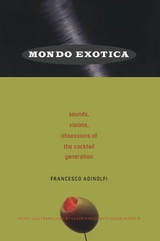
Mondo Exotica
Sounds, Visions, Obsessions of the Cocktail GenerationFrancesco Adinolfi Edited and translated by Karen Pinkus with Jason Vivrette
Duke University Press, 2008
Adinolfi interviewed a number of exotica greats, and Mondo Exotica incorporates material from his interviews with Martin Denny, Esquivel, the Italian film composers Piero Piccioni and Piero Umiliani, and others. It begins with an extended look at the postwar popularity of exotica in the United States. Adinolfi describes how American bachelors and suburbanites embraced the Polynesian god Tiki as a symbol of escape and sexual liberation; how Les Baxter’s album Ritual of the Savage (1951) ushered in the exotica music craze; and how Martin Denny’s Exotica built on that craze, hitting number one in 1957. Adinolfi chronicles the popularity of performers from Yma Sumac, “the Peruvian Nightingale,” to Esquivel, who was described by Variety as “the Mexican Duke Ellington,” to the chanteuses Eartha Kitt, Julie London, and Ann-Margret. He explores exotica’s many sub-genres, including mood music, crime jazz, and spy music. Turning to Italy, he reconstructs the postwar years of la dolce vita, explaining how budget spy films, spaghetti westerns, soft-core porn movies, and other genres demonstrated an attraction to the foreign. Mondo Exotica includes a discography of albums, compilations, and remixes.
Mongolian Sound Worlds
Edited by Jennifer C. Post, Sunmin Yoon, and Charlotte D'Evelyn
University of Illinois Press, 2022
A merger of expert scholarship and eyewitness experience, Mongolian Sound Worlds illuminates a diverse and ever-changing musical culture.
Contributors: Bayarsaikhan Badamsuren, Otgonbaayar Chuulunbaatar, Andrew Colwell, Johanni Curtet, Charlotte D’Evelyn, Tamir Hargana, Peter K. Marsh, K. Oktyabr, Rebekah Plueckhahn, Jennifer C. Post, D. Tserendavaa, and Sunmin Yoon
More Important Than the Music
A History of Jazz DiscographyBruce D. Epperson
University of Chicago Press, 2013

More Opera Scenes for Class and Stage
From One Hundred Selected OperasMary Elaine Wallace and Robert Wallace
Southern Illinois University Press, 1990
Reviewing the first volume of Opera Scenes for Class and Stage, Walter Ducloux wrote in the Opera Journal: "If you can come up, within five seconds, with an operatic excerpt involving two sopranos, four mezzo-sopranos, two tenors, and a bass, you don't need this book. Otherwise hurry and buy it. I keep it on my night table."
In More Opera Scenes, the Wallaces have reviewed 100 additional operas and have chosen over 700 scenes. The popular "Table of Voice Categories" providing more than 300 combinations is also featured in this volume.
Mormons, Musical Theater, and Belonging in America
Jake Johnson
University of Illinois Press, 2019

Mosè in Egitto
Azione tragico-sacra in Three Acts by Andrea Leone TottolaGioachino Rossini
University of Chicago Press, 2005
This critical edition presents the version performed in 1820 after Rossini had revised the unsuccessful and now lost third act of 1818. The edition includes an appendix with the original aria for Pharaoh written by Michele Carafa, which was performed throughout the nineteenth century even after Rossini replaced it with one of his own. Also featured are vocal ornamentation used in Paris performances and detailed information on the Paris productions between 1822 and 1840. This comprehensive critical edition provides a reliable source for interpretation and study of a work that Rossini called "sublime."
Mothership Connected
The Women of Parliament-FunkadelicSeth Neblett
University of Texas Press, 2025
An oral history with the women of Parliament-Funkadelic, from forming the band to landing the mothership.
Parliament-Funkadelic is perhaps the greatest funk band ever assembled. Yet at the time of the group’s induction into the Rock & Roll Hall of Fame, none of the women who helped create the sound and performed in P-Funk were invited to the ceremony and their contributions have been largely overlooked.
Mothership Connected tells the story of Mallia Franklin, Lynn Mabry, Dawn Silva, Debbie Wright, and Shirley Hayden, all of whom were instrumental in making Parliament-Funkadelic, as well as the spin-off groups Parlet and the Brides of Funkenstein, into the legends they are today. Assembled by Seth Neblett, son of the “Queen of Funk” Mallia Franklin, and filled with the voices of funk icons like George Clinton, Sly Stone, Bootsy Collins, and the women themselves, this oral history makes clear why these “architects” at the “core” of P-Funk were both essential—and erased. From Franklin introducing Bootsy Collins to Clinton, to the Brides’ top-10 hit “Disco to Go,” to the drugs that helped destroy the group, this book reveals the hidden lives and uncomfortable truths of life in P-Funk. More than sex, drugs, and rock and roll, Mothership Connected is about Black women navigating a tumultuous era and industry to become musical pioneers. Now, after decades in the shadows, these genre-defining women are finally telling their story.
Move On Up
Chicago Soul Music and Black Cultural PowerAaron Cohen
University of Chicago Press, 2019
A Booklist Top 10 Arts Book of 2019
A No Depression Top Music Book of 2019
Curtis Mayfield. The Chi-Lites. Chaka Khan. Chicago’s place in the history of soul music is rock solid. But for Chicagoans, soul music in its heyday from the 1960s to the 1980s was more than just a series of hits: it was a marker and a source of black empowerment. In Move On Up, Aaron Cohen tells the remarkable story of the explosion of soul music in Chicago. Together, soul music and black-owned businesses thrived. Record producers and song-writers broadcast optimism for black America’s future through their sophisticated, jazz-inspired productions for the Dells and many others. Curtis Mayfield boldly sang of uplift with unmistakable grooves like “We’re a Winner” and “I Plan to Stay a Believer.” Musicians like Phil Cohran and the Pharaohs used their music to voice Afrocentric philosophies that challenged racism and segregation, while Maurice White of Earth, Wind, and Fire and Chaka Khan created music that inspired black consciousness. Soul music also accompanied the rise of African American advertisers and the campaign of Chicago’s first black mayor, Harold Washington, in 1983. This empowerment was set in stark relief by the social unrest roiling in Chicago and across the nation: as Chicago’s homegrown record labels produced rising stars singing songs of progress and freedom, Chicago’s black middle class faced limited economic opportunities and deep-seated segregation, all against a backdrop of nationwide deindustrialization.
Drawing on more than one hundred interviews and a music critic’s passion for the unmistakable Chicago soul sound, Cohen shows us how soul music became the voice of inspiration and change for a city in turmoil.
Moving Away from Silence
Music of the Peruvian Altiplano and the Experience of Urban MigrationThomas Turino
University of Chicago Press, 1993
Turino's ethnography is the first large-scale study to concentrate on the pervasive effects of migration on Andean people and their music. Turino uses the musical traditions of Conima, Peru as a unifying thread, tracing them through the varying lives of Conimeos in different locales. He reveals how music both sustains and creates meaning for a people struggling amid the dramatic social upheavals of contemporary Peru.
Moving Away from Silence contains detailed interpretations based on comparative field research of Conimeo musical performance, rehearsals, composition, and festivals in the highlands and Lima. The volume will be of great importance to students of Latin American music and culture as well as ethnomusicological and ethnographic theory and method.

Mozart and His World
Edited by Simon P. Keefe
University of Chicago Press, 2026
A collection of essays that reinvigorates our understanding of some of Mozart's best-loved works.
One of the world’s most revered composers, Wolfgang Amadeus Mozart (1756–1791) wrote works in almost every genre. His life and work continue to fascinate scholars, performers, and music lovers alike. Mozart and His World brings original perspectives to perennially popular topics in Mozart studies. Through wide-ranging essays that address interpretive, biographical, and contextual themes, the volume simultaneously widens and refines our view of Mozart’s oeuvre.
Mozart and His World moves from studies of instrumental music and musicians to the interpretation and reception of Mozart’s operas, and finally to primary sources from the decade or so after Mozart’s death. Across original chapters and several archival documents, Mozart and His World points new ways forward in key areas of Mozart scholarship, including the study of intellectual and stylistic ideas informing his works and of musicians and institutions within his orbit. While the volume reshapes our understanding of some of Mozart’s best-loved works, including The Magic Flute and his other operas, it also probes works that have received less attention, such as his early string quartets, an opera parody, and wind-music culture and arrangements.
Mozart and the Mediation of Childhood
Adeline Mueller
University of Chicago Press, 2021
The story of Wolfgang Amadeus Mozart’s precocity is so familiar as to be taken for granted. In scholarship and popular culture, Mozart the Wunderkind is often seen as belonging to a category of childhood all by himself. But treating the young composer as an anomaly risks minimizing his impact. In this book, Adeline Mueller examines how Mozart shaped the social and cultural reevaluation of childhood during the Austrian Enlightenment. Whether in a juvenile sonata printed with his age on the title page, a concerto for a father and daughter, a lullaby, a musical dice game, or a mass for the consecration of an orphanage church, Mozart’s music and persona transformed attitudes toward children’s agency, intellectual capacity, relationships with family and friends, political and economic value, work, school, and leisure time.
Thousands of children across the Habsburg Monarchy were affected by the Salzburg prodigy and the idea he embodied: that childhood itself could be packaged, consumed, deployed, “performed”—in short, mediated—through music. This book builds upon a new understanding of the history of childhood as dynamic and reciprocal, rather than a mere projection or fantasy—as something mediated not just through texts, images, and objects but also through actions. Drawing on a range of evidence, from children’s periodicals to Habsburg court edicts and spurious Mozart prints, Mueller shows that while we need the history of childhood to help us understand Mozart, we also need Mozart to help us understand the history of childhood.

Mozart the Performer
Variations on the Showman's ArtDorian Bandy
University of Chicago Press, 2023
We know Mozart as one of history’s greatest composers. But his contemporaries revered him as a multi-instrumentalist, a dazzling improviser, and the foremost keyboard virtuoso of his time. When he composed, it was often with a single aim in mind: to set the stage, quite literally, for compelling and captivating performances. He wrote piano concertos not with an eye to posterity but to give himself a repertoire with which to flaunt his keyboard wizardry before an awestruck public. The same was true of his sonatas, string quartets, symphonies, and operas, all of which were painstakingly crafted to produce specific effects on those who played or heard them, amusing, stirring, and ravishing colleagues and consumers alike.
Mozart the Performer brings to life this elusive side of Mozart’s musicianship. Dorian Bandy traces the influence of showmanship on Mozart’s style, showing through detailed analysis and imaginative historical investigation how he conceived his works as a series of dramatic scripts. Mozart the Performer is a book for anyone who wishes to engage more deeply with Mozart’s artistry and legacy and understand why, centuries later, his music still captivates us.
Music In Cuba
Alejo Carpentier
University of Minnesota Press, 2002
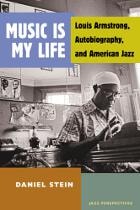
Music Is My Life
Louis Armstrong, Autobiography, and American JazzDaniel Stein
University of Michigan Press, 2012
Music Is My Life is the first comprehensive analysis of Louis Armstrong's autobiographical writings (including his books, essays, and letters) and their relation to his musical and visual performances. Combining approaches from autobiography theory, literary criticism, intermedia studies, cultural history, and musicology, Daniel Stein reconstructs Armstrong's performances of his life story across various media and for different audiences, complicating the monolithic and hagiographic views of the musician.
The book will appeal to academic readers with an interest in African American studies, jazz studies, musicology, and popular culture, as well as general readers interested in Armstrong's life and music, jazz, and twentieth-century entertainment. While not a biography, it provides a key to understanding Armstrong's oeuvre as well as his complicated place in American history and twentieth-century media culture.
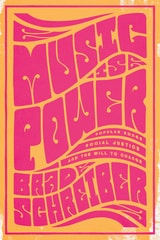
Music Is Power
Popular Songs, Social Justice, and the Will to ChangeBrad Schreiber
Rutgers University Press, 2024
Honorable Mention, Graphis 2021 Design Annual Competition
Popular music has long been a powerful force for social change. Protest songs have served as anthems regarding war, racism, sexism, ecological destruction, and so many other crucial issues.
Music Is Power takes us on a guided tour through the past one hundred years of politically conscious music, from Pete Seeger and Woody Guthrie to Green Day and NWA. Covering a wide variety of genres, including reggae, country, metal, psychedelia, rap, punk, folk, and soul, Brad Schreiber demonstrates how musicians can take a variety of approaches— angry rallying cries, mournful elegies to the victims of injustice, or even humorous mockeries of authority—to fight for a fairer world. While shining a spotlight on Phil Ochs, Gil Scott-Heron, the Dead Kennedys and other seminal, politicized artists, he also gives readers a new appreciation of classic acts such as Lesley Gore, James Brown, and Black Sabbath, who overcame limitations in their industry to create politically potent music
Music Is Power tells fascinating stories about the origins and the impact of dozens of world-changing songs, while revealing political context and the personal challenges of legendary artists from Bob Dylan to Bob Marley.
Supplemental material (Artist and Title List): https://d3tto5i5w9ogdd.cloudfront.net/wp-content/uploads/2020/07/24001955/Music_Is_Power_Supplementary_Artist_Title_List.doc
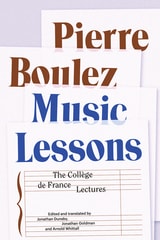
Music Lessons
The Collège de France LecturesPierre Boulez
University of Chicago Press, 2018
Music Lessons marks the first publication in English of Pierre Boulez’s Collège de France lectures, written while he held the chair of Invention, Technique and Language in Music at the Collège between 1976 and 1995. Representing Boulez’s most significant writings from the period, the lectures offer a sustained intellectual engagement with one of the dominant figures of twentieth-century music, a consummate composer-conductor who remained central to the conversation around contemporary music until his death in 2016. Boulez explores, among other topics, the process through which a musical idea is realized in a full-fledged composition, the complementary roles of craft and inspiration and the degree to which the memory of other musical works can influence and change the act of creation. Boulez also gives a penetrating account of problems in classical music that are still present today, such as the conservatism of a musical community fixated on the repertory of the past. Woven into the discussion are stories of his own compositions and those of fellow composers whose work he engaged with in his many roles as teacher, thinker, and conductor: from Stravinsky to Stockhausen and Varèse, from Bartók to Berg, Debussy to Mahler and Wagner, and all the way back to his beloved J. S. Bach.
Including a foreword by semiologist Jean-Jacques Nattiez, who was for years close to the composer, this edition is also enriched by an illuminating preface by Jonathan Goldman. With an authoritative translation retaining Boulez’s fierce convictions, cutting opinions and signature wit, Music Lessons is an essential and entertaining volume.
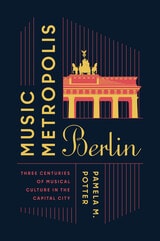
Music Metropolis Berlin
Three Centuries of Musical Culture in the Capital CityPamela M. Potter
University of Chicago Press, 0
Tracing the development of Berlin as a center of music from the eighteenth century to the present, examining how its music survived despite its turbulent history.
Berlin is a music-lover’s paradise, offering up everything from operas to raves. Yet unlike Vienna, Leipzig, or even Nashville, Berlin does not immediately come to mind as a city of music. Instead, its turbulent history evokes images of industry, commerce, militarism, destruction, division, and resurrection. Over the past three centuries, Berlin was the capital of a kingdom, an empire, a republic, and a dictatorship; it was ravaged by war and occupied by foreign powers; and its division and reunification made it a powerful symbol of the Cold War. Through all these highs and lows, the music played on. Music Metropolis Berlin is the first full-length exploration of how Berlin became a city of music against all odds.
Unlike the other European music centers that stake their reputations on the fame of composers like Bach or Beethoven, Berlin is known for its ensembles, artists, theaters, organizers, intellectuals, and media stars. This is because Berlin took a very different, and almost accidental, route to becoming a city of music. Hampered for centuries by rulers who were more focused on military and industrial expansion than on cultural prestige, Berlin’s musical life prospered thanks to the ambitions of entrepreneurs and politicians who saw the value in serving the ever-changing music public in an expanding urban landscape. By focusing on Berlin as a rapidly developing global capital, Music Metropolis Berlin looks beyond the music, its creators, and its institutions to reveal how political, economic, and social forces fueled the creation of the Berlin metropolis and continue to nurture a vibrant and diverse musical life.
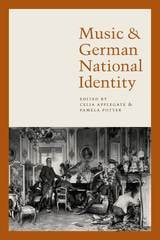
Music and German National Identity
Celia Applegate and Pamela Potter
University of Chicago Press, 2002
This book explores the questions of how music came to be associated with German identity, when and how Germans came to be regarded as the "people of music," and how music came to be designated as "the most German art." Drawing on the expertise of leading scholars in German history, musicology, and German literature, the essays assembled here examine philosophy, literature, politics, and social currents, as well as the creation and performance of folk music, art music, church music, jazz, and pop to explore the ways in which music has continued to play a central role in the German national imagination and in shaping German identity.
Music and Ideas in the Sixteenth and Seventeenth Centuries
Thomas Mathiesen
University of Illinois Press, 2017
Music and Mystique in Muscle Shoals
Christopher M. Reali
University of Illinois Press, 2022
The forceful music that rolled out of Muscle Shoals in the 1960s and 1970s shaped hits by everyone from Wilson Pickett and Aretha Franklin to the Rolling Stones and Paul Simon. Christopher M. Reali's in-depth look at the fabled musical hotbed examines the events and factors that gave the Muscle Shoals sound such a potent cultural power. Many artists trekked to FAME Studios and Muscle Shoals Sound in search of the sound of authentic southern Black music—and at times expressed shock at the mostly white studio musicians waiting to play it for them. Others hoped to draw on the hitmaking production process that defined the scene. Reali also chronicles the overlooked history of Muscle Shoals's impact on country music and describes the region's recent transformation into a tourism destination.
Multifaceted and informed, Music and Mystique in Muscle Shoals reveals the people, place, and events behind one of the most legendary recording scenes in American history.
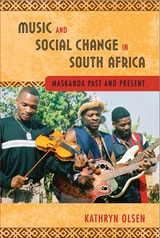
Music and Social Change in South Africa
Maskanda Past and PresentKathryn Olsen
Temple University Press, 2014
Working closely with translated song lyrics and musical notation-and applying musical and socio-political analysis to this music and its cultural context-Olsen argues that maskanda offers insight into how the post-apartheid ideal of social transformation is experienced by those who were marginalized for most of the twentieth century.
Drawing on a decade of research, Olsen strives to demystify the Zulu part of contemporary experience in South Africa and to reveal some of the complexities of the social, economic, and political landscape of contemporary South Africa.
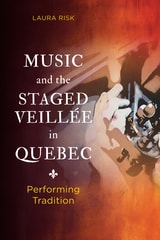
Music and the Staged Veillée in Quebec
Performing TraditionLaura Risk
University of Illinois Press, 2026
Fiddlers, step dancers, storytellers, traditional singers, and folklorists staged Montreal’s first veillée in 1919. All that was missing, announced one of the organizers, was a magic carpet to transport the audience into the countryside and a kiss of forgetfulness to erase the woes of modern life.
Laura Risk tells the story of the veillées and explores how these commercial performances of idealized rural life became part of Quebec’s cultural heritage. Her in-depth examinations of key performances and recordings follow traditional music and dance from the stage onto radio, records and other audio media, and television. Throughout, Risk documents how veillées redefined folklore in twentieth-century Quebec and illuminates how their distinctive framing of traditional musicians and repertoire impacts the performance and reception of the music to the present day.
Astute and evocative, Music and the Staged Veillée in Quebec reveals the music, dancing, call-and-response songs, and extramusical associations winding through century-long conversations about nation, culture, and identity in Quebec.
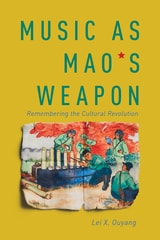
Music as Mao's Weapon
Remembering the Cultural RevolutionLei X. Ouyang
University of Illinois Press, 2022
China's Cultural Revolution (1966-1976) produced propaganda music that still stirs unease and, at times, evokes nostalgia. Lei X. Ouyang uses selections from revolutionary songbooks to untangle the complex interactions between memory, trauma, and generational imprinting among those who survived the period of extremes. Interviews combine with ethnographic fieldwork and surveys to explore both the Cultural Revolution's effect on those who lived through it as children and contemporary remembrance of the music created to serve the Maoist regime. As Ouyang shows, the weaponization of music served an ideological revolution but also revolutionized the senses. She examines essential questions raised by this phenomenon, including: What did the revolutionization look, sound, and feel like? What does it take for individuals and groups to engage with such music? And what is the impact of such an experience over time?
Perceptive and provocative, Music as Mao's Weapon is an insightful look at the exploitation and manipulation of the arts under authoritarianism.