212 books match the query 'German' and 6 start with m

cover of Mediating Culture in the Seventeenth-Century German Novel: Eberhard Werner Happel, 1647-1690

Mediating Culture in the Seventeenth-Century German Novel

Eberhard Werner Happel, 1647-1690

Gerhild Scholz Williams

University of Michigan Press, 2014

Eberhard Happel, German Baroque author of an extensive body of work of fiction and nonfiction, has for many years been categorized as a “courtly-gallant” novelist. In Mediating Culture in the Seventeenth-Century German Novel, author Gerhild Scholz Williams argues that categorizing him thus is to seriously misread him and to miss out on a fascinating perspective on this dynamic period in German history.

Happel primarily lived and worked in the vigorous port city of Hamburg, which was a “media center” in terms of the access it offered to a wide library of books in public and private collections. Hamburg’s port status meant it buzzed with news and information, and Happel drew on this flow of data in his novels. His books deal with many topics of current interest—national identity formation, gender and sexualities, Western European encounters with neighbors to the East, confrontations with non-European and non-Western powers and cultures—and they feature multiple media, including news reports, news collections, and travel writings. As a result, Happel’s use of contemporary source material in his novels feeds our current interest in the impact of the production of knowledge on seventeenth-century narrative. Mediating Culture in the Seventeenth-Century German Novel explores the narrative wealth and multiversity of Happel’s work, examines Happel’s novels as illustrative of seventeenth-century novel writing in Germany, and investigates the synergistic relationship in Happel’s writings between the booming print media industry and the evolution of the German novel.
[more]
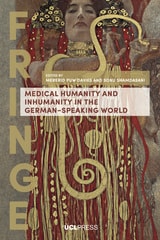
cover of Medical Humanity and Inhumanity in the German-Speaking World

Medical Humanity and Inhumanity in the German-Speaking World

Edited by Mererid Puw Davies and Sonu Shamdasani

University College London, 2020
Medical Humanity and Inhumanity in the German-Speaking World is the first volume dedicated to exploring the interface of medicine, the human and the humane in the German-speaking lands. The volume tracks the designation and making through medicine of the human and inhuman, and the humane and inhumane, from the Middle Ages to the present day. Eight individual chapters undertake explorations into ways in which theories and practices of medicine in the German-speaking world have come to define the human and highlight how such theories and practices have consolidated, or undermined, notions of humane behavior. Cultural analysis is central to this investigation, foregrounding the reflection, refraction and indeed creation of these theories and practices in literature, life-writing, and other discourses and media. Contributors bring to bear perspectives from literary studies, film studies, critical theory, cultural studies, history, and the history of medicine and psychiatry. Thus, this collection is historical in the most expansive sense, for it debates not only what historical accounts bring to our understanding of this topic. It encompasses, too, investigation of life-writing, theory and literary and documentary works and so brings to light elusive, paradoxical, underexplored – yet vital – issues in history and culture.
 
[more]
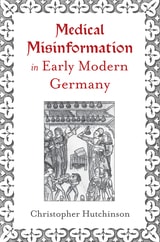
cover of Medical Misinformation in Early Modern Germany

Medical Misinformation in Early Modern Germany

Christopher Hutchinson

University of Delaware Press, 2026

Medical Misinformation in Early Modern Germany examines how doctors, writers, and printers in sixteenth-century Germany responded to the rapid expansion of print and its implications for medical knowledge. The spread of printed texts generated widespread suspicion about print’s reliability as a conduit of information and led writers to reflect on questions of audience, vernacularity, and medical authority in their responses to disease. The book investigates literary texts alongside popular vernacular medical pamphlets on the major epidemic diseases of the period––plague, syphilis, and the English sweating sickness––to reveal a widespread concern with the impact of printed texts on public health. During the 1529 outbreak of the English sweating sickness, this concern culminated in writers’ use of a “rhetoric of virality,” explicitly comparing the circulation of texts to the spread of disease, as they confronted the parallel contagions of disease and information.
[more]
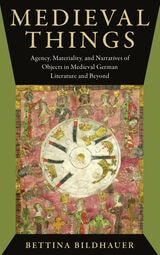
cover of Medieval Things: Agency, Materiality, and Narratives of Objects in Medieval German Literature and Beyond

Medieval Things

Agency, Materiality, and Narratives of Objects in Medieval German Literature and Beyond

Bettina Bildhauer

The Ohio State University Press, 2020
What does medieval literature look like from the point of view not of knights and ladies, but of treasure, and rings, nets and the grail? How does medieval literature imagine the agency of material things, and what exactly distinguishes human subjects from inanimate objects? Medieval Things: Agency, Materiality, and Narratives of Objects in Medieval German Literature and Beyond brings together a theoretically informed and politically engaged new materialist approach with a study of how everyday objects are understood in medieval literature. Bettina Bildhauer argues that medieval narratives can inspire current critical theory on agency and materiality. She focuses on famous and forgotten German narratives from the twelfth to the sixteenth centuries, including Wolfram of Eschenbach’s Parzival and the epic Song of the Nibelungs, and sets them in their global context. Many such tales can be reconceptualized as “thing biographies”—stories that follow the trajectory not of a human hero but of a coin, a gown, a treasure, or a ring. Many also use nets and networks to conceptualize dangerous structures of knowledge. Shine, glamour, and charisma emerge as particularly powerful ways in which material things exert a kind of agency that is neither pseudo-human nor fetishistic. In analyzing details like these from medieval literature, Bildhauer thus contributes in new ways to current theory on agency and materiality.
[more]
cover of More Than Life: Georg Simmel and Walter Benjamin on Art

More Than Life

Georg Simmel and Walter Benjamin on Art

Stéphane Symons

Northwestern University Press, 2017

More Than Life: Georg Simmel and Walter Benjamin on Art is the first book to trace the philosophical relation between Georg Simmel and his one-time student Walter Benjamin, two of the most influential German thinkers of the twentieth century.

Reading Simmel’s work, particularly his essays on Michelangelo, Rembrandt, and Rodin, alongside Benjamin’s concept of Unscheinbarkeit (inconspicuousness) and his writings on Charlie Chaplin, More Than Life demonstrates that both Simmel and Benjamin conceive of art as the creation of something entirely new rather than as a mimetic reproduction of a given. The two thinkers diverge in that Simmel emphasizes the presence of a continuous movement of life, whereas Benjamin highlights the priority of discontinuous, interruptive moments.

With the aim of further elucidating Simmel and Benjamin’s ideas on art, Stéphane Symons presents a number of in-depth analyses of specific artworks that were not discussed by these authors. Through an insightful examination of both the conceptual affinities and the philosophical differences between Simmel and Benjamin , Symons reconstructs a crucial episode in twentieth-century debates on art and aesthetics.  

[more]
cover of mit worten lûter unde glanz: Metapoetics in Konrad von Würzburg’s Trojanerkrieg

mit worten lûter unde glanz

Metapoetics in Konrad von Würzburg’s Trojanerkrieg

Esther Laufer

University of London Press, 2016

How can you fathom a bottomless abyss? How can you capture ineffable beauty in words? How do you narrate the master of all stories? These are the challenges that  seasoned poet Konrad von Würzburg set himself when at the end of the 13th century he composed his account of the Trojan War from a multitude of sources.   Konrad has long been recognized as an exceptionally self-conscious author who frequently reflects on the nature, status and function of poetry, and who at times appears more concerned with the sparkling surface of his discourse than with the events he narrates. Taking these observations as a starting point, this study presents the first comprehensive treatment of metapoetics in the Trojanerkrieg. Focusing on traditional and often discussed loci of metapoetic significance, it also uncovers the far-reaching network of explicit and implicit metapoetic expression that permeates the text on every level - even though its multifaceted imagery and arguments resist translation into the language of formal literary theory. The fact that Konrad’s metapoetic vocabulary regularly draws on imagery of religious origin offers a new perspective from which to address the controversial question of the Christian author’s attitude towards the pagan splendour of the narrated world. In highlighting the pitfalls of metapoetic interpretation and mapping out possible conceptualizations of textuality, language and poetry in Middle High German poetry as well as the relationship between secular and religious literature, this study also makes a broader contribution to medieval literary studies.
[more]