Results by title
98 books match the query 'Government' and 2 start with m
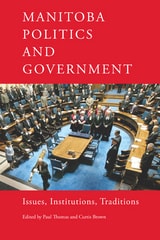
Manitoba Politics and Government
Issues, Institutions, TraditionsPaul Thomas
University of Manitoba Press, 2010
Manitoba has always been a province in the middle, geographically, economically, and culturally. Lacking Quebec’s cultural distinctiveness, Ontario’s traditional economic dominance, or Alberta’s combustible mix of prairie populism and oil wealth, Manitoba appears to blend into the background of the Canadian family portrait. But Manitoba has a distinct political culture, one that has been overlooked in contemporary political studies.Manitoba Politics and Government brings together the work of political scientists, historians, sociologists, economists, public servants, and journalists to present a comprehensive analysis of the province’s political life and its careful “mutual fund model” approach to economic and social policy that mirrors the steady and cautious nature of its citizens. Moving beyond the Legislature, the authors address contemporary social issues like poverty, environmental stewardship, gender equality, health care, and the province’s growing Aboriginal population to reveal the evolution of public policy in the province. They also examine the province’s role at the intergovernmental and international level.Manitoba Politics and Government is a rich and fascinating account of a province that strives for the centre, for the delicate middle ground where individualism and collectivism overlap, and where a multitude of different cultures and traditions create a highly balanced society.
[more]
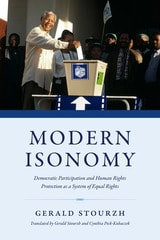
Modern Isonomy
Democratic Participation and Human Rights Protection as a System of Equal RightsGerald Stourzh
University of Chicago Press, 2021
Until the eighteenth century, Western societies were hierarchical ones. Since then, they have transformed themselves into societies dominated by two features: participatory democracy and the protection of human rights. In Modern Isonomy, distinguished political theorist Gerald Stourzh unites these ideas as “isonomy.”
The ideal, Stourzh argues, is a state, and indeed a world, in which individual rights, including the right to participate in politics equally, are clearly defined and possessed by all. Stourzh begins with ancient Greek thought contrasting isonomy—which is associated with the rule of the many—with “gradated societies,” oligarchies, and monarchies. He then discusses the American experiment with the development of representative democracy as well as the French Revolution, which proclaimed that all people are born and remain free and with equal rights. But progress on the creation and protection of rights for all has been uneven. Stourzh discusses specifically the equalization of slaves, peasants, women, Jews, and indigenous people. He demonstrates how deeply intertwined the protection of equal rights is with the development of democracy and gives particular attention to the development of constitutional adjudication, notably the constitutional complaint of individuals. He also discusses the international protection human rights. Timely and thought-provoking, Modern Isonomy is an erudite exploration of political and human rights.
The ideal, Stourzh argues, is a state, and indeed a world, in which individual rights, including the right to participate in politics equally, are clearly defined and possessed by all. Stourzh begins with ancient Greek thought contrasting isonomy—which is associated with the rule of the many—with “gradated societies,” oligarchies, and monarchies. He then discusses the American experiment with the development of representative democracy as well as the French Revolution, which proclaimed that all people are born and remain free and with equal rights. But progress on the creation and protection of rights for all has been uneven. Stourzh discusses specifically the equalization of slaves, peasants, women, Jews, and indigenous people. He demonstrates how deeply intertwined the protection of equal rights is with the development of democracy and gives particular attention to the development of constitutional adjudication, notably the constitutional complaint of individuals. He also discusses the international protection human rights. Timely and thought-provoking, Modern Isonomy is an erudite exploration of political and human rights.
[more]