Results by title
133 books match the query 'Guatemala' and 16 start with m
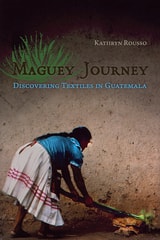
Maguey Journey
Discovering Textiles in GuatemalaKathryn Rousso
University of Arizona Press, 2010
In this fascinating book, Kathryn Rousso, an accomplished textile artist, takes a detailed look at the state of maguey culture, use, and trade in Guatemala. She has spent years traveling in Guatemala, highlighting maguey workers’ interactions in many locations and blending historical and current facts to describe their environments. Along the way, Rousso has learned the process of turning a raw leaf into beautiful and useful textile products and how globalization and modernization are transforming the maguey trade in Guatemala.
Featuring a section of full-color illustrations that follow the process from plant to weaving to product, Maguey Journey presents the story of this fiber over recent decades through the travels of an impassioned artist. Useful to cultural anthropologists, ethnobotanists, fiber artists, and interested travelers alike, this book offers a snapshot of how the industry stands now and seeks to honor those who keep the art alive in Guatemala.
Managing the Counterrevolution
The United States and Guatemala, 1954–1961Stephen M. Streeter
Ohio University Press, 2001
The Eisenhower administration’s intervention in Guatemala is one of the most closely studied covert operations in the history of the Cold War. Yet we know far more about the 1954 coup itself than its aftermath. This book uses the concept of “counterrevolution” to trace the Eisenhower administration’s efforts to restore U.S. hegemony in a nation whose reform governments had antagonized U.S. economic interests and the local elite.
Comparing the Guatemalan case to U.S.-sponsored counterrevolutions in Iran, the Dominican Republic, Brazil, and Chile reveals that Washington’s efforts to roll back “communism” in Latin America and elsewhere during the Cold War represented in reality a short-term strategy to protect core American interests from the rising tide of Third World nationalism.
Maya Achi Marimba Music In Guatemala
Sergio Navarrete Pellicer
Temple University Press, 2005
Maya Bonesetters
Manual Healers in a Changing GuatemalaBy Servando Z. Hinojosa; Illustrations by Servando G. Hinojosa
University of Texas Press, 2020
Scholarship on Maya healing traditions has focused primarily on the roles of midwives, shamans, herbalists, and diviners. Bonesetters, on the other hand, have been largely excluded from conversations about traditional health practitioners and community health resources. Maya Bonesetters is the first book-length study of bonesetting in Guatemala and situates the manual healing tradition within the current cultural context—one in which a changing medical landscape potentially threatens bonesetters’ work yet presents an opportunity to strengthen its relevance.
Drawing on extensive field research in highland Guatemala, Servando Z. Hinojosa introduces readers to a seldom documented, though nonetheless widespread, variety of healer. This book examines the work of Kaqchikel and Tz’utujiil Maya bonesetters, analyzes how they diagnose and treat injuries, and contrasts the empirical and sacred approaches of various healers. Hinojosa shows how bonesetters are carefully adapting certain biomedical technologies to meet local expectations for care and concludes that, despite pressures and criticisms from the biomedical community, bonesetting remains culturally meaningful and vital to Maya people, even if its future remains uncertain.
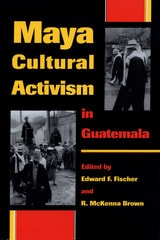
Maya Cultural Activism in Guatemala
Edited by Edward F. Fischer and R. McKenna Brown
University of Texas Press, 1996
Maya Cultural Activism in Guatemala marks a new era in Guatemalan studies by offering an up-to-the-minute look at the pan-Maya movement and the future of the Maya people as they struggle to regain control over their cultural destiny. The successful emergence of what is in some senses a nationalism grounded in ethnicity and language has challenged scholars to reconsider their concepts of nationalism, community, and identity.
Editors Edward F. Fischer and R. McKenna Brown have brought together essays by virtually all the leading U.S. experts on contemporary Maya communities and the top Maya scholars working in Guatemala today. Supplementing scholarly analysis of Mayan cultural activism is a position statement originating within the movement and more wide-ranging and personal reflections by anthropologists and linguists who have worked with the Maya over the years. Among the broader issues that come in for examination are the complex relations between U.S. Mayanists and the Mayan cultural movement, efforts to promote literacy in Mayan languages, the significance of woven textiles and native dress, the relations between language and national identity, and the cultural meanings that the present-day Maya have encountered in ancient Mayan texts and hieroglyphic writing.
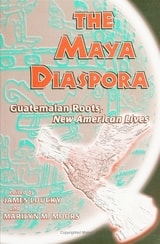
Maya Diaspora
Guatemalan Roots, New American Livesedited by James Loucky and Marilyn M. Moors
Temple University Press, 2000
This widespread poverty was endemic throughout northwestern Guatemala, where 80 percent of Maya children were chronically malnourished, and forced wide-scale migration to the Pacific coast. The self-help aid that flowed into the area in the 1960s and 1970s raised hopes for justice and equity that were brutally suppressed by Guatemala's military government. This military reprisal led to a massive diaspora of Maya throughout Canada, the United States, Mexico, and Central America.
This collection describes that process and the results. The chapters show the dangers and problems of the migratory/refugee process and the range of creative cultural adaptations that the Maya have developed. It provides the first comparative view of the formation and transformation of this new and expanding transnational population, presented from the standpoint of the migrants themselves as well as from a societal and international perspective. Together, the chapters furnish ethnographically grounded perspectives on the dynamic implications of uprooting and resettlement, social and psychological adjustment, long-term prospects for continued links to migration history from Guatemala, and the development of a sense of co-ethnicity with other indigenous people of Maya descent. As the Maya struggle to find their place in a more global society, their stories of quiet courage epitomize those of many other ethnic groups, migrants, and refugees today.
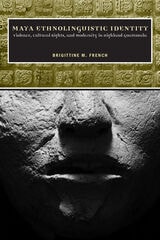
Maya Ethnolinguistic Identity
Violence, Cultural Rights, and Modernity in Highland GuatemalaBrigittine M. French
University of Arizona Press, 2010
French shows, with useful examples, how constructions of language and collective identity are in fact strategies undertaken to serve the goals of institutions (including the government, the military, the educational system, and the church) and social actors (including linguists, scholars, and activists). But by incorporating in-depth fieldwork with groups that speak Kaqchikel and K’iche’ along with analyses of Spanish-language discourses, Maya Ethnolinguistic Identity also shows how some individuals in urban, bilingual Indian communities have disrupted the essentializing projects of multiculturalism. And by focusing on ideologies of language, the author is able to explicitly link linguistic forms and functions with larger issues of consciousness, gender politics, social positions, and the forging of hegemonic power relations.
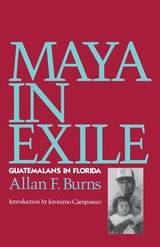
Maya In Exile
Guatemalans in FloridaAllan F. Burns, introduction by Jerónimo Camposeco
Temple University Press, 1993
The Maya are the single largest group of indigenous people living in North and Central America. Beginning in the early 1980s, hundreds of thousands of Maya fled the terror of Guatemalan civil strife to safety in Mexico and the U.S. This ethnography of Mayan immigrants who settled in Indiatown, a small agricultural community in south central Florida, presents the experiences of these traditional people, their adaptations to life in the U.S., and the ways they preserve their ancestral culture. For more than a decade, Allan F. Burns has been researching and doing advocacy work for these immigrant Maya, who speak Kanjobal, Quiche, Mamanâ, and several other of the more than thirty distinct languages in southern Mexico and Guatemala. In this fist book on the Guatemalan Maya in the U.S, he uses their many voices to communicate the experience of the Maya in Florida and describes the advantages and results of applied anthropology in refugee studies and cultural adaptation.
Burns describes the political and social background of the Guatemalan immigrants to the U.S. and includes personal accounts of individual strategies for leaving Guatemala and traveling to Florida. Examining how they interact with the community and recreate a Maya society in the U.S., he considers how low-wage labor influences the social structure of Maya immigrant society and discusses the effects of U.S. immigration policy on these refugees.
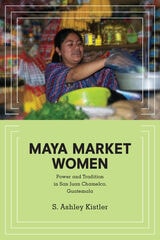
Maya Market Women
Power and Tradition in San Juan Chamelco, GuatemalaS. Ashley Kistler
University of Illinois Press, 2014
As cultural mediators, Chamelco's market women offer a model of contemporary Q'eqchi' identity grounded in the strength of the Maya historical legacy. Guatemala's Maya communities have faced nearly five hundred years of constant challenges to their culture, from colonial oppression to the instability of violent military dictatorships and the advent of new global technologies. In spite of this history, the people of San Juan Chamelco, Guatemala, have effectively resisted significant changes to their cultural identities. Chamelco residents embrace new technologies, ideas, and resources to strengthen their indigenous identities and maintain Maya practice in the 21st century, a resilience that sets Chamelco apart from other Maya towns.
Unlike the region's other indigenous women, Chamelco's Q'eqchi' market women achieve both prominence and visibility as vendors, dominating social domains from religion to local politics. These women honor their families' legacies through continuation of the inherited, high-status marketing trade. In Maya Market Women, S. Ashley Kistler describes how market women gain social standing as mediators of sometimes conflicting realities, harnessing the forces of global capitalism to revitalize Chamelco's indigenous identity. Working at the intersections of globalization, kinship, gender, and memory, Kistler presents a firsthand look at Maya markets as a domain in which the values of capitalism and indigenous communities meet.

Maya Political Science
Time, Astronomy, and the CosmosBy Prudence M. Rice
University of Texas Press, 2004
How did the ancient Maya rule their world? Despite more than a century of archaeological investigation and glyphic decipherment, the nature of Maya political organization and political geography has remained an open question. Many debates have raged over models of centralization versus decentralization, superordinate and subordinate status—with far-flung analogies to emerging states in Europe, Asia, and Africa. But Prudence Rice asserts that neither the model of two giant "superpowers" nor that which postulates scores of small, weakly independent polities fits the accumulating body of material and cultural evidence.
In this groundbreaking book, Rice builds a new model of Classic lowland Maya (AD 179-948) political organization and political geography. Using the method of direct historical analogy, she integrates ethnohistoric and ethnographic knowledge of the Colonial-period and modern Maya with archaeological, epigraphic, and iconographic data from the ancient Maya. On this basis of cultural continuity, she constructs a convincing case that the fundamental ordering principles of Classic Maya geopolitical organization were the calendar (specifically a 256-year cycle of time known as the may) and the concept of quadripartition, or the division of the cosmos into four cardinal directions. Rice also examines this new model of geopolitical organization in the Preclassic and Postclassic periods and demonstrates that it offers fresh insights into the nature of rulership, ballgame ritual, and warfare among the Classic lowland Maya.
Maya Saints and Souls in a Changing World
By John M. Watanabe
University of Texas Press, 1992
The Maya of Santiago Chimaltenango have experienced increasingly rapid, even violent, integration into Guatemalan society in the last fifty years, yet they still distinguish themselves ethnically from Spanish-speaking Guatemalans and other Maya. Why this sense of ethnic identity persists—and also changes—over time is the focus of Maya Saints and Souls in a Changing World, a beautifully written ethnography of a Mam-speaking Maya town in the western highlands of Guatemala.
John Watanabe uniquely explores how Chimaltecos themselves define their local distinctiveness. This approach uncovers significant continuities in lifeways and world view that might otherwise remain imperceptible to an outsider.
Another important feature of the study is that it updates Charles Wagley's pioneering research in the community during the 1930s. Watanabe identifies both the external, historical factors that have prompted change in the community since Wagley's time and the people's responses to these changes.
Maya after War
Conflict, Power, and Politics in GuatemalaBy Jennifer L. Burrell
University of Texas Press, 2013
Guatemala’s thirty-six-year civil war culminated in peace accords in 1996, but the postwar transition has been marked by continued violence, including lynchings and the rise of gangs, as well as massive wage-labor exodus to the United States. For the Mam Maya municipality of Todos Santos Cuchumatán, inhabited by a predominantly indigenous peasant population, the aftermath of war and genocide resonates with a long-standing tension between state techniques of governance and ancient community-level power structures that incorporated concepts of kinship, gender, and generation. Showing the ways in which these complex histories are interlinked with wartime and enduring family/class conflicts, Maya after War provides a nuanced account of a unique transitional postwar situation, including the complex influence of neoliberal intervention.
Drawing on ethnographic field research over a twenty-year period, Jennifer L. Burrell explores the after-war period in a locale where community struggles span culture, identity, and history. Investigating a range of tensions from the local to the international, Burrell employs unique methodologies, including mapmaking, history workshops, and an informal translation of a historic ethnography, to analyze the role of conflict in animating what matters to Todosanteros in their everyday lives and how the residents negotiate power. Examining the community-based divisions alongside national postwar contexts, Maya after War considers the aura of hope that surrounded the signing of the peace accords, and the subsequent doubt and waiting that have fueled unrest, encompassing generational conflicts. This study is a rich analysis of the multifaceted forces at work in the quest for peace, in Guatemala and beyond.
Mayas in Postwar Guatemala
Harvest of Violence RevisitedEdited by Walter E. Little and Timothy J. Smith
University of Alabama Press, 2009
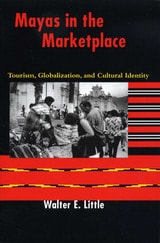
Mayas in the Marketplace
Tourism, Globalization, and Cultural IdentityBy Walter E. Little
University of Texas Press, 2004
2005 — Best Book Award – New England Council of Latin American Studies
Selling handicrafts to tourists has brought the Maya peoples of Guatemala into the world market. Vendors from rural communities now offer their wares to more than 500,000 international tourists annually in the marketplaces of larger cities such as Antigua, Guatemala City, Panajachel, and Chichicastenango. Like businesspeople anywhere, Maya artisans analyze the desires and needs of their customers and shape their products to meet the demands of the market. But how has adapting to the global marketplace reciprocally shaped the identity and cultural practices of the Maya peoples?
Drawing on over a decade of fieldwork, Walter Little presents the first ethnographic study of Maya handicraft vendors in the international marketplace. Focusing on Kaqchikel Mayas who commute to Antigua to sell their goods, he explores three significant issues:
- how the tourist marketplace conflates global and local distinctions.
- how the marketplace becomes a border zone where national and international, developed and underdeveloped, and indigenous and non-indigenous come together.
- how marketing to tourists changes social roles, gender relationships, and ethnic identity in the vendors' home communities.
Little's wide-ranging research challenges our current understanding of tourism's negative impact on indigenous communities. He demonstrates that the Maya are maintaining a specific, community-based sense of Maya identity, even as they commodify their culture for tourist consumption in the world market.
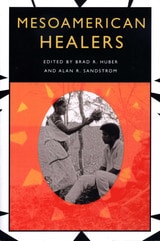
Mesoamerican Healers
Edited by Brad R. Huber and Alan R. Sandstrom
University of Texas Press, 2001
Healing practices in Mesoamerica span a wide range, from traditional folk medicine with roots reaching back into the prehispanic era to westernized biomedicine. These sometimes cooperating, sometimes competing practices have attracted attention from researchers and the public alike, as interest in alternative medicine and holistic healing continues to grow.
Responding to this interest, the essays in this book offer a comprehensive, state-of-the-art survey of Mesoamerican healers and medical practices in Mexico and Guatemala. The first two essays describe the work of prehispanic and colonial healers and show how their roles changed over time. The remaining essays look at contemporary healers, including bonesetters, curers, midwives, nurses, physicians, social workers, and spiritualists. Using a variety of theoretical approaches, the authors examine such topics as the intersection of gender and curing, the recruitment of healers and their training, healers' compensation and workload, types of illnesses treated and recommended treatments, conceptual models used in diagnosis and treatment, and the relationships among healers and between indigenous healers and medical and political authorities.
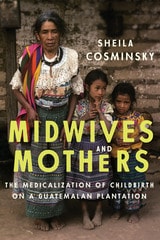
Midwives and Mothers
The Medicalization of Childbirth on a Guatemalan PlantationBy Sheila Cosminsky
University of Texas Press, 2016
The World Health Organization is currently promoting a policy of replacing traditional or lay midwives in countries around the world. As part of an effort to record the knowledge of local midwives before it is lost, Midwives and Mothers explores birth, illness, death, and survival on a Guatemalan sugar and coffee plantation, or finca, through the lives of two local midwives, Doña Maria and her daughter Doña Siriaca, and the women they have served over a forty-year period.
By comparing the practices and beliefs of the mother and daughter, Sheila Cosminsky shows the dynamics of the medicalization process and the contestation between the midwives and biomedical personnel, as the latter try to impose their system as the authoritative one. She discusses how the midwives syncretize, integrate, or reject elements from Mayan, Spanish, and biomedical systems. The midwives’ story becomes a lens for understanding the impact of medicalization on people’s lives and the ways in which women’s bodies have become contested terrain between traditional and contemporary medical practices. Cosminsky also makes recommendations for how ethno-obstetric and biomedical systems may be accommodated, articulated, or integrated. Finally, she places the changes in the birthing system in the larger context of changes in the plantation system, including the elimination of coffee growing, which has made women, traditionally the primary harvesters of coffee beans, more economically dependent on men.