Results by title
116 books match the query 'Health aspects' and 9 start with m
Making Americans Healthier
Social and Economic Policy as Health PolicyRobert F. Schoeni
Russell Sage Foundation, 2008
Making the Unseen Visible
Science and the Contested Histories of Radiation ExposureJacob Darwin Hamblin
Oregon State University Press, 2023
From 2017 to 2020, Jacob Hamblin and Linda Richards ran the Oregon State University Downwinders Project, sponsored by the National Science Foundation, to support research and scholarship on the Hanford downwinders cases. Additionally, each summer the project team sponsored a workshop that brought a variety of stakeholders together to explore the science, history, and lived experiences of nuclear exposure. These workshops took a broad view of nuclear exposure, beyond Hanford, beyond the United States, and beyond academia. Community members and activists presented their testimonies and creative work alongside scholars studying exposure worldwide.
Making the Unseen Visible collects the best work arising from the project and its workshops. Scholarly research chapters and reflective essays cover topics and experiences ranging from colonial nuclear testing in North Africa, to Hiroshima survivor stories, to uranium mining in the Navajo Nation, to battles over public memory around Hanford. Scholarship on nuclear topics has largely happened on a case study basis, focusing on individual disasters or locations. Making the Unseen Visible brings a variety of current community and scholarly work together to create a clearer, larger web uniting nuclear humanities research across time and geography.
Malaria on the Move
Rural Communities and Public Health in Zimbabwe, 1890-2015Kundai Manamere
Ohio University Press, 2025

Mammographies
The Cultural Discourses of Breast Cancer NarrativesMary K. DeShazer
University of Michigan Press, 2015
While breast cancer continues to affect the lives of millions, contemporary writers and artists have responded to the ravages of the disease in creative expression. Mary K. DeShazer’s book looks specifically at breast cancer memoirs and photographic narratives, a category she refers to as mammographies, signifying both the imaging technology by which most Western women discover they have this disease and the documentary imperatives that drive their written and visual accounts of it. Mammographies argues that breast cancer narratives of the past ten years differ from their predecessors in their bold address of previously neglected topics such as the link between cancer and environmental carcinogens, the ethics and efficacy of genetic testing and prophylactic mastectomy, and the shifting politics of prosthesis and reconstruction.
Mammographies is distinctive among studies of contemporary illness narratives in its exclusive focus on breast cancer, its analysis of both memoirs and photographic texts, its attention to hybrid and collaborative narratives, and its emphasis on ecological, genetic, transnational, queer, and anti-pink discourses. DeShazer’s methodology—best characterized as literary critical, feminist, and interdisciplinary—includes detailed interpretation of the narrative strategies, thematic contours, and visual imagery of a wide range of contemporary breast cancer memoirs and photographic anthologies. The author explores the ways in which the narratives constitute a distinctive testimonial and memorial tradition, a claim supported by close readings and theoretical analysis that demonstrates how these narratives question hegemonic cultural discourses, empower reader-viewers as empathic witnesses, and provide communal sites for mourning, resisting, and remembering.
Mass Destruction
The Men and Giant Mines That Wired America and Scarred the PlanetTimothy J. LeCain
Rutgers University Press, 2009
Mass destruction mining soon spread around the nation and the globe, providing raw materials essential to the mass production and mass consumption that increasingly defined the emerging "American way of life." At the dawn of the last century, Jackling's open pit replaced immense but constricted underground mines that probed nearly a mile beneath the earth, to become the ultimate symbol of the modern faith that science and technology could overcome all natural limits. A new culture of mass destruction emerged that promised nearly infinite supplies not only of copper, but also of coal, timber, fish, and other natural resources.
But, what were the consequences? Timothy J. LeCain deftly analyzes how open-pit mining continues to affect the environment in its ongoing devastation of nature and commodification of the physical world. The nation's largest toxic Superfund site would be one effect, as well as other types of environmental dead zones around the globe. Yet today, as the world's population races toward American levels of resource consumption, truly viable alternatives to the technology of mass destruction have not yet emerged.
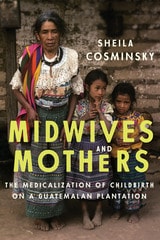
Midwives and Mothers
The Medicalization of Childbirth on a Guatemalan PlantationBy Sheila Cosminsky
University of Texas Press, 2016
The World Health Organization is currently promoting a policy of replacing traditional or lay midwives in countries around the world. As part of an effort to record the knowledge of local midwives before it is lost, Midwives and Mothers explores birth, illness, death, and survival on a Guatemalan sugar and coffee plantation, or finca, through the lives of two local midwives, Doña Maria and her daughter Doña Siriaca, and the women they have served over a forty-year period.
By comparing the practices and beliefs of the mother and daughter, Sheila Cosminsky shows the dynamics of the medicalization process and the contestation between the midwives and biomedical personnel, as the latter try to impose their system as the authoritative one. She discusses how the midwives syncretize, integrate, or reject elements from Mayan, Spanish, and biomedical systems. The midwives’ story becomes a lens for understanding the impact of medicalization on people’s lives and the ways in which women’s bodies have become contested terrain between traditional and contemporary medical practices. Cosminsky also makes recommendations for how ethno-obstetric and biomedical systems may be accommodated, articulated, or integrated. Finally, she places the changes in the birthing system in the larger context of changes in the plantation system, including the elimination of coffee growing, which has made women, traditionally the primary harvesters of coffee beans, more economically dependent on men.
Migration and Health
Edited by Sandro Galea, Catherine K. Ettman, and Muhammad H. Zaman
University of Chicago Press, 2022
International migrants compose more than three percent of the world’s population, and internal migrants—those migrating within countries—are more than triple that number. Population migration has long been, and remains today, one of the central demographic shifts shaping the world around us. The world’s history—and its health—is shaped and colored by stories of migration patterns, the policies and political events that drive these movements, and narratives of individual migrants.
Migration and Health offers the most expansive framework to date for understanding and reckoning with human migration’s implications for public health and its determinants. It interrogates this complex relationship by considering not only the welfare of migrants, but also that of the source, destination, and ensuing-generation populations. The result is an elevated, interdisciplinary resource for understanding what is known—and the considerable territory of what is not known—at an intersection that promises to grow in importance and influence as the century unfolds.
Migration and Mortality
Social Death, Dispossession, and Survival in the AmericasEdited by Jamie Longazel and Miranda Cady Hallett
Temple University Press, 2021
Death threatens migrants physically during perilous border crossings between Central and North America, but many also experience legal, social, and economic mortality. Rooted in histories of colonialism and conquest, exclusionary policies and practices deliberately take aim at racialized, dispossessed people in transit. Once in the new land, migrants endure a web of systems across every facet of their world—work, home, healthcare, culture, justice—that strips them of their personhood, denies them resources, and creates additional obstacles that deprive them of their ability to live fully.
As laws and policies create ripe conditions for the further extraction of money, resources, and labor power from the dispossessed, the contributors to this vibrant anthology, Migration and Mortality, examine restrictive immigration policies and the broader capitalist systems of exploitation and inequality while highlighting the power of migrants’ collective resistance and resilience.
The case studies in this timely collection explore border deaths, detention economies, asylum seeking, as well as the public health and mental health of migrants. Ultimately, these examples of oppression and survival contribute to understanding broader movements for life and justice in the Americas.
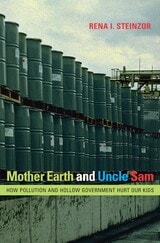
Mother Earth and Uncle Sam
How Pollution and Hollow Government Hurt Our KidsBy Rena I. Steinzor
University of Texas Press, 2007
In this compelling study, Rena Steinzor highlights the ways in which the government, over the past twenty years, has failed to protect children from harm caused by toxic chemicals. She believes these failures—under-funding, excessive and misguided use of cost/benefit analysis, distortion of science, and devolution of regulatory authority—have produced a situation in which harm that could be reduced or eliminated instead persists.
Steinzor states that, as a society, we are neglecting our children's health to an extent that we would find unthinkable as individual parents, primarily due to the erosion of the government's role in protecting public health and the environment. At this pace, she asserts, our children will inherit a planet under grave threat. We can arrest these developments if a critical mass of Americans become convinced that these problems are urgent and the solutions are near at hand.
By focusing on three specific case studies—mercury contamination through the human food chain, perchlorate (rocket fuel) in drinking water, and the effects of ozone (smog) on children playing outdoors—Steinzor creates an analysis grounded in law, economics, and science to prove her assertions about the existing dysfunctional system.
Steinzor then recommends a concise and realistic series of reforms that could reverse these detrimental trends and serve as a blueprint for restoring effective governmental intervention. She argues that these recommendations offer enough material to guide government officials and advocacy groups toward prompt implementation, for the sake of America's—and the world's—future generations.