Results by title
883 books match the query 'Historical' and 49 start with m
Macmillan
Francis Beckett
Haus Publishing, 2006
Mail and Female
Epistolary Narrative and Desire in Ovid's HeroidesSara H. Lindheim
University of Wisconsin Press, 2003
Using feminist and psychoanalytic approaches to examine the "female voice" in the Heroides, Sara H. Lindheim closely reads these fictive letters in which the women seemingly tell their own stories. She points out that in Ovid’s verse epistles all the women represent themselves in a strikingly similar and disjointed fashion. Lindheim turns to Lacanian theory of desire to explain these curious and hauntingly repetitive representations of the heroines in the "female voice." Lindheim’s approach illuminates what these poems reveal about both masculine and feminine constructions of the feminine
Major
Robert Taylor
Haus Publishing, 2006
Making History Move
Five Principles of the Historical FilmKim Nelson
Rutgers University Press, 2024
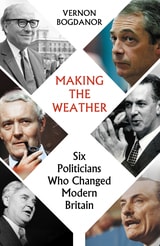
Making the Weather
Six Politicians Who Changed Modern BritainVernon Bogdanor
Haus Publishing, 2025
Making the Weather is the story of six postwar politicians, all of whom exerted an outsized influence on the political life of the United Kingdom—an influence greater than that of most prime ministers. Vernon Bogdanor’s cast includes three from the political Left—Aneurin “Nye” Bevan, Roy Jenkins, and Tony Benn—and three from the Right—Enoch Powell, Keith Joseph, and Nigel Farage. Each study is a fascinating analysis examining how these men achieved such prominence and influence and how, though very different figures in many ways, they came to dominate the political landscape, often for years.
Each of the six made fundamental contributions to the debate about Britain’s future and to the vibrancy of British democracy. From immigration to Europe, from the National Health Service to devolution, the issues and causes that brought these men to prominence are still relevant.
Malambo
Lucía Charún-Illescas
Swan Isle Press, 2004
“In Malambo . . . the Rimac proudly rubs elbows with the freedmen, the cimarrons, and smuggled slaves. . . It runs united to the other subterranean springs underneath Blanket Street, Weavers Lane, and under Jewish Street . . . and Swordmaker’s Lanes.”
The Rimac shapes the narrative of this compelling historical novel that probes the brutal clash of ethnicity, religion, and class in sixteenth- and seventeenth-century Peru. Set against the backdrop of Spanish colonialism and the Spanish Inquisition in the “New World,” Malambo peels back the layers of Peru’s society to focus on the subtle connections among indigenous peoples— Africans, Jews, Christians, and others—whose cultural fusion pervades Latin American history and culture.
At the heart of the novel is Tomason, an African artist living along the Rimac who paints religious murals for the church and his colonial masters. The intermingling of his Yoruba heritage with his life in a Spanish colony transforms him into a griot figure who unearths the deeper truths of his painful and complex experience by sharing it. Other memorable characters’ stories intertwine with Tomason’s tale, developing a narrative that powerfully reflects on the themes of dislocation and enslavement.
Malambo is an unforgettable work that explores the origins of the Afro-Hispanic experience and offers a profound meditation on the forces of history.
Manassas
A Novel of the WarUpton Sinclair
University of Alabama Press, 2000
Centers on the moral dimension of the conflict as it traces a young Mississippi boy’s conversion from pro-slavery Southerner to abolitionist Union soldier
Allan Montague, born on a Mississippi plantation about twenty years before the Civil War, has grown up with slavery and considers it natural. When his father moves to Boston for business and takes the boy with him, young Allan carries a knife given to him by his cousin to use in killing abolitionists.
The first abolitionist young Allan meets in Boston is Levi Coffin, the reputed founder of the Underground Railroad. In this first of many meetings with historical figures, Allan forms a friendship with Coffin, who eventually takes him to hear a speech by former slave Frederick Douglass. Douglass's powerful words cement Allan's transformation into an abolitionist—a transformation that will lead him back to his Deep South home with the hope of freeing slaves and eventually back to the North and the fateful Battle of Manassas.
Kent Gramm, author of the introduction for this new edition of Manassas, calls the novel “a modern version of the morality play,” with the United States as the central character. “The real story, he writes, is the moral phenomenon of the Civil War.” It is a powerful book that deserves to be revived, read, and studied.
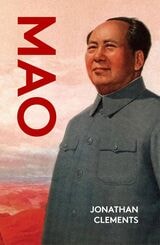
Mao
Jonathan Clements
Haus Publishing, 2026
A concise and comprehensive biography of Mao Zedong, published to coincide with the fiftieth anniversary of his death.
A half-century after his death in September 1976, Mao Zedong remains one of history’s most polarizing figures: a peasant boy who became a revolutionary leader, a general in World War II, and finally the Great Helmsman, the founding father of the People's Republic of China. His legacy is a mix of national liberation and human tragedy. Today, Mao is no static icon on a banknote but the architect of a superpower whose ideas, methods, and personal life are continually reexamined through a modern lens.
This comprehensive biography bridges the gap between the revolutionary and the man without overlooking the events that led to the end of China’s Century of Humiliation, the brutal cost of the Great Leap Forward, and the Cultural Revolution, reevaluating his “mass line” ideology.
Based on new archival information and startling revelations from his inner circle—including his personal physician, Dr. Li Zhisui, and former nurses—Clements offers a clear and accessible portrait of a leader whose persistent influence reminds us why Mao’s story remains essential to understanding the global power dynamics of today.
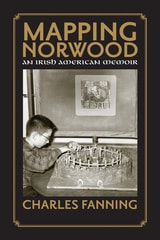
Mapping Norwood
An Irish-American MemoirCharles Fanning
University of Massachusetts Press, 2010
This memoir is an act of map making, of plotting out overlapping territories—topographical, temporal, and psychological. Centered on family life in a Massachusetts town from the 1920s to the 1960s, the author's investigation extends outward to include the Boston area from colonial times to the recent past, encounters with Boston's Museum of Fine Arts and with Harvard College, the American Civil War, and Ireland and Germany in the nineteenth century.
Charles Fanning re-creates the landscape of childhood and adolescence in a place and time both ordinary and rich with possibility. An expert on Irish immigration, he was born and raised in Norwood, Massachusetts, twelve miles outside of Boston, where Yankee and Irish cultures bumped against each other. The narrative traces his personal growth, shaped by family, school, baseball, radio drama, and art. He was the first in his family to attend college, and the book ends with his undergraduate experience at Harvard, class of 1964.
Along with this coming-of-age story, Mapping Norwood features forays back in time, including chapters on each of Fanning's parents and historical excavations and meditations on three ancestors. Guided by his own experience as a scholar, the pressure of these chapters is epistemological—the thrill of the hunt toward knowing. Fanning's great-grandfather, John Fanning, disappeared from the family in the late 1880s, and a chapter chronicles the discovery of “Walking John's” fifty years of hidden later life in East St. Louis, Illinois, where he died alone in 1946. Fanning's great-great-grandfather, Winslow Radcliffe, was a veteran of the 35th Massachusetts Infantry in the Civil War, and the author traces this regiment through the horrors of Antietam and Fredericksburg, by means of diaries and letters by four men from Winslow's company. The evidence gleaned helps explain Winslow's suicide after the war. An Irish immigrant ancestor, Phillip Fanning, came to Boston from County Monaghan just after the Great Famine of the late 1840s. Relying on historical research, Fanning imagines vividly the lives led by Phillip's family and thousands like them in the wake of Ireland's nineteenth-century catastrophe.
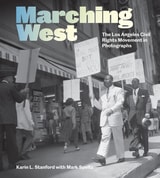
Marching West
The Los Angeles Civil Rights Movement in PhotographsKarin L. Stanford
J. Paul Getty Trust, The, 2026
This volume presents the first visual history of the people and organizations that led the fight for change during the civil rights era in Los Angeles.
During a 1963 speech to a crowd of nearly forty thousand at Wrigley Field in Los Angeles, Dr. Martin Luther King Jr. addressed the question of how Angelenos could contribute to the civil rights movement: “The most important thing that you can do is to set Los Angeles free, because you have segregation and discrimination here, and police brutality.”
Marching West illuminates the dynamic history of civil rights activism in Los Angeles and explores how the medium of photography both witnessed and advanced the fight for Black equality. Over one hundred images, some of which have never been previously published, reveal connections between the local and national movements and document the actions of Western coalitions, religious leaders, Hollywood stars, and concerned citizens. Drawn from the Tom & Ethel Bradley Center at California State University, Northridge (CSUN), the Getty Research Institute, and other Southern California collections—including prints by Harry Adams, Howard Bingham, Charles Brittin, Joe Flowers, Vera Jackson, and Charles Williams—this unprecedented volume presents less familiar but essential stories about American progress toward social justice.
Marco Polo
Jonathan Clements
Haus Publishing, 2006
Marta Oulie
A Novel of BetrayalSigrid Undset
University of Minnesota Press, 2014
“I have been unfaithful to my husband.” Marta Oulie’s opening line scandalized Norwegian readers in 1907. And yet, Sigrid Undset had a gift for depicting modern women “sympathetically but with merciless truthfulness,” as the Swedish Academy noted in awarding her the Nobel Prize for Literature in 1928. At the time she was one of the youngest recipients and only the third woman so honored. It was Undset’s honest story of a young woman’s love life—“the immoral kind,” as she herself bluntly put it—that made her first novel an instant sensation in Norway.
Marta Oulie, written in the form of a diary, intimately documents the inner life of a young woman disappointed and constrained by the conventions of marriage as she longs for an all-consuming passion. Set in Kristiania (now Oslo) at the beginning of the twentieth century, Undset’s book is an incomparable psychological portrait of a woman whose destiny is defined by the changing mores of her day—as she descends, inevitably, into an ever-darker reckoning. Remarkably, though Undset’s other works have attracted generations of readers, Marta Oulie has never before appeared in English translation. Tiina Nunnally, whose award-winning translation of Undset’s Kristin Lavransdatter captured the author’s beautifully clear style, conveys the voice of Marta Oulie with all the stark poignancy of the original Norwegian.
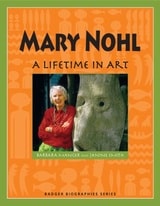
Mary Nohl
A Lifetime in ArtBarbara Manger
Wisconsin Historical Society Press, 2013
LOOK INSIDE THE LIFE — AND HOME — OF LEGENDARY 'OUTSIDER' ARTIST MARY NOHL
"Mary Nohl: A Lifetime in Art" by Barbara Manger and Janine Smith, tells the story of Milwaukee-born artist, Mary Nohl. A prolific and fanciful maker who worked in a variety of media, Nohl was both a mysterious figure and an iconic "outsider" artist. This new addition to the Badger Biographies series captures her life and will capture the imagination of readers, and artists, of all ages.
Nohl didn't just make art — she lived it. From the time she was young, Mary enjoyed making things, from the model airplane that won her a citywide prize to assignments in shop class, where she learned to work with tools.
Her interests in art blossomed during the years she spent training at the Art Institute of Chicago, leading to a lifetime of curiosity and ventures into new artistic media. From pottery to silver jewelry and oil painting to concrete sculpture, Mary explored new ways of making art. Many of her pieces were made from found objects that other people might think of as junk — like chicken bones, bedsprings and sand that she made into concrete.
Nohl, who made her home on the shores of Lake Michigan, decorated the interior of her cottage with bright colors and eye-catching figures in driftwood and glass. During her later years, her home became known as the "Witch's House" — a place of local legend known far beyond Fox Point. Though she died in 2001, Mary's legacy continues. Her art is held at the John Michael Kohler Arts Center in Sheboygan, and her home is listed on the National Register of Historic Places.
The popular Badger Biographies series for young readers explores the lives of famous and not-so-famous figures in Wisconsin history. The Wisconsin Historical Society Press is proud to celebrate the release of this, the 21st book in the series.
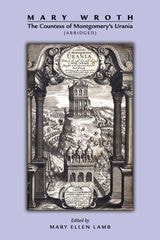
Mary Wroth
The Countess of Montgomery's Urania (Abridged)Edited by Mary Ellen Lamb
Arizona Center for Medieval and Renaissance Studies, 2000

Max Nohl’s Underwater Adventures
Jane Kelley
Wisconsin Historical Society Press, 2027
Dive into the thrilling adventures of the daring explorer who pushed the limits of underwater exploration.
From discovering a pocket of air beneath a half-sunken rowboat as a young boy to setting a world diving record hundreds of feet below the surface of Lake Michigan, Max Nohl never stopped chasing the mysteries of our lakes, seas, and oceans. In Max Nohl’s Underwater Adventures, young readers will dive into the remarkable true story of the man who helped to modernize scuba diving and expand our ability to explore the watery depths.
Inventor, engineer, and explorer, Nohl was pushing the limits of human courage beneath the waves long before scuba diving became a recreational pastime. Readers of this biography for ages 8–11 will follow his riveting shipwreck treasure hunts, daring salvage expeditions, close encounters with sharks, and dramatic escapes from the many dangers under the sea.
But Nohl was more than an adventurer and thrill-seeker. Determined to make diving safer, he studied engineering at MIT and invented new equipment and techniques, including self-contained underwater breathing systems and helium-oxygen mixtures that opened the door to deeper exploration. He also helped pioneer advances in underwater camera equipment that allowed Hollywood moviemakers and others to capture watery scenes on film. Looking beyond Nohl’s own life story, this biography includes sidebars that give readers a peek into the history of deep-sea diving, tales of Great Lakes shipwrecks, and exploits of other record-breaking divers.
Filled with peril, discovery, ingenuity, and larger-than-life escapades, Max Nohl’s Underwater Adventures introduces young readers to an innovator whose curiosity and determination helped to unlock one of Earth’s last great frontiers—the mysterious world beneath the sea.
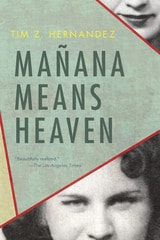
Mañana Means Heaven
Tim Z. Hernandez
University of Arizona Press, 2013
When they meet, Franco is a migrant farmworker with two children and a failing marriage, living with poverty, violence, and the looming threat of deportation, while the “college boy” yearns to one day make a name for himself in the writing world. The significance of their romance poses vastly different possibilities and consequences.
Mañana Means Heaven deftly combines fact and fiction to pull back the veil on one of literature’s most mysterious and evocative characters. Inspired by Franco’s love letters to Kerouac and Hernandez’s interviews with Franco, now in her nineties and living in relative obscurity, the novel brings this lost gem of a story out of the shadows and into the spotlight.
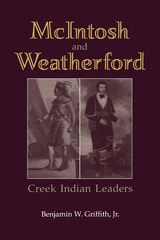
McIntosh and Weatherford
Creek Indian LeadersBenjamin W. Griffith
University of Alabama Press, 1998
The human story behind the Creek War and the coming of Indian Removal.
About the time of the American Revolutionary war, when the Creek Indians owned land that is today approximately the lower two-thirds of Alabama and of Georgia west of the Oconee River, two sons were born to Indian mothers and Scots fathers in obscure towns in the territory of the Creek Nation. Both sons were named William, and both were to become leaders of their mothers’ people.
The two remarkable men lived during a period of war and turbulence along the frontier in Alabama and Georgia. More often the subjects of folk tale and legend than serious historical inquiry, McIntosh and Weatherford fought on opposing sides in the Creek War of 1813-1814. McIntosh allied himself with Andrew Jackson and the friendly Lower Creeks, while Weatherford joined with the hostile Red Stick and was the leader of a band of Upper Creeks in the massacre at Fort Mims. McIntosh, who was given the rank of brigadier general for his military feats, was involved in the machinations that led to the ceding of Creek lands to Georgia. As a result, he died in disgrace at the hands of his fellow Creeks. Weatherford, once hated and feared, died a planter and local hero in Alabama near the site of Fort Mims.
McKay's Bees
A NovelThomas McMahon
University of Chicago Press, 1978
Melville in His Own Time
A Biographical Chronicle of His Life, Drawn from Recollection, Interviews, and Memoirs by Family, Friends, and AssociatesSteven Olsen-Smith
University of Iowa Press, 2015
Melville’s mastery of the English language and heterodox views made him a source of both controversy and fascination to western readers, until his increasing commitment to artistry and contempt for artificial conventions led him to write Moby-Dick (1851) and its successor Pierre (1852). Although the former is considered his masterwork today, the books offended mid-nineteenth-century cultural sensibilities and alienated Melville from the American literary marketplace. The resulting eclipse of his popular reputation was deepened by his voluntary withdrawal from society, so that obituaries written after his death in 1891 frequently expressed surprise that he hadn’t died long before.
With most of his personal papers and letters lost or destroyed, his library of marked and annotated books dispersed, and first-hand accounts of him scattered, brief, and frequently conflicting, Melville’s place in American literary scholarship illustrates the importance of accurately edited documents and the value of new information to our understanding of his life and thought. As a chronologically organized collection of surviving testimonials about the author, Melville in His Own Time continues the tradition of documentary research well-exemplified over the past half-century by the work of Jay Leyda, Merton M. Sealts, and Hershel Parker. Combining recently discovered evidence with new transcriptions of long-known but rarely consulted testimony, this collection offers the most up-to-date and correct record of commentary on Melville by individuals who knew him.
Memoir of My Youth in Cuba
A Soldier in the Spanish Army during the Separatist War, 1895–1898Dolores J. Walker
University of Alabama Press, 2017
A historically significant memoir offering a firsthand perspective on life, identity, and cultural transformation in nineteenth-century Cuba.
Memoir of My Youth in Cuba: A Soldier in the Spanish Army during the Separatist War, 1895–1898 is a translation of the memoir Memorias de mi juventud en Cuba: Un soldado del ejército español en la guerra separatista (1895–1898) by Josep Conangla. The English edition is based on the Spanish version edited by Joaquín Roy, who found the memoir and was given access to the Conangla family archives. Conangla’s memoir, now available in English, is an important addition to the accounts of Spanish and Cuban soldiers who served in Cuba’s second War of Independence.
Spaniard Josep Conangla was conscripted at the age of twenty and sent to Cuba. In the course of his time there, he reaffirmed his pacifism and support of Cuban independence. The young man was a believer who unfailingly connected his view of events to the Christian humanitarianism on which he prided himself. Conangla’s advanced education and the influence of well-placed friends facilitated his assignment to safe bureaucratic positions during the war, ensuring that he would not see combat. From his privileged position, he was a keen observer of his surroundings. He described some of the decisions he made—which at times put him at odds with the military bureaucracy he served—along with what he saw as the consequences of General Valeriano Weyler’s decree mandating the reconcentración, an early version of concentration camps. What Conangla saw fueled his revulsion at the collusion of the Spanish state and its state-sponsored religion in that policy. “Red Mass,” published six years after the War of Independence and included in his memoir, is a vivid expression in verse of his abhorrence.
Conangla’s recollections of the contacts between Spaniards and Cubans in the areas to which he was assigned reveal his ability to forge friendships even with Creole opponents of the insurrection. As an aspiring poet and writer, Conangla included material on fellow writers, Cuban and Spanish, who managed to meet and exchange ideas despite their circumstances. His accounts of the Spanish defeat, the scene in Havana around the end of the war, along with his return to Spain, are stirring.
Memoirs
Marie Mancini and Hortense Mancini
University of Chicago Press, 2008
Through their writings, the Mancinis sought to rehabilitate their reputations and reclaim the right to define their public images themselves, rather than leave the stories of their lives to the intrigues of the court—and to their disgruntled ex-husbands. First translated in 1676 and 1678 and credited largely to male redactors, the two memoirs reemerge here in an accessible English translation that chronicles the beginnings of women’s rights to personal independence within the confines of an otherwise circumscribed early modern aristocratic society.
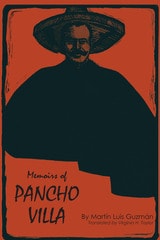
Memoirs of Pancho Villa
By Martín Luis Guzmán
University of Texas Press, 1965
This is a tale that might be told around a campfire, night after night in the midst of a military campaign. The kinetic and garrulous Pancho Villa talking on and on about battles and men; bursting out with hearty, masculine laughter; weeping unashamed for fallen comrades; casually mentioning his hotheadedness—"one of my violent outbursts"—which sent one, two, or a dozen men before the firing squad; recounting amours; and always, always protesting dedication to the Revolutionary cause and the interests of "the people."
Villa saw himself as the champion, eventually almost the sole champion, of the Mexican people. He fought for them, he said, and opponents who called him bandit and murderer were hypocrites.
This is his story, his account of how it all began when as a peasant boy of sixteen he shot a rich landowner threatening the honor of his sister. This lone, starved refugee hiding out in the mountains became the scourge of the Mexican Revolution, the leader of thousands of men, and the hero of the masses of the poor.
Great battles of the Revolution are described, sometimes as broad sweeps of strategy, sometimes as they developed half hour by half hour. Long, dusty horseback forays and cold nights spent pinned down under enemy fire on a mountainside are made vivid and gripping. The assault on Ciudad Juárez in 1911, the battles of Tierra Blanca, of Torreón, of Zacatecas, of Celaya, all are here, told with a feeling of great immediacy. This volume ends as Villa and Obregón prepare to engage each other in the war between victorious generals into which the Revolution degenerated before it finally ended.
Martín Luis Guzmán, eminent historian of Mexico, knew and traveled with Pancho Villa at various times during the Revolution. General Villa offered young Martín Luis a position as his secretary, but he declined. When many years later some of Villa's private papers, records, and what was apparently the beginning of an autobiography came into Guzmán's hands, he was ideally suited to blend all these into an authentic account of the Revolution as Pancho Villa saw it, and of the General's life as known only to Villa himself.
The Memoirs were first published in Mexico in 1951, where they were extremely popular; this volume was the first English publication. Virginia H. Taylor, translator in the Spanish Archives of the State of Texas Land Office, has accurately captured in English the flavor of the narrative.
Memoirs of a Fortunate Jew
An Italian StoryDan Vittorio Segre
University of Chicago Press, 2008
“Taut and illuminating . . . memorable . . . written with the humility of he who confesses himself and with the honesty of he who bore witness.”—Primo Levi
“The writing of memoirs is a difficult art that Dan Segre fully possesses. Under his pen, history and psychology merge in one captivating narrative which illuminates the turmoils, fears and triumphs of his generation.”—Elie Wiesel
“Beautifully written. . . . [A] labyrinthine, spell-binding autobiography, full of passionate tenderness.”—New York Review of Books
“An unusually attractive book—attractive in its irony, its energy and its moral insight. Mr. Segre had some rich material to work with, and he has done it justice.”—New York Times
Memoirs of a Revolutionary
Victor Serge
University of Iowa Press, 2002
Men of No Reputation
Robert Boatright, the Buckfoot Gang, and the Fleecing of Middle AmericaKimberly Harper
University of Arkansas Press, 2024
Winner, 2025 Missouri Conference on History Book Award
Swindler. Murderer. Scoundrel.
Robert Boatright was one of Middle America’s greatest confidence men. Although little remembered today, his story provides a rare glimpse into America’s criminal past. Working in concert with a local bank and an influential Democratic boss, “this dean of modern confidence men” and his colorful confederacy of con men known as the Buckfoot Gang seemed untouchable. A series of missteps, however, led to a string of court cases across the country that brought Boatright’s own criminal enterprise to an end. And yet, the con continued: Boatright’s successor, John C. Mabray, and his cronies, many of whom had been in the Buckfoot Gang, preyed upon victims across North America in one of the largest midwestern criminal syndicates in history before they were brought to heel.
Like the works of Sinclair Lewis, Boatright’s story exposes a rift in the wholesome midwestern stereotype and furthers our understanding of nineteenth- and twentieth-century American society.

Men, War and Film
The Calling Blighty Films of World War IISteve Hawley
Intellect Books, 2025
The Calling Blighty series of films produced by the Combined Kinematograph Service around the end of World War II were one-reel films in which soldiers of the “Forgotten Army” gave short spoken messages to the camera as a means of connecting the front line and the home front. Shown in local cinemas, these were the first films in which men spoke openly in their regional accents, and they hold profound meaning for remembrance, documentary representation, and the ecology of film in wartime. Of the four hundred films made on the Far Eastern Front, only sixty-four survive. Until now, however, these films have barely been researched, despite being a valuable source of social history. This book expands the history of Calling Blighty, placing it in a broader context for contemporary audiences.

Mickey’s Harvest
A Novel of a Deaf Boy’s Checkered LifeHoward L. Terry
Gallaudet University Press, 2015
Mickey Dunmore’s story begins with the sinking of his father’s merchant sailing ship and ends with a cliffhanger in World War I. In school, after an illness caused his deafness, Mickey finds himself constantly fighting the hearing boys and later competing with the signing students when he attends a residential school for deaf students. In college, he and his best friend Dick Wagner leave early to travel the nation with the hobos, carnies, and grifters. In one town, they outfox a barker who was using a deaf girl to “read” the minds of their marks. Further on, they meet Bunny, the Mighty Mite deaf man who helps expose a hearing woman posing as deaf to scam sympathetic people. Mickey faces his greatest challenge when he falls in love with Marion Carrel, a deaf girl whose hearing father forbids their romance on eugenics grounds.
Terry, who became deaf at the age of 11, states from the outset that he means for his novel to reveal the biases confronting deaf people at the time. As a tonic, he populates Mickey’s Harvest with artistic, talented deaf individuals who engage readers in an earlier, colorful time as they “show their stuff.”
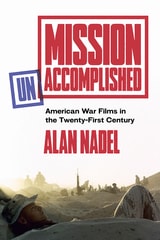
Mission Unaccomplished
American War Films in the Twenty-First CenturyAlan Nadel
University of Texas Press, 2025
An analysis of how post-9/11 war movies changed from following soldiers on specific missions to chronicling war as a day-to-day occupation.
In 2003, the United States began a war in Iraq without a mission. Instead of fighting to restore peace—the traditional objective of warfare—servicemembers faced the grim reality that there was no goal. Lacking even certainty as to who was the enemy, soldiers discovered that their task was simply to survive.
Mission Unaccomplished explores how Hollywood grasped the experience of Iraq from the perspective of US soldiers, reinventing the war film in the process. Historically, films such as Saving Private Ryan valorized the goals of war by chronicling missions that unambiguously contribute to the defeat of the enemy and the restoration of peace. But in The Hurt Locker, American Sniper, Green Zone, and other recent dramas, soldiers just try to outlast the chaos. Dramatizing the aimlessness of the war, events occur in random order, and soldiers have no sense of how their actions contribute to victory or peace. Looking to recent WWII movies such as Dunkirk and Hacksaw Ridge, which use this same cinematic vocabulary to position soldiering as merely a deadly job to be endured, Alan Nadel argues that the disillusionment of Iraq has influenced cinema broadly, inspiring a newly critical war film genre.

Moon Lily
(a novel)Susan Lang
University of Nevada Press, 2008
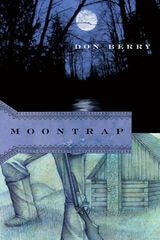
Moontrap
Don Berry
Oregon State University Press, 1962
Winner of the Western Writers of America Spur Award for best historical novel, Moontrap is a book of remarkable beauty and power about a man caught between his vivid past and an uncertain future.
The year is 1850, a transitional period in the new Oregon Territory, with settlers and lawmakers working to subdue the untamed region. Johnson Monday, a former mountain man, has been living on a bend of the Willamette River near Oregon City for seven years with his Shoshone Indian wife, struggling to make a place in settled society. One day, Webster T. Webster, a raucous, unrepentant trapper, arrives for an unexpected visit. With his earthy humor and stubborn adherence to the simple life, "Webb" leads Monday through adventures that flirt dangerously close to lawlessness, while helping him to rediscover his moral center. Through defiance, triumph, and tragedy, Moontrap follows Johnson Monday as he realizes that relinquishing the stark honesty of mountain life for the compromises of civilization may be too high a price to pay.
Following Trask in Don Berry's trilogy of novels set in the Oregon Territory, Moontrap offers a richly comic and intensely poignant portrayal of pioneer life.
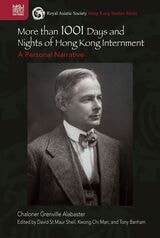
More than 1001 Days and Nights of Hong Kong Internment
A Personal NarrativeChaloner Grenville Alabaster
Hong Kong University Press, 2022
More Than 1001 Days and Nights of Hong Kong Internment is the wartime journal of Sir Chaloner Grenville Alabaster, former attorney-general of Hong Kong and one of the three highest-ranking British officials during the Japanese occupation. He was imprisoned by the Japanese at the Stanley Internment Camp from 1941 to 1945. During his internment, he kept a diary of his life in the camp in small notebooks, hiding them until his release in 1945. He wrote his wartime journal on the basis of these notes. The journal records his day-to-day experiences of the fall of Hong Kong, his time at Stanley, and his eventual release. The book is an important primary source for understanding the daily operation of the Stanley Internment Camp and the period immediately after the fall of Hong Kong.
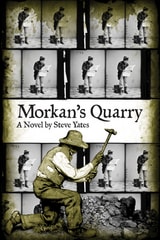
Morkan's Quarry
A NovelSteve Yates
Moon City Press, 2010
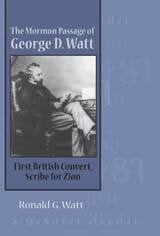
Mormon Passage of George D. Watt
First British Convert, Scribe for ZionRonald G. Watt
Utah State University Press, 2009
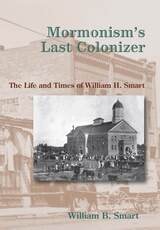
Mormonism's Last Colonizer
The Life and Times of William H. SmartWilliam B. Smart
Utah State University Press, 2008
Winner of the Evans Handcart Prize 2009
Winner of the Mormon History Assn Best Biography Award 2009
By the early twentieth century, the era of organized Mormon colonization of the West from a base in Salt Lake City was all but over. One significant region of Utah had not been colonized because it remained in Native American hands--the Uinta Basin, site of a reservation for the Northern Utes. When the federal government decided to open the reservation to white settlement, William H. Smart--a nineteenth-century Mormon traditionalist living in the twentieth century, a polygamist in an era when it was banned, a fervently moral stake president who as a youth had struggled mightily with his own sense of sinfulness, and an entrepreneurial businessman with theocratic, communal instincts--set out to ensure that the Uinta Basin also would be part of the Mormon kingdom.
Included with the biography is a searchable CD containing William H. Smart's extensive journals, a monumental personal record of Mormondom and its transitional period from nineteenth-century cultural isolation into twentieth-century national integration.
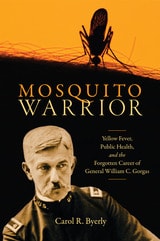
Mosquito Warrior
Yellow Fever, Public Health, and the Forgotten Career of General William C. GorgasCarol R. Byerly
University of Alabama Press, 2024
A compelling biography of General William C. Gorgas, the US Army doctor's campaign against mosquito-borne disease reshaped public health, military medicine, and U. S. power on the world stage.
Mosquito Warrior tells the engrossing story of General William C. Gorgas (1854–1920), the once-renowned pioneer in tropical disease research and public health. His fascinating life illuminates vast transformations in the United States, including the end of the Civil War and the industrialization of the US military and economy, the emergence of germ theory and the modernization of the public health system, and the rise of the United States as a world power.
A scion of Confederate elites, Gorgas came of age amidst war and disease and the politics of racial segregation. He followed his father into military service as an army medical officer, treating troops on America’s western frontier posts. During the US occupation of Cuba, Gorgas applied Walter Reed’s research on the theory of mosquito-borne disease transmission, ending centuries of yellow fever in Havana through the eradication of the deadly Aedes aegypti mosquito. Applying similar strategies on the isthmus of Panama against yellow fever and malaria, Gorgas enabled the completion of the Panama Canal, then the largest engineering project in the world. Hailed a hero, he pursued his fight against mosquito-borne disease throughout the tropics, expanding American interests as he went. Appointed as US Army surgeon general on the eve of World War I, Gorgas resumed work modernizing the army health care system, strengthening US medical and military authority on the world stage.
Celebrated in life, Gorgas’s reputation fell victim to competing political interests and jealousies after his death, a cautionary tale about historical memory and the politics of science and personality. Carol R. Byerly’s balanced and contemporary examination of Gorgas illuminates his complex legacy in medicine and public health, military history, and American ambitions at the dawn of US global ascendency.
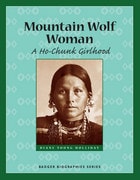
Mountain Wolf Woman
A Ho-Chunk GirlhoodDiane Holliday
Wisconsin Historical Society Press, 2007
With the seasons of the year as a backdrop, author Diane Holliday describes what life was like for a Ho-Chunk girl who lived in the late nineteenth and early twentieth century. Central to the story is the movement of Mountain Wolf Woman and her family in and around Wisconsin. Like many Ho-Chunk people in the mid-1800s, Mountain Wolf Woman's family was displaced to Nebraska by the U.S. government. They later returned to Wisconsin but continued to relocate throughout the state as the seasons changed to gather and hunt food.
Based on her own autobiography as told to anthropologist Nancy Lurie, Mountain Wolf Woman's words are used throughout the book to capture her feelings and memories during childhood. Author Holliday draws young readers into this Badger Biographies series book by asking them to think about how the lives of their ancestors and how their lives today compare to the way Mountain Wolf Woman lived over a hundred years ago.

Mourner's Bench
A NovelSanderia Faye
University of Arkansas Press, 2015
But first, Sarah would need to navigate the growing tensions of small-town Arkansas in the 1960s. Both smarter and more serious than her years (a “fifty-year-old mind in an eight-year-old body,” according to Esther), Sarah was torn between the traditions, religion, and work ethic of her community and the progressive civil rights and feminist politics of her mother, who had recently returned from art school in Chicago. When organizers from the Student Non-Violent Coordinating Committee (SNCC) came to town just as the revival was beginning, Sarah couldn’t help but be caught up in the turmoil. Most folks just wanted to keep the peace, and Reverend Jefferson called the SNCC organizers “the evil among us.” But her mother, along with local civil rights activist Carrie Dilworth, the SNCC organizers, Daisy Bates, attorney John Walker, and indeed most of the country, seemed determined to push Maeby toward integration.
With characters as vibrant and evocative as their setting, Mourner’s Bench is the story of a young girl coming to terms with religion, racism, and feminism while also navigating the terrain of early adolescence and trying to settle into her place in her family and community.
Mr. President
A Life of Benjamin HarrisonRay E. Boomhower
Indiana Historical Society Press, 2018
Mud on the Stars
William Bradford Huie
University of Alabama Press, 1996
William Bradford Huie’s first novel, Mud on the Stars, is largely autobiographical and is set in the years 1929-1942. As in many of his later books, the theme here is of the education of the inexperienced youth, which is, after all, the quintessential American story. Drawing on his own boyhood, Huie gives the reader a detailed account of rural life and race relations in the Tennessee Valley in the early years of this century, including a vivid picture of college life at The University of Alabama during the Great Depression. Through a careful weaving of characters and events, fact and fiction, Huie’s novel captures the tumultuous times before World War II in the urban South, times of social unrest and testing of new political ideologies. The book’s publication in 1942 was a huge financial success, by the economic standards of the day, and not only brought Huie the acclaim his talent warranted but also focused an approving national spotlight on this prolific Alabama writer.
Murder on the Mountain
Crime, Passion, and Punishment in Gilded Age New JerseyPeter J. Wosh
Rutgers University Press, 2022
Was Margaret the calculating murderess and adulteress portrayed by the press? Or was she a battered wife pushed to the edge? Or was she, as she claimed to the end, innocent? Murder on the Mountain considers all sides of this fascinating and mysterious true crime story. In turn, it examines why this murder trial became front-page news, as it resonated with public discussions about capital punishment, mental health, anti-immigrant sentiment, domestic violence, and women’s independence. This is a gripping and thought-provoking study of a murder that shocked the nation.
My Father's Name
A Black Virginia Family after the Civil WarLawrence P. Jackson
University of Chicago Press, 2012
My Father’s Name is a family story full of twists and turns—and one of haunting familiarity to many Americans, who may question whether the promises of emancipation have ever truly been fulfilled. It is also a resolute look at the duties that come with reclaiming and honoring Americans who survived slavery and a thoughtful meditation on its painful and enduring history.
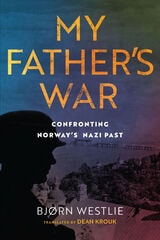
My Father's War
A True Story of Nazism and Treasonby Bjørn Westlie, translated by Dean Krouk
University of Wisconsin Press, 2023
With an insightful introduction from translator Dean Krouk, My Father’s War is a contemporary classic of war literature. Committed to genuine understanding without falling into undue sympathizing, this sober and reflective book presents an eye-opening, moving, intense, and necessary account of the allure of fascism in a world at war—and its personal costs.
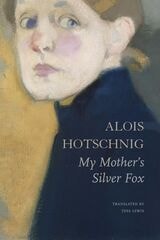
My Mother's Silver Fox
Alois Hotschnig
Seagull Books, 2025
Heinz Fitz has only one tangible clue to his past: a worn piece of paper from the SS-Lebensborn program, a Nazi initiative designed to promote so-called racial purity. His mother, a Norwegian woman, fell in love with the wrong man—an Austrian soldier—during the German occupation. Betrayed and abandoned, she fled to Austria, only to be turned away by his family. Branded a collaborator in her homeland and a pariah in a foreign land, she was left to survive as best she could. Now, years later, her son is determined to piece together the fragments of his origins.
But every answer leads to more questions, and as he unearths painful truths, an alternative story—one of resilience, love, and survival—emerges from the darkness. Inspired by real events, Alois Hotschnig’s novel is both a fierce reckoning with history and a poignant tribute to a mother’s strength. A masterful meditation on memory and storytelling, My Mother’s Silver Fox asks whether the past can ever truly be understood—or if it will always slip through our grasp, like snow through our fingers.

My Palestine
An Impossible ExileMohammad Tarbush
Haus Publishing, 2025
Mohammad Tarbush was born in British Mandate Palestine. As an infant, he and his family were forced to evacuate their village together with its entire population, after the Zionist victory that led to the establishment of the State of Israel. Then as landless refugees in the West Bank, the family sank into poverty. When, as a teenager, Tarbush left home one day under the pretext of visiting relatives in Jordan, he in fact set off on a year-long hitchhiking journey to Europe, where he would eventually become a highly successful international banker and a key behind-the-scenes promoter of the Palestinian cause. In My Palestine, Mohammad Tarbush combines a poignant personal memoir with incisive political and economic commentary on the tumultuous events that shaped the history of Israel, Palestine, and the modern Middle East.
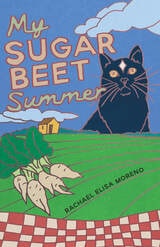
My Sugar Beet Summer
Rachael Elisa Moreno
Michigan State University Press, 2026
In 1928, nine-year-old Teresa leaves everything she knows in San Antonio—including her beloved cat Diamante—and boards a train bound for Michigan, where her parents have found work in the vast sugar beet fields of Saginaw. The long train north is a source of fascination, but stepping into Michigan feels like entering a different world—the cold wind, the strange houses, and the long days helping on the farm instead of going to school. Teresa cares for her little sisters while her parents tend to the sugar beets. She learns to navigate a life shaped by hard work, migration, and constant change. After the harvest, a new season begins, and the whole family must pack up and make the long trip back to Texas, to plant new roots. Based on the stories the author’s grandparents told her about their lives as Texas migrants in Michigan’s Thumb, My Sugar Beet Summer pulls the reader into Teresa and her family’s life in a new land, on a sugar beet farm on the eve of the Great Depression.
My Version of the Facts
Carla Pekelis, translated from the Italian by George Hochfield
Northwestern University Press, 2005
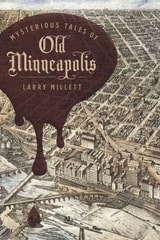
Mysterious Tales of Old Minneapolis
Larry Millett
University of Minnesota Press, 2025
Three novellas of murder and mystery in nineteenth-century Minneapolis
OWNER DIES UNDER STRANGE CIRCUMSTANCES AT MINNEAPOLIS MILL!
HOTEL BELLMAN FOUND DEAD IN OSCAR WILDE’S ROOM!
$10,000 REWARD FOR DISCOVERING MY MURDERER!
These headlines are just the beginning as Larry Millett returns to the scene of the crime in three tales of intrigue and murder in historic Minneapolis. The mind that brought us the intrepid Shadwell Rafferty now introduces three unlikely but talented new detectives—in-laws Sophia Westerly and Annie Nichols, and the incomparable Oscar Wilde—who are thrown into murder investigations amid flour milling, literary culture, and labor organizing in the burgeoning city.
Murder at the Falls takes us to the Perfection Flour Mill at St. Anthony Falls when one owner turns up dead under grotesque circumstances and suspicion lands on the other, plunging the city into a frenzy of dark speculation. In A Wilde Night at the Nicollet House, Oscar Wilde, in the midst of his 1882 North American tour and spouting witticisms as only he can, teams up with the long-time house detective at the Nicollet House Hotel to search for the murderer of the hotel bell captain found dead in his room. In The Death Committee, a champion lawyer of the working class, convinced his own murder is imminent, arranges for three citizens to investigate his death, with a $10,000 reward going to the one who finds the killer.
Shining light on the colorful characters and curious corners of Twin Cities history, Mysterious Tales of Old Minneapolis brings the nineteenth-century city to vibrant life (and dastardly death) in the spellbinding style that Larry Millett’s legion of loyal readers has come to love.
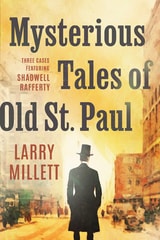
Mysterious Tales of Old St. Paul
Three Cases Featuring Shadwell RaffertyLarry Millett
University of Minnesota Press, 2024
Tales of murder and revenge: the early exploits of detective Shadwell Rafferty
Shadwell Rafferty’s last case may have led to his murder, but naturally—and fortunately, for followers of the indefatigable St. Paul detective—there’s more to the story. Mysterious Tales of Old St. Paul gathers three novellas from Larry Millett, casting back to Rafferty’s beginnings to recount a trio of intriguing cases that honed his skills before he joined forces with Sherlock Holmes.
In “Death in the News,” St. Paul citizens wake one morning to find that the sign on downtown’s tallest building that reads PIONEER PRESS has been altered—at considerable effort—to LIARS. An elaborate prank, yes, but it foreshadows a far worse crime, and Rafferty is on the case. In “The Birdman of Summit Avenue,” cats are turning up dead in the yards of St. Paul’s prominent citizens, and suspicion swiftly falls on the wealthy avian enthusiast Ambrose Harriman, but the case turns darker still when a neighborhood boy is found murdered in Harriman’s yard. In “The Gold King,” an enigmatic stranger arrives in town, calling himself the Gold King and announcing his plans to unearth hidden treasure, which eventually leads to a shocking conclusion.
Steeped in the mystery and history of nineteenth-century St. Paul, these interlocking detective stories feature the characters—and the local character—that have made the Shadwell Rafferty series irresistible. Spellbinding as ever, these stories also afford the curious pleasure of watching Rafferty find his footing on his way to becoming the consummate detective whose exploits have delighted readers again and again.
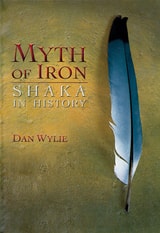
Myth of Iron
Shaka in HistoryDan Wylie
Ohio University Press, 2008
Meanwhile the public image, sometimes monstrous, sometimes heroic, juggernauts on—truly a “myth of iron” that is so intriguing, so dramatic, so archetypal, and sometimes so politically useful that few have subjected it to proper scrutiny.
Myth of Iron: Shaka in History is the first book-length scholarly study of Shaka to be published. It lays out, as far as possible, all the available evidence—mainly hitherto underutilized Zulu oral testimonies, supported by other documentary sources—and decides, item by item, legend by legend, what exactly is known about Shaka’s reign. The picture that emerges in this meticulously researched and absorbing antibiography is very different from the popular narrative.