Results by title
71 books match the query 'Historical Events' and 3 start with m
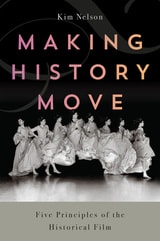
Making History Move
Five Principles of the Historical FilmKim Nelson
Rutgers University Press, 2024
Making History Move: Five Principles of the Historical Film builds upon decades of scholarship investigating history in visual culture by proposing a methodology of five principles to analyze history in moving images in the digital age. It charts a path to understanding the form of history with the most significant impact on public perceptions of the past. The book develops insights across these fields, including philosophical considerations of film and history, to clarify the form and function of history in moving images. It addresses the implications of the historical film on public historical consciousness, presenting criteria to engage and assess the truth status of depictions of the past. Each chapter offers a detailed aspect of this methodology for analyzing history in moving images. Together, they propose five principles to organize past and future scholarship in this vital, interdisciplinary field of study.
[more]
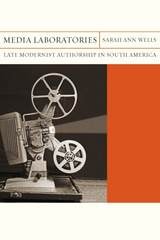
Media Laboratories
Late Modernist Authorship in South AmericaSarah Ann Wells
Northwestern University Press, 2017
Winner, LASA Best Book Published in 2017, Southern Cone Section, Humanities category
Media Laboratories explores a pivotal time for South American literature of the 1930s and ’40s. Cinema, radio, and the typewriter, once seen as promising catalysts for new kinds of writing, began to be challenged by authors, workers, and the public. What happens when media no longer seem novel and potentially democratic but rather consolidated and dominant? Moving among authors from Brazil, Argentina, and Uruguay, and among the genres of fiction, the essay, popular journalism, and experimental little magazines, Sarah Ann Wells shows how writers on the periphery of global modernity were fashioning alternative approaches to these media. Analyzing authors such as Clarice Lispector, Jorge Luis Borges, and Felisberto Hernández, along with their lesser-known contemporaries, Media Laboratories casts a wide net: from spectators of Hollywood and Soviet montage films, to inventors of imaginary media, to proletarian typists who embodied the machine-human encounters of the period. The text navigates contemporary scholarly and popular debates about the relationship of literature to technological innovation, media archaeology, sound studies, populism, and global modernisms. Ultimately, Wells underscores a question that remains relevant: what possibilities emerge when the enthusiasm for new media has been replaced by anxiety over their potentially pernicious effects in a globalizing, yet vastly unequal, world?
Media Laboratories explores a pivotal time for South American literature of the 1930s and ’40s. Cinema, radio, and the typewriter, once seen as promising catalysts for new kinds of writing, began to be challenged by authors, workers, and the public. What happens when media no longer seem novel and potentially democratic but rather consolidated and dominant? Moving among authors from Brazil, Argentina, and Uruguay, and among the genres of fiction, the essay, popular journalism, and experimental little magazines, Sarah Ann Wells shows how writers on the periphery of global modernity were fashioning alternative approaches to these media. Analyzing authors such as Clarice Lispector, Jorge Luis Borges, and Felisberto Hernández, along with their lesser-known contemporaries, Media Laboratories casts a wide net: from spectators of Hollywood and Soviet montage films, to inventors of imaginary media, to proletarian typists who embodied the machine-human encounters of the period. The text navigates contemporary scholarly and popular debates about the relationship of literature to technological innovation, media archaeology, sound studies, populism, and global modernisms. Ultimately, Wells underscores a question that remains relevant: what possibilities emerge when the enthusiasm for new media has been replaced by anxiety over their potentially pernicious effects in a globalizing, yet vastly unequal, world?
[more]
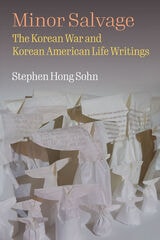
Minor Salvage
The Korean War and Korean American Life WritingsStephen Hong Sohn
University of Michigan Press, 2022
The Korean War, often invoked in American culture as “the forgotten war,” remains ongoing. Though active fighting only occurred between 1950 and 1953, the signing of an armistice resulted in an infamous stalemate and the construction of the Korean Peninsula’s Demilitarized Zone. Minor Salvage reads early Korean American life writings in order to explore the admittedly partial ways in which those made precarious by war seek to rebuild their lives. The titular phrase “minor salvage,” draws on different valences of the word salvage which, while initially associated with naval recovery efforts, can also be used to describe the rescue of waste material. Spurred by the stories told and retold to him by his parents Soon Ho and Yunpyo, Sohn enacts minor salvage by reading overlooked early Korean American life writings penned by Induk Pahk, Taiwon Koh, Joseph Anthony, and Kim Yong-ik alongside a later generation of life writings authored by Sunny Che and K. Connie Kang. In the context of the Korean War, Sohn argues, life writings take on a crucial political orientation precisely because of the fragility attached to refugees, civilians, children, women, and divided family members. To depict the possibility of life is to acknowledge simultaneously the threat of death, violence, and brutality, and in this regard, such life writings are part of a longer genealogy in which marginalized communities find representational power through the creative process.
[more]