Results by title
668 books match the query 'History & Surveys' and 30 start with m
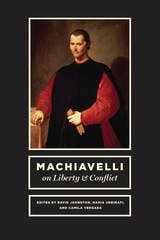
Machiavelli on Liberty and Conflict
Edited by David Johnston, Nadia Urbinati, and Camila Vergara
University of Chicago Press, 2017
With Machiavelli on Liberty and Conflict, David Johnston, Nadia Urbinati, and Camila Vergara have brought together the most recent research on The Prince, with contributions from many of the leading scholars of Machiavelli, including Quentin Skinner, Harvey Mansfield, Erica Benner, John McCormick, and Giovanni Giorgini. Organized into four sections, the book focuses first on Machiavelli’s place in the history of political thought: Is he the last of the ancients or the creator of a new, distinctly modern conception of politics? And what might the answer to this question reveal about the impact of these disparate traditions on the founding of modern political philosophy? The second section contrasts current understandings of Machiavelli’s view of virtues in The Prince. The relationship between political leaders, popular power, and liberty is another perennial problem in studies of Machiavelli, and the third section develops several claims about that relationship. Finally, the fourth section explores the legacy of Machiavelli within the republican tradition of political thought and his relevance to enduring political issues.
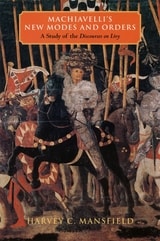
Machiavelli's New Modes and Orders
A Study of the Discourses on LivyHarvey C. Mansfield
University of Chicago Press, 2001
Mansfield's aim is to discern Machiavelli's intention in writing the book: he argues that Machiavelli wanted to introduce new modes and orders in political philosophy in order to make himself the founder of modern politics. Mansfield maintains that Machiavelli deliberately concealed part of his intentions so that only the most perceptive reader could see beneath the surface of the text and understand the whole of his book. Previously out of print, Mansfield's penetrating study brings to light the hidden thoughts lurking in the details of the Discourses on Livy to inform and challenge its readers at every step along the way.
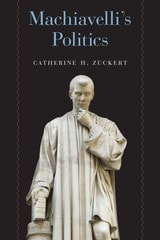
Machiavelli's Politics
Catherine H. Zuckert
University of Chicago Press, 2017
Starting with Machiavelli’s two major political works, Zuckert persuasively shows that the moral revolution Machiavelli sets out in The Prince lays the foundation for the new form of democratic republic he proposes in the Discourses. Distrusting ambitious politicians to serve the public interest of their own accord, Machiavelli sought to persuade them in The Prince that the best way to achieve their own ambitions was to secure the desires and ambitions of their subjects and fellow citizens. In the Discourses, he then describes the types of laws and institutions that would balance the conflict between the two in a way that would secure the liberty of most, if not all. In the second half of her book, Zuckert places selected later works—La Mandragola, The Art of War, The Life of Castruccio Castracani, Clizia, and Florentine Histories—under scrutiny, showing how Machiavelli further developed certain aspects of his thought in these works. In The Art of War, for example, he explains more concretely how and to what extent the principles of organization he advanced in The Prince and the Discourses ought to be applied in modern circumstances. Because human beings act primarily on passions, Machiavelli attempts to show readers what those passions are and how they can be guided to have productive rather than destructive results.
A stunning and ambitious analysis, Machiavelli’s Politics brilliantly shows how many conflicting perspectives do inform Machiavelli’s teachings, but that one needs to consider all of his works in order to understand how they cohere into a unified political view. This is a magisterial work that cannot be ignored if a comprehensive understanding of the philosopher is to be obtained.
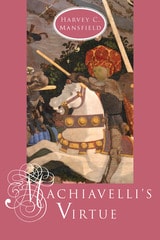
Machiavelli's Virtue
Harvey C. Mansfield
University of Chicago Press, 1996
"The book brings together essays that have mapped [Mansfield's] paths of reflection over the past thirty years. . . . The ground, one would think, is ancient and familiar, but Mansfield manages to draw out some understandings, or recognitions, jarringly new."—Hadley Arkes, New Criterion
"Mansfield's book more than rewards the close reading it demands."—Colin Walters, Washington Times
"[A] masterly new book on the Renaissance courtier, statesman and political philosopher. . . . Mansfield seeks to rescue Machiavelli from liberalism's anodyne rehabilitation."—Roger Kimball, The Wall Street Journal
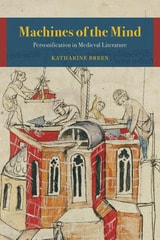
Machines of the Mind
Personification in Medieval LiteratureKatharine Breen
University of Chicago Press, 2021
In Machines of the Mind, Katharine Breen proposes that medieval personifications should be understood neither as failed novelistic characters nor as instruments of heavy-handed didacticism. She argues that personifications are instead powerful tools for thought that help us to remember and manipulate complex ideas, testing them against existing moral and political paradigms. Specifically, different types of medieval personification should be seen as corresponding to positions in the rich and nuanced medieval debate over universals. Breen identifies three different types of personification—Platonic, Aristotelian, and Prudentian—that gave medieval writers a surprisingly varied spectrum with which to paint their characters.
Through a series of new readings of major authors and works, from Plato to Piers Plowman, Breen illuminates how medieval personifications embody the full range of positions between philosophical realism and nominalism, varying according to the convictions of individual authors and the purposes of individual works. Recalling Gregory the Great’s reference to machinae mentis (machines of the mind), Breen demonstrates that medieval writers applied personification with utility and subtlety, employing methods of personification as tools that serve different functions. Machines of the Mind offers insight for medievalists working at the crossroads of religion, philosophy, and literature, as well as for scholars interested in literary character-building and gendered relationships among characters, readers, and texts beyond the Middle Ages.

Maimonides and Spinoza
Their Conflicting Views of Human NatureJoshua Parens
University of Chicago Press, 2012
Until the last century, it was generally agreed that Maimonides was a great defender of Judaism, and Spinoza—as an Enlightenment advocate for secularization—among its key opponents. However, a new scholarly consensus has recently emerged that the teachings of the two philosophers were in fact much closer than was previously thought. In his perceptive new book, Joshua Parens sets out to challenge the now predominant view of Maimonides as a protomodern forerunner to Spinoza—and to show that a chief reason to read Maimonides is in fact to gain distance from our progressively secularized worldview.
Maimonides' "Guide of the Perplexed"
A Philosophical GuideAlfred L. Ivry
University of Chicago Press, 2016
Drawing on a lifetime of study, Alfred L. Ivry has written the definitive guide to the Guide—one that makes it comprehensible and exciting to even those relatively unacquainted with Maimonides’ thought, while also offering an original and provocative interpretation that will command the interest of scholars. Ivry offers a chapter-by-chapter exposition of the widely accepted Shlomo Pines translation of the text along with a clear paraphrase that clarifies the key terms and concepts. Corresponding analyses take readers more deeply into the text, exploring the philosophical issues it raises, many dealing with metaphysics in both its ontological and epistemic aspects.
Margins of Philosophy
Jacques Derrida
University of Chicago Press, 1982

Marsilio Ficino, Three Books on Life
A Critical Edition and TranslationCarol V. Kaske
Arizona Center for Medieval and Renaissance Studies, 2019
Martin Heidegger
George Steiner
University of Chicago Press, 1987
Acquaintance with the work of Martin Heidegger is indispensable to an understanding of contemporary thought and culture. His work has had a profound influence on a number of disciplines, including theology, Sartrean existentialism, linguistics, Hellenic studies, the structuralist and hermeneutic schools of textual interpretation, literary theory, and literature itself. With characterisitc lucidity and style, George Steiner makes this philosopher’s immensely difficult body of work accessible to the general reader. The breadth of Steiner’s learning and interests also allows him to place Heidegger in a broader Continental literary-cultural context. In a new Introduction, Steiner addresses language and philosophy and the rise of Nazism

Marx on Suicide
Karl Marx
Northwestern University Press, 1999
Marxism and the Interpretation of Culture
Edited by Cary Nelson and Lawrence Grossberg
University of Illinois Press, 1988
Meaning, Basic Self-Knowledge, and Mind
Essays on Tyler BurgeEdited by María Frápolli and Esther Romero
CSLI, 2003
The authors of the eleven papers here expound their versions of this position and go on to critique Burge's version. Together with Burge's replies, this volume offers a major contribution to contemporary philosophy.
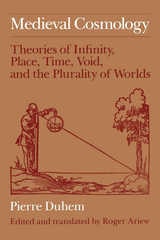
Medieval Cosmology
Theories of Infinity, Place, Time, Void, and the Plurality of WorldsPierre Duhem
University of Chicago Press, 1987
Medieval Philosophy Redefined as the Latin Age
John Deely
St. Augustine's Press, 2016
“With the sophistic modern and Enlightenment misconceptions about philosophy’s nature and history daily crashing and burning around us, Deely’s unconventional way of understanding medieval philosophy is like a breath of fresh air amid intellectual smog. This is a great book, the single most important study of medieval thought in half a century or more. It deserves an unbiased hearing by anyone today claiming to be a serious philosopher.” — Peter A. Redpath
Founding Chairman, Universities of Western Civilization Chairman of the Board, The International Etienne Gilson Society
“Drawing upon the thought of John Poinsot and Charles Pierce, John Deely has opened a distinctively postmodern path to the metaphysics of being, at once illuminating much of this ancient tradition while casting new light upon it in the context of contemporary thought. His treatment notably of St. Thomas is not merely a return to an earlier thinker, but an opening to a different path, at once in profound agreement with St. Thomas and yet heretofore unexplored. This book, thus, not only constitutes a return to a past era, but shows this era in a new light that illuminates as well the contemporary scene.” — Kenneth L. Schmitz
Professor Emeritus, University of Toronto, Canada Pontifical John Paul II Institute for Studies on Marriage and Family, Washington, D.C.
Memory, History, Forgetting
Paul Ricoeur
University of Chicago Press, 2004
Why do major historical events such as the Holocaust occupy the forefront of the collective consciousness, while profound moments such as the Armenian genocide, the McCarthy era, and France's role in North Africa stand distantly behind? Is it possible that history "overly remembers" some events at the expense of others? A landmark work in philosophy, Paul Ricoeur's Memory, History, Forgetting examines this reciprocal relationship between remembering and forgetting, showing how it affects both the perception of historical experience and the production of historical narrative.
Memory, History, Forgetting, like its title, is divided into three major sections. Ricoeur first takes a phenomenological approach to memory and mnemonical devices. The underlying question here is how a memory of present can be of something absent, the past. The second section addresses recent work by historians by reopening the question of the nature and truth of historical knowledge. Ricoeur explores whether historians, who can write a history of memory, can truly break with all dependence on memory, including memories that resist representation. The third and final section is a profound meditation on the necessity of forgetting as a condition for the possibility of remembering, and whether there can be something like happy forgetting in parallel to happy memory. Throughout the book there are careful and close readings of the texts of Aristotle and Plato, of Descartes and Kant, and of Halbwachs and Pierre Nora.
A momentous achievement in the career of one of the most significant philosophers of our age, Memory, History, Forgetting provides the crucial link between Ricoeur's Time and Narrative and Oneself as Another and his recent reflections on ethics and the problems of responsibility and representation.
Metaphysical Disputation I
On the Nature of First Philosophy or MetaphysicsFrancisco Suarez
Catholic University of America Press, 2021
Metaphysical Disputation II
On the Essential Concept or Concept of BeingFrancisco Suarez
Catholic University of America Press, 2022
Metaphysical Disputations III and IV
On Being's Passions in General and Its Principles and On Transcendental Unity in GeneralFrancisco Suarez
Catholic University of America Press, 2023
Metaphysical Themes in Thomas Aquinas III
John F. Wippel
Catholic University of America Press, 2020

Miscellaneous Writings
G.W.F. Hegel
Northwestern University Press, 2000
Modern Enlightenment and the Rule of Reason
John C. McCarthy
Catholic University of America Press, 2018

Modern Social Imaginaries
Charles Taylor
Duke University Press, 2004
Retelling the history of Western modernity, Taylor traces the development of a distinct social imaginary. Animated by the idea of a moral order based on the mutual benefit of equal participants, the Western social imaginary is characterized by three key cultural forms—the economy, the public sphere, and self-governance. Taylor’s account of these cultural formations provides a fresh perspective on how to read the specifics of Western modernity: how we came to imagine society primarily as an economy for exchanging goods and services to promote mutual prosperity, how we began to imagine the public sphere as a metaphorical place for deliberation and discussion among strangers on issues of mutual concern, and how we invented the idea of a self-governing people capable of secular “founding” acts without recourse to transcendent principles. Accessible in length and style, Modern Social Imaginaries offers a clear and concise framework for understanding the structure of modern life in the West and the different forms modernity has taken around the world.
Monad and Thou
Phenomenological Ontology Of Human BeingHiroshi Kojima
Ohio University Press, 2000
The genesis for this volume was in the bombing of Japan during World War II, where the author, as a young boy, watched the bombers overhead, speculating about the lives of the pilots and their relationship with those huddled on the ground.
From this disturbing diorama, Professor Hiroshi Kojima, the translator of Martin Buber into Japanese, unfolds a new approach to Buber’s “I-Thou” relation, drawing upon insights from Husserl, Heidegger, and others in the tradition of continental philosophy to extend and deepen Buber’s thought.
In chapters that reflect upon a wide range of phenomena—from religion, science, and technology, to imagination, embodiment, and power—Professor Kojima articulates a conception of what it means to be a human being that stands as an alternative to atomism and alienation of the modern world. Analyses of haiku and other aspects of Japanese culture demonstrate how Kojima’s theory can illuminate the spiritual traditions of both East and West.
Original in its thought and revealing in its insight into Japanese thought and culture, Monad and Thou represents the life’s work of one of Japan’s great thinkers.

Montesquieu and the Despotic Ideas of Europe
An Interpretation of "The Spirit of the Laws"Vickie B. Sullivan
University of Chicago Press, 2017
Nowhere is Montesquieu’s critique of the despotic ideas of Europe more powerful than in his enormously influential The Spirit of the Laws, and Vickie B. Sullivan guides readers through Montesquieu’s sometimes veiled, yet sharply critical accounts of Machiavelli, Hobbes, Aristotle, and Plato, as well as various Christian thinkers. He finds deleterious consequences, for example, in brutal Machiavellianism, in Hobbes’s justifications for the rule of one, in Plato’s reasoning that denied slaves the right of natural defense, and in the Christian teachings that equated heresy with treason and informed the Inquisition.
In this new reading of Montesquieu’s masterwork, Sullivan corrects the misconception that it offers simple, objective observations, showing it instead to be a powerful critique of European politics that would become remarkably and regrettably prescient after Montesquieu’s death when despotism wound its way through Europe.
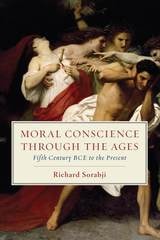
Moral Conscience through the Ages
Fifth Century BCE to the PresentRichard Sorabji
University of Chicago Press, 2014
Sorabji examines an impressive breadth of topics: the longing for different kinds of freedom of conscience, the proper limits of freedom itself, protests at conscience’s being ‘terrorized,’ dilemmas of conscience, the value of conscience to human beings, its secularization, its reliability, and ways to improve it. These historical issues are alive today, with fresh concerns about topics such as conscientious objection, the force of conscience, or the balance between freedoms of conscience, religion, and speech. The result is a stunningly comprehensive look at a central component of our moral understanding.
Moral Vision and Tradition
Antonio S. Cua
Catholic University of America Press, 2018
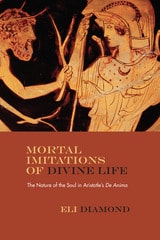
Mortal Imitations of Divine Life
The Nature of the Soul in Aristotle's De AnimaEli Diamond
Northwestern University Press, 2015
In Mortal Imitations of Divine Life, Diamond offers an interpretation of De Anima, which explains how and why Aristotle places souls in a hierarchy of value. Aristotle’s central intention in De Anima is to discover the nature and essence of soul—the principle of living beings. He does so by identifying the common structures underlying every living activity, whether it be eating, perceiving, thinking, or moving through space. As Diamond demonstrates through close readings of De Anima, the nature of the soul is most clearly seen in its divine life, while the embodied soul’s other activities are progressively clear approximations of this principle. This interpretation shows how Aristotle’s psychology and biology cannot be properly understood apart from his theological conception of God as life, and offers a new explanation of De Anima’s unity of purpose and structure.
Moses Maimonides and His Time
Eric L. Ormsby
Catholic University of America Press, 2018

Mystery and Intelligibility
History of Philosophy as Pursuit of WisdomJeffrey Dirk Wilson
Catholic University of America Press, 2021