Results by title
112 books match the query 'Immigration' and 6 start with m
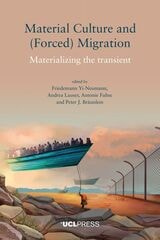
Material Culture and (Forced) Migration
Materializing the TransientEdited by Friedemann Yi-Neumann, Andrea Lauser, Antonie Fuhse, and Peter J. Bräunlein
University College London, 2022
Material Culture and (Forced) Migration argues that materiality is a fundamental dimension of migration. People take things with them, or they lose, find, and engage things along the way. Movements themselves are framed by objects such as borders, passports, tents, camp infrastructures, boats, and mobile phones. This volume brings together chapters on a broad range of movements—from forced migration and displacement to retirement migration. What ties the chapters together is their perspective of material culture.
Centering on four interconnected themes—temporality and materiality, methods of object-based migration research, the affective capacities of objects, and the engagement of things in place-making practices—the volume provides a material culture perspective for migration scholars around the globe, from a wide range of disciplines. The chapters’ focus on everyday objects and practices will appeal to all those interested in the tangible experiences of migration.
Meanings of Mobility
Family, Education, and Immigration in the Lives of Latino YouthLeah Schmalzbauer
Russell Sage Foundation, 2023
To better understand these experiences, Schmalzbauer draws on interviews with 60 low-income Latino youth who graduated or were set to graduate from Amherst College, one of the most selective private colleges in the United States. The vast majority of these students were the first in their immigrant families to go to college in the U.S. She finds that while most of the students believed attending Amherst provided them with previously unimaginable opportunities, adjusting to life on campus came with significant challenges. Many of the students Schmalzbauer spoke with had difficulties adapting to the cultural norms at Amherst as well as with relating to their non-Latino, non-low-income peers. The challenges these students faced were not limited to life on campus. As they attempted to adapt to Amherst, many felt distanced from the family and friends they left behind who could not understand the new challenges they faced.
The students credit their elite education for access to extraordinary educational and employment opportunities. However, their experiences while in college and afterward reveal that the relationship between educational and social mobility is much more complicated and less secure than popular conversations about the “American Dream” suggest. Many students found that their educational attainment was not enough to erase the core challenges of growing up in a marginalized immigrant family: many were still poor, faced racism, and those who were undocumented or had undocumented family members still feared deportation.
Schmalzbeauer suggests ways elite colleges can better support low-income Latino students and lower the emotional price of educational mobility, including the creation of immigration offices on campus to provide programming and support for undocumented students and their families. She recommends educating staff to better understand the centrality of family for these students and the challenges they face, as well as educating more privileged students about inequality and the life experiences of their marginalized peers.
Meanings of Mobility provides compelling insights into the difficulties faced by low-income Latinos pursuing educational and social mobility in America’s elite institutions.
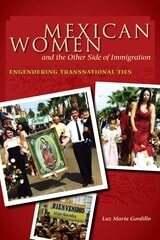
Mexican Women and the Other Side of Immigration
Engendering Transnational TiesBy Luz María Gordillo
University of Texas Press, 2010
Weaving narratives with gendered analysis and historiography of Mexicans in the Midwest, Mexican Women and the Other Side of Immigration examines the unique transnational community created between San Ignacio Cerro Gordo, Jalisco, and Detroit, Michigan, in the last three decades of the twentieth century, asserting that both the community of origin and the receiving community are integral to an immigrant's everyday life, though the manifestations of this are rife with contradictions.
Exploring the challenges faced by this population since the inception of the Bracero Program in 1942 in constantly re-creating, adapting, accommodating, shaping, and creating new meanings of their environments, Luz María Gordillo emphasizes the gender-specific aspects of these situations. While other studies of Mexican transnational identity focus on social institutions, Gordillo's work introduces the concept of transnational sexualities, particularly the social construction of working-class sexuality. Her findings indicate that many female San Ignacians shattered stereotypes, transgressing traditionally male roles while their husbands lived abroad. When the women themselves immigrated as well, these transgressions facilitated their adaptation in Detroit. Placed within the larger context of globalization, Mexican Women and the Other Side of Immigration is a timely excavation of oral histories, archival documents, and the remnants of three decades of memory.
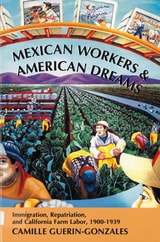
Mexican Workers and the American Dream
Immigration, Repatriation, and California Farm Labor, 1900-1939Guerin-Gonzales, Camille
Rutgers University Press, 1994
"Based on exhaustive research in U.S. and Mexican archives, this study offers a richly-textured history of Mexican immigrants in rural California. A work of exceptional breadth, especially with regard to repatriation, [it] is a pivotal contribution to Chicano historiography and immigration studies."--Vicki L. Ruiz, Andrew W. Mellon All-Claremont Professor in the Humanities, The Claremont Graduate School
In the first forty years of this century, over one million Mexican immigrants moved to the United States, attracted by the prospect of farm work in California. They became workers in industrial agriculture --barely recognized, never respected, and poorly paid. Native white American workers did not resent the Mexicans during prosperous times, when everyone who wanted to work could do so. But during the Great Depression, native workers began to realize that many of the Mexican workers were here to stay. Native workers, blaming their unemployment on the immigrants, joined with government officials to demand that Mexican workers and their families return to Mexico. During the 1930s, the federal government and county relief agencies cooperated in a nasty repatriation program, forcing half a million Mexicans living in the U.S. to return to Mexico.
Camille Guerin-Gonzales tells the story of their migration, their years here, and of the repatriation program--one of the largest mass removal operations ever sanctioned by the U.S. government.She documents both their efforts to resist and the overpowering forces that worked against them.

Migration and Multiculturalism in Scandinavia
Edited by Eric Einhorn, Sherrill Harbison, and Markus Huss
University of Wisconsin Press, 2022
Drawing from personal experiences and theoretical perspectives in such varied fields as sociology, political science, literature, and media studies, nineteen scholars assess recent shifts in Scandinavian societies and how they intertwine with broader transformations in Europe and beyond. Chapters explore a variety of topics, including themes of belonging and identity in Norway, the experiences and activism of the Nordic countries’ Indigenous populations, and parallels between the racist far-right resurgence in Sweden and the United States.
Contributors: Ellen A. Ahlness, Julie K. Allen, Grete Brochmann, Eric Einhorn, Sherrill Harbison, Anne Heith, Markus Huss, Peter Leonard, Barbara Mattsson, Kelly McKowen, Andreas Önnerfors, Elisabeth Oxfeldt, Tony Sandset, Carly Elizabeth Schall, Ryan Thomas Skinner, Admir Skodo, Benjamin R. Teitelbaum, Sayaka Osanami Törngren, Ethelene Whitmire

Mutual Integration in Immigration Society
An Epistemic ArgumentBodi Wang
Campus Verlag, 2023
The public culture of the receiving society and the dominant understanding of belonging and political membership can influence the social participation of immigrants as much as immigration law. However, current discussions of integration focus primarily on the distribution of rights and neglect the role of tacit knowledge. Through a systematical and philosophical analysis of identity’s role in policymaking, governance, and social practice, Bodi Wang shows how a one-sided understanding of integration resembles “assimilation” and why integration should be expected from locals as well. This argument weaves together extensive findings in sociology, history, critical race theory, and Chinese philosophy with ethics and migration studies.