Results by title
36 books match the query 'Line'
A Broken Thing
Poets on the LineEmily Rosko and Anton Vander Zee
University of Iowa Press, 2011
In the arena of poetry and poetics over the past century, no idea has been more alive and contentious than the idea of form, and no aspect of form has more emphatically sponsored this marked formal concern than the line. But what, exactly, is the line? Emily Rosko and Anton Vander Zee’s anthology gives seventy original answers that lead us deeper into the world of poetry, but also far out into the world at large: its people, its politics, its ecology. The authors included here, emerging and established alike, write from a range of perspectives, in terms of both aesthetics and identity. Together, they offer a dynamic hybrid collection that captures a broad spectrum of poetic practice in the twenty-first century.
A Nation on the Line
Call Centers as Postcolonial Predicaments in the PhilippinesJan M. Padios
Duke University Press, 2018

A New Generation Draws the Line
'Humanitarian' Intervention and the Standards of the WestNoam Chomsky
Pluto Press, 2012

BETTING THE LINE
SPORTS WAGERING IN AMERICAN LIFERichard O. Davies and Richard G. Abram
The Ohio State University Press, 2001
Below the Line
Producers and Production Studies in the New Television EconomyVicki Mayer
Duke University Press, 2011
Bodies on the Line
Performance and the Sixties Poetry ReadingRaphael Allison
University of Iowa Press, 2014
By comparing these two dominant styles of reading, Allison argues that attention to sixties poetry readings reveals poets struggling between the kind of immediacy and presence that readings suggested and a private retreat from such performance-based publicity, one centered on the text itself. Recordings of Robert Frost, Charles Olson, Gwendolyn Brooks, Larry Eigner, and William Carlos Williams—all of whom emphasized voice, breath, and spoken language and who were inveterate professional readers in the sixties—expose this struggle in often surprising ways. In deconstructing assertions about the role and importance of the poetry reading during this period, Allison reveals just how dramatic, political, and contentious poetry readings could be. By discussing how to "hear" as well as "read" poetry, Bodies on the Line offers startling new vantage points from which to understand American poetry since the 1960s as both performance and text.
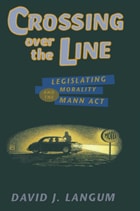
Crossing over the Line
Legislating Morality and the Mann ActDavid J. Langum
University of Chicago Press, 1994
This book is the first history of the Mann Act's often bizarre career, from its passage to the amendment that finally laid it low. In David J. Langum's hands, the story of the Act becomes an entertaining cautionary tale about the folly of legislating private morality.
Langum recounts the colorful details of numerous court cases to show how enforcement of the Act mirrored changes in America's social attitudes. Federal prosecutors became masters in the selective use of the Act: against political opponents of the government, like Charlie Chaplin; against individuals who eluded other criminal charges, like the Capone mobster "Machine Gun" Jack McGurn; and against black men, like singer Chuck Berry and boxer Jack Johnson, who dared to consort with white women. The Act engendered a thriving blackmail industry and was used by women like Frank Lloyd Wright's wife to extort favorable divorce settlements.
"Crossing over the Line is a work of scholarship as wrought by a civil libertarian, and the text . . . sizzles with the passion of an ardent believer in real liberty under reasonable laws."—Jonathan Kirsch, Los Angeles Times
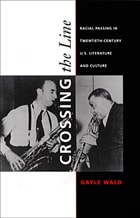
Crossing the Line
Racial Passing in Twentieth-Century U.S. Literature and CultureGayle Wald
Duke University Press, 2000
Wald begins her reading of twentieth-century passing narratives by analyzing works by African American writers James Weldon Johnson, Jessie Fauset, and Nella Larsen, showing how they use the “passing plot” to explore the negotiation of identity, agency, and freedom within the context of their protagonists' restricted choices. She then examines the 1946 autobiography Really the Blues, which details the transformation of Milton Mesirow, middle-class son of Russian-Jewish immigrants, into Mezz Mezzrow, jazz musician and self-described “voluntary Negro.” Turning to the 1949 films Pinky and Lost Boundaries, which imagine African American citizenship within class-specific protocols of race and gender, she interrogates the complicated representation of racial passing in a visual medium. Her investigation of “post-passing” testimonials in postwar African American magazines, which strove to foster black consumerism while constructing “positive” images of black achievement and affluence in the postwar years, focuses on neglected texts within the archives of black popular culture. Finally, after a look at liberal contradictions of John Howard Griffin’s 1961 auto-ethnography Black Like Me, Wald concludes with an epilogue that considers the idea of passing in the context of the recent discourse of “color blindness.”
Wald’s analysis of the moral, political, and theoretical dimensions of racial passing makes Crossing the Line important reading as we approach the twenty-first century. Her engaging and dynamic book will be of particular interest to scholars of American studies, African American studies, cultural studies, and literary criticism.
Cultural Boundaries of Science
Credibility on the LineThomas F. Gieryn
University of Chicago Press, 1998
Gieryn looks at episodes of boundary-work: Was phrenology good science? How about cold fusion? Is social science really scientific? Is organic farming? After centuries of disputes like these, Gieryn finds no stable criteria that absolutely distinguish science from non-science. Science remains a pliable cultural space, flexibly reshaped to claim credibility for some beliefs while denying it to others. In a timely epilogue, Gieryn finds this same controversy at the heart of the raging "science wars."
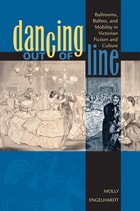
Dancing out of Line
Ballrooms, Ballets, and Mobility in Victorian Fiction and CultureMolly Engelhardt
Ohio University Press, 2009
Dancing out of Line transports readers back to the 1840s, when the craze for social and stage dancing forced Victorians into a complex relationship with the moving body in its most voluble, volatile form.
By partnering cultural discourses with representations of the dance and the dancer in novels such as Jane Eyre, Bleak House, and Daniel Deronda, Molly Engelhardt makes explicit many of the ironies underlying Victorian practices that up to this time have gone unnoticed in critical circles. She analyzes the role of the illustrious dance master, who created and disseminated the manners and moves expected of fashionable society, despite his position as a social outsider of nebulous origins. She describes how the daughters of the social elite were expected to “come out” to society in the ballroom, the most potent space in the cultural imagination for licentious behavior and temptation. These incongruities generated new, progressive ideas about the body, subjectivity, sexuality, and health.
Engelhardt challenges our assumptions about Victorian sensibilities and attitudes toward the sexual/social roles of men and women by bringing together historical voices from various fields to demonstrate the versatility of the dance, not only as a social practice but also as a forum for Victorians to engage in debate about the body and its pleasures and pathologies.
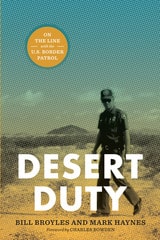
Desert Duty
On the Line with the U.S. Border PatrolBy Bill Broyles and Mark Haynes
University of Texas Press, 2010
While politicians and pundits endlessly debate immigration policy, U.S. Border Patrol agents put their lives on the line to enforce immigration law. In a day's work, agents may catch a load of narcotics, apprehend groups of people entering the country illegally, and intercept a potential terrorist. Their days often include rescuing aliens from death by thirst or murder by border bandits, preventing neighborhood assaults and burglaries, and administering first aid to accident victims, and may involve delivering an untimely baby or helping stranded motorists. As Bill Broyles and Mark Haynes sum it up, "Border Patrol is a hero job," one that too often goes unrecognized by the public.
Desert Duty puts a human face on the Border Patrol. It features interviews with nineteen active-duty and retired agents who have worked at the Wellton, Arizona, station that watches over what is arguably the most perilous crossing along the border—a sparsely populated region of the Sonoran Desert with little water and summer temperatures that routinely top 110°F. The agents candidly discuss the rewards and frustrations of holding the line against illegal immigrants, smugglers, and other criminals—while often having to help the very people they are trying to thwart when they get into trouble in the desert. As one agent explains, "The thrill is tracking 'em up before they die. It's a rough ol' way to go—run outta water in this desert."
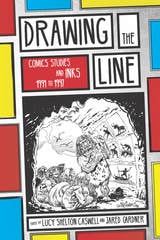
Drawing the Line
Comics Studies and INKS, 1994–1997Lucy Shelton Caswell and Jared Gardner
The Ohio State University Press, 2017
Included in the volume are essays by pioneering comics scholars on newspaper comic strips, Japanese manga, Chinese lianhuanhua, comic books, graphic novels, and editorial cartoons, alongside writings and artwork by celebrated cartoonists such as Will Eisner, Oliver Harrington, Charles Schulz, and Frank Stack. This volume serves as an invaluable resource for anyone interested in the history and study of the comics form, visual culture, or the history of journalism.
Drawing the Line
The Irish Border in British PoliticsIvan Gibbons
Haus Publishing, 2017

End of the Line
Autoworkers and the American DreamEdited by Richard Feldman and Michael Betzold
University of Illinois Press, 1988
"A richly detailed, well-crafted portrait of a cross section of autoworkers in the midst of an identity crisis and a crisis gripping the U.S. auto industry."--Frank Hammer, President, United Auto Workers Local 909
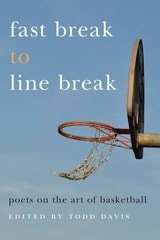
Fast Break to Line Break
Poets on the Art of BasketballTodd Davis
Michigan State University Press, 2012
If baseball is the sport of nostalgic prose, basketball’s movement, myths, and culture are truly at home in verse. In this extraordinary collection of essays, poets meditate on what basketball means to them: how it has changed their perspective on the craft of poetry; how it informs their sense of language, the body, and human connectedness; how their love of the sport made a difference in the creation of their poems and in the lives they live beyond the margins. Walt Whitman saw the origins of poetry as communal, oral myth making. The same could be said of basketball, which is the beating heart of so many neighborhoods and communities in this country and around the world. On the court and on the page, this “poetry in motion” can be a force of change and inspiration, leaving devoted fans wonderstruck.
Jumping the Line
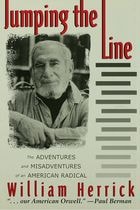
The Adventures and Misadventures of an American RadicalWilliam Herrick
University of Wisconsin Press, 1998
An eye-opening account of time served in the great battles of our century— for workers’ rights, against Fascism, Communism, and racism—Jumping the Line is the life story of an American original. William Herrick chronicles his adventures and misadventures on the front lines of the Spanish Civil War, in (and very much out of) the Communist Party, driving a tractor on a communal farm in Michigan, jumping the line as a hobo, organizing African American sharecroppers in Georgia, at work with Orson Welles, and immersed in his own writing.
Herrick chronicles a life of great conviction and great disillusion. He went to Spain in 1936 to fight against the Fascists and there witnessed the horrifying acts that Fascists and Communists alike committed, before he was felled by a near-fatal wound. Here he tells about the life that led him, a working-class Jewish kid from New York, into the idealism and then the murky politics of this internecine conflict. From the bloody fight in Spain he takes us to the battlefields of the Communist movement in the U.S., where he found himself parading up and down the garment district of Manhattan, denouncing his former comrades.
When Paul Berman interviewed Herrick in the Village Voice in 1986, for the fiftieth anniversary of the Spanish Civil War, Herrick’s remarks so incensed other veterans of the Abraham Lincoln battalion that they picketed the paper. What William Herrick has to say doesn’t always go down easily. But for those who like the truth, with a dash of wit and a healthy dose of history, it can be exhilarating.
Just Below the Line
Disability, Housing, and Equity in the SouthKorydon H. Smith
University of Arkansas Press, 2010
Published in collaboration with the Fay Jones School of Architecture.
Laboring Below the Line
The New Ethnography of Poverty, Low-Wage Work, and Survival in the Global EconomyFrank Munger
Russell Sage Foundation, 2002
Latinas on the Line
Invisible Information Workers in TelecommunicationsMelissa Villa-Nicholas
Rutgers University Press, 2022

Line Of Sight
American Avant-Garde Film Since 1965Paul Arthur
University of Minnesota Press, 2005
For three decades, Paul Arthur has been a leading observer and critic as well as a direct participant in America’s avant-garde cinema. In A Line of Sight, he provides a sweeping new account of the extravagant energies of American experimental cinema since 1965.
Balancing close analysis of both major and lesser-known films with detailed examinations of their production, distribution, and exhibition, Arthur addresses the avant-garde’s cultural significance while offering a timely reconsideration of accepted critical categories and artistic options. Rather than treating American avant-garde cinema as a series of successive artistic breakthroughs, A Line of Sight emphasizes the importance of social and institutional networks, material exchanges, and historical disruptions and continuities. Throughout, Arthur pays close attention to themes and visual practices neglected or underrepresented in previous studies, scrutinizing portraiture as a vehicle for projecting dissident identities, highlighting the essay film and the contemporary city symphony, and assessing the contributions of regional and African American filmmaking to the avant-garde. He also explores thematic and formal questions that have been central to the avant-garde achievement: experimental film's relationship with mainstream narrative cinema and postwar American painting as well as the legacy of sixties’s counterculture; the uses and theoretical implications of found footage and the allegorizing of technology; and the schism between a poetic, expressive cinema and the antisubjective, rationalist bias of structural filmmaking.
Amid the current resurgence of experimental filmmakers and the emergence of a new audience for their work, A Line of Sight reaffirms the extraordinary breadth and diversity of the avant-garde tradition in America.

Line of Fall
Miles Wilson
University of Iowa Press, 1989
With a full range of narrative techniques, the fourteen stories in this volume explore the arcs people trace as they make their way in the world. Miles Wilson's compelling narrative presents characters at crucial moments in their trajectories, when the nature and outcome of their lives can be illuminated. Though built out of the texture of ordinary life, these stories concentrate their focus where the luminous intersects the commonplace.
Many of the stories are set in the American West, which often rises out of the background, virtually assuming the role of another character. In "Outsider," a fable of the artist and society is played out as a metaphysical western. "Wyoming" portrays a college professor, his career hanging by a thread, who meets an uncanny woman on a strange journey through a Wyoming blizzard. And in "Fire Season," a U.S. Forest Service firefighter undergoes an apocalyptic Santa Ana fire that takes him to the bewildering margins of the human and natural worlds.
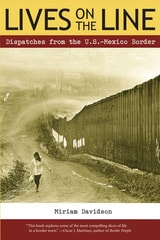
Lives on the Line
Dispatches from the U.S.-Mexico BorderMiriam Davidson
University of Arizona Press, 2000
In Lives on the Line, Miriam Davidson tells five true stories from these border cities to show the real-life effects that the maquiladora boom and the law enforcement crackdown have had on the people of "Ambos (Both) Nogales." Readers will meet Yolanda Sánchez, a single mother who came to work in the factories; Jimmy Teyechea, a cancer victim who became an outspoken environmental activist; Dario Miranda Valenzuela, an undocumented immigrant who was shot and killed by a U.S. Border Patrol agent; Cristina, a "tunnel kid" who aspired to flee the gang lifestyle; and Hope Torres and Tom Higgins, maquiladora managers who have made unique contributions to the community.
In sharing these stories of people transformed by love and faith, by pain and loss, Davidson relates their experiences to larger issues and shows that, although life on the border is tough, it is not without hope.
Lives on the Line is an impassioned look at the changes that have swept the U.S.-Mexico border: the rising tension concerning free trade and militarization, the growing disparity between the affluent and the impoverished. At the same time, the book highlights the positive aspects of change, revealing challenges and opportunities not only for the people who live on the border but for all Americans.
Male Matters
Masculinity, Anxiety, and the Male Body on the LineCalvin Thomas
University of Illinois Press, 1996
reveals the act and production of writing as a bodily, material process
that transgresses the boundaries of gender. Wise and quirky, sophisticated
and coarse, serious and hilarious, this look at male identity and creativity
and dislocation at the end of the twentieth century definitely will not
assuage male anxiety!
"An excellent and important
book. . . . By mixing high and low, by speaking candidly about what we
usually keep in the (water) closet, while simultaneously engaging the
'highest' philosophies of language and culture, Thomas calls the entire
enterprise of criticism into question." -- Jeremy Earp, Journal
of Gay, Lesbian, and Bisexual Identity
"A brave, indispensable
exercise in writing the male body, and a tour de force of theoretically
informed close reading." -- Kevin Floyd, Journal of the Midwest
Modern Language Association
"Both analyzes and performs
our anxieties about masculinity. . . . This experiment in criticism transgresses
boundaries of theory, gender, and academic taste in ways sure to delight
and infuriate its readers." -- Gregory Jay, author of America
the Scrivener: Deconstruction and the Subject of Literary History
"Calvin Thomas is able
to hint at a way out of the prison-house, as he puts it, of straight male
identity." -- Kathy Acker, author of In Memoriam to Identity
Manhood on the Line
Working-Class Masculinities in the American HeartlandStephen Meyer
University of Illinois Press, 2016
Moscow to the End of the Line
Venedikt Erofeev, translated from the Russian by H. William Tjalsma
Northwestern University Press, 1992
No Day without a Line
From Notebooks by Yury OleshaYury Olesha
Northwestern University Press, 1998
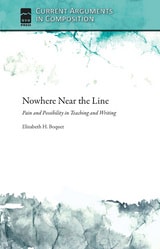
Nowhere Near the Line
Pain and Possibility in Teaching and WritingElizabeth H. Boquet
Utah State University Press, 2016
In this short work, Elizabeth Boquet explores the line Lawrence Schall describes above, tracing the overlaps and intersections of a lifelong education around guns and violence, as a student, a teacher, a feminist, a daughter, a wife, a citizen and across the dislocations and relocations that are part of a life lived in and around school. Weaving narratives of family, the university classroom and administration, her husband’s work as a police officer, and her work with students and the Poetry for Peace effort that her writing center sponsors in the local schools, she recounts her efforts to respond to moments of violence with a pedagogy of peace. “Can we not acknowledge that our experiences with pain anywhere should render us more, not less, capable of responding to it everywhere?” she asks. “Compassion, it seems to me, is an infinitely renewable resource.”
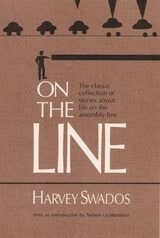
On the Line
Harvey Swados
University of Illinois Press, 1957

Ordinary Medicine
Extraordinary Treatments, Longer Lives, and Where to Draw the LineSharon R. Kaufman
Duke University Press, 2015
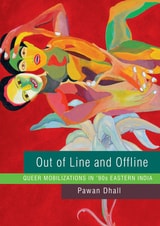
Out of Line and Offline
Queer Mobilizations in '90s Eastern IndiaPawan Dhall
Seagull Books, 2020
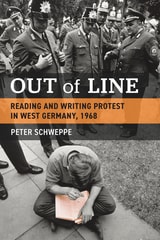
Out of Line
Reading and Writing Protest in West Germany, 1968Peter Schweppe
University of Michigan Press, 2026
By analyzing how protest fused the politics of reading and writing in 1968 West Germany, author Peter Schweppe uncovers the vibrant history of an alternative literary form during a watershed moment of social upheaval. Out of Line interlinks the politics of reading and writing with the verve of Global Sixties’ protest, where fringe books, underground newspapers, incendiary flyers, and furtive graffiti galvanized readers and writers alike. The phrase “out of line” scrutinizes the emerging performative relationship between visual and textual media in the late 1960s as it metamorphosed modes of West German literary production, channeled the agenda of the protest movement, and, in doing so, shaped new kinds of textual meaning. Through its engagement with theories of materiality and “things,” Out of Line interrogates the dynamic ways that protest readers and writers pushed and broke conventional boundaries. Schweppe’s exploration of form discloses how reading and writing out of line implicates a textual and material history of protest and the lessons it offers protest histories to come.

Patriarchy on the Line
Labor, Gender, and Ideology in the Mexican Maquila IndustrySusan Tiano
Temple University Press, 1994
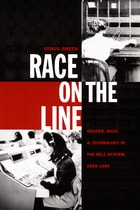
Race on the Line
Gender, Labor, and Technology in the Bell System, 1880–1980Venus Green
Duke University Press, 2001
More than a simple story of the impact of technology, Race on the Line combines oral history, personal experience, and archival research to weave a complicated history of how skill is constructed and how its meanings change within a rapidly expanding industry. Green discusses how women faced an environment where male union leaders displayed economic as well as gender biases and where racism served as a persistent system of division. Separated into chronological sections, the study moves from the early years when the Bell company gave both male and female workers opportunities to advance; to the era of the “white lady” image of the company, when African American women were excluded from the industry and feminist working-class consciousness among white women was consequently inhibited; to the computer era, a time when black women had waged a successful struggle to integrate the telephone operating system but faced technological displacement and unrewarding work.
An important study of working-class American women during the twentieth century, this book will appeal to a wide audience, particularly students and scholars with interest in women’s history, labor history, African American history, the history of technology, and business history.
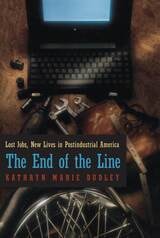
The End of the Line
Lost Jobs, New Lives in Postindustrial AmericaKathryn Marie Dudley
University of Chicago Press, 1994
"An excellent study not only of the cultural disruptions caused by the shutdown of Chrysler's operations in Kenosha, Wisconsin, but also of the ideology of progress that abetted the shutdown."—Stephen Amberg, Industrial and Labor Relations Review
"With the eye of an anthropologist, [Dudley] examines the tensions between the 'culture of hands' and the 'culture of mind.' Her account is especially instructive because, by many measures, Kenosha has successfully recovered, yet for many the pain still remains."—Booklist
"Exceptional. . . . Should be widely read."—Douglas Harper, Contemporary Sociology
"Make[s] clear what a tenuous concept economic security is, especially when the rules for achieving security are in flux."—Barbara Presley Noble, New York Times
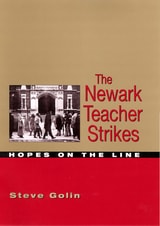
The Newark Teacher Strikes
Hopes on the LineGolin, Steve
Rutgers University Press, 2002
Winner of the Richard P. McCormick 2003 Prize for Scholarly Publication, given by the New Jersey Historical Commission
For three weeks in 1970 and for eleven weeks in 1971, the schools in Newark, New Jersey, were paralyzed as the teachers went on strike. In the wake of the 1971 strike, almost two hundred were arrested and jailed. The Newark Teachers Union said their members wanted improved education for students. The Board of Education claimed the teachers primarily desired more money. After interviewing more than fifty teachers who were on the front lines during these strikes, historian Steve Golin concludes that another, equally important agenda was on the table, and has been ignored until now. These professionals wanted power, to be allowed a voice in the educational agenda.
Through these oral histories, Golin examines the hopes of the teachers as they picketed, risking arrest and imprisonment. Why did they strike? How did the union represent them? How did their action—and incarceration—change them? Did they continue to teach in impoverished schools? Golin also discusses the tensions arising during that period. These include differences in attitudes toward unions among black, Jewish, and Italian teachers; different organizing strategies of men and women; and conflict between teachers’ professional and working-class identities.
The first part of the book sets the stage by exploring the experience of teachers in Newark from World War II to the 1970 strike. After covering both strikes, Golin brings the story up to 1995 in the epilogue, which traces the connection between educational reform and union democracy. Teacher Power enhances our understanding of what has worked and what hasn’t worked in attempts at reforming urban schools. Equally importantly, the teachers’ vivid words and the author’s perceptive analysis enables us to view the struggles of not just Newark, but the entire United States during a turbulent time.
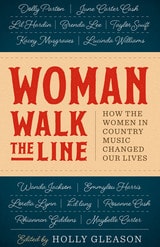
Woman Walk the Line
How the Women in Country Music Changed Our LivesBy Holly Gleason
University of Texas Press, 2017
Full-tilt, hardcore, down-home, and groundbreaking, the women of country music speak volumes with every song. From Maybelle Carter to Dolly Parton, k.d. lang to Taylor Swift—these artists provided pivot points, truths, and doses of courage for women writers at every stage of their lives. Whether it’s Rosanne Cash eulogizing June Carter Cash or a seventeen-year-old Taylor Swift considering the golden glimmer of another precocious superstar, Brenda Lee, it’s the humanity beneath the music that resonates.
Here are deeply personal essays from award-winning writers on femme fatales, feminists, groundbreakers, and truth tellers. Acclaimed historian Holly George Warren captures the spark of the rockabilly sensation Wanda Jackson; Entertainment Weekly’s Madison Vain considers Loretta Lynn’s girl-power anthem “The Pill”; and rocker Grace Potter embraces Linda Ronstadt’s unabashed visual and musical influence. Patty Griffin acts like a balm on a post-9/11 survivor on the run; Emmylou Harris offers a gateway through paralyzing grief; and Lucinda Williams proves that greatness is where you find it.
Part history, part confessional, and part celebration of country, Americana, and bluegrass and the women who make them, Woman Walk the Line is a very personal collection of essays from some of America’s most intriguing women writers. It speaks to the ways in which artists mark our lives at different ages and in various states of grace and imperfection—and ultimately how music transforms not just the person making it, but also the listener.