Results by title
63 books match the query 'Indigenous Languages in the Americas' and 3 start with m

Maya Glyphs
The VerbsBy Linda Schele
University of Texas Press, 1982
The key to the study of the language and history of the Classic Maya (A.D. 293–900) is the verb. Maya Glyphs: The Verbs is a comprehensive study of the verb morphology and syntax of the Maya writing system.
Linda Schele's summary of methodology makes available in a single place many important discoveries and approaches to the Maya language. Hers is the first sourcebook to include so broad a range of dates and to identify for the first time so many Maya rulers and events.
The admirably lucid text provides an excellent introduction to Maya hieroglyphics for the beginner, and, for the experienced Mayanist, it offers a fascinating explanation of methodology, including paraphrasing, and important information about syntactical structures, special verbal constructions, and literary conventions.
Schele's extensive catalog of known verbal phrases is useful for a variety of purposes. Because it is organized according to verbal affix patterns, it provides the only available source for the distribution of such patterns in the writing system. At the same time it registers the date of each event, its agent and patient (if recorded), the dedication date of the monument on which the glyphs occur, and a pictorial illustration, rather than a T-number transcription, of each example. Extensive notes treating problems of dating, interpretation, and dynastic information contain theories about the meaning and function of the events recorded in the Maya inscriptions.
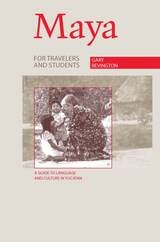
Maya for Travelers and Students
A Guide to Language and Culture in YucatanBy Gary Bevington
University of Texas Press, 1995
The Yucatan Peninsula draws many North American and European travelers each year to view the ruins of the pre-Columbian Classical Maya civilization and the abundant native flora and fauna. For these travelers, as well as armchair travelers and students, Gary Bevington has prepared the first general English-language introduction to Yucatec Maya, the native language of the people indigenous to the region.
Written in nontechnical terms for learners who have a basic knowledge of simple Mexican Spanish, the book presents easily understood, practical information for anyone who would like to communicate with the Maya in their native language. In addition to covering the pronunciation and grammar of Maya, Bevington includes invaluable tips on learning indigenous languages "in the field." Most helpful are his discussions of the cultural and material worlds of the Maya, accompanied by essential words and expressions for common objects and experiences. A Maya-English-Spanish glossary with extensive usage examples and an English-Maya glossary conclude the book.
Note: The supplemental audiocasette, Spoken Maya for Travelers and Students, is now available as a free download through the book's page on the University of Texas Press's website.
Mayan Texts
Volumes I, II, and IIIEdited by Louanna Furbee-Losee
University of Chicago Press Journals, 1976