Results by title
105 books match the query 'Iran' and 4 start with m
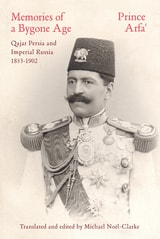
Memories of a Bygone Age
Qajar Persia and Imperial Russia 1853-1902Prince Arfa
Gingko, 2016
Prince Arfa writes with arresting wit about the deadly intrigues of the Qajar court. Lamentingly, but resolutely, he chronicles the decline of Iran from a once great empire to an almost bankrupt, lawless state, in which social unrest is channelled and exploited by the clergy. He describes the complex interactions between Iran and Europe, including an account of Naser-od-Din Shah’s profligate visits to Britain and France; the splendor and eccentricities of the doomed Tsar Nicholas II’s court; the Tsar’s omen-laden coronation; and his own favor with the Tsarina, who would grant him concessions on matters of vital importance to his country. The result is a memoir of extraordinary political intrigue.
Mission for Development
Utah Universities and the Point Four Program in IranRichard Garlitz
Utah State University Press, 2018
The Point Four Program sponsored American technical assistance for developing countries during the 1950s—an American Cold War strategy to cultivate friendly governments and economic development in countries purportedly susceptible to Communist influence. Between 1951 and 1964, advisors from Brigham Young University sought to modernize Iranian public education, experts from Utah State University worked to improve agricultural production, and doctors and nurses from the University of Utah helped with the Iranian government’s rural health initiatives. In A Mission for Development, author Richard Garlitz offers a critical and clear-eyed assessment of the challenges the Utahns faced and the contributions they made to Iranian development.
The book also reexamines the Iranian political crisis of the early 1950s and the overthrow of Prime Minister Mohammad Mossadegh through the eyes of the Utah advisors. A Mission for Development provides rare insight into the university role in international development and will be of interest to historians and policy makers.
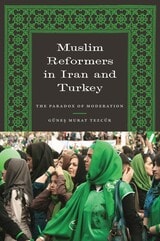
Muslim Reformers in Iran and Turkey
The Paradox of ModerationBy Güneş Murat Tezcür
University of Texas Press, 2010
Moderation theory describes the process through which radical political actors develop commitments to electoral competition, political pluralism, human rights, and rule of law and come to prefer negotiation, reconciliation, and electoral politics over provocation, confrontation, and contentious action. Revisiting this theory through an examination of two of the most prominent moderate Islamic political forces in recent history, Muslim Reformers in Iran and Turkey analyzes the gains made and methods implemented by the Reform Front in the Islamic Republic of Iran and the Justice and Development Party in Turkey.
Both of these groups represent Muslim reformers who came into continual conflict with unelected adversaries who attempted to block their reformist agendas. Based on extensive field research in both locales, Muslim Reformers in Iran and Turkey argues that behavioral moderation as practiced by these groups may actually inhibit democratic progress. Political scientist Güneş Murat Tezcür observes that the ability to implement conciliatory tactics, organize electoral parties, and make political compromises impeded democracy when pursued by the Reform Front and the Justice and Development Party. Challenging conventional wisdom, Tezcür's findings have broad implications for the dynamics of democratic progress.
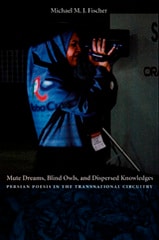
Mute Dreams, Blind Owls, and Dispersed Knowledges
Persian Poesis in the Transnational CircuitryMichael M. J. Fischer
Duke University Press, 2004
Fischer reveals how the distinctive expressive idiom emerging in contemporary Iranian film reworks Persian imagery that has itself been in dialogue with other cultures since the time of Zoroaster and ancient Greece. He examines a range of narrative influences on this expressive idiom and imagery, including Zoroastrian ritual as it is practiced in Iran, North America, and India; the mythic stories, moral lessons, and historical figures written about in Iran’s national epic, the Shahnameh; the dreamlike allegorical world of Persian surrealism exemplified in Sadeq Hedayat’s 1939 novella The Blind Owl; and the politically charged films of the 1960s and 1970s. Fischer contends that by combining Persian traditions with cosmopolitan influences, contemporary Iranian filmmakers—many of whom studied in Europe and America—provide audiences around the world with new modes of accessing ethical and political experiences.