Results by title
52 books match the query 'Islam and politics' and 6 start with m
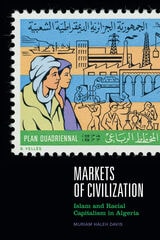
Markets of Civilization
Islam and Racial Capitalism in AlgeriaMuriam Haleh Davis
Duke University Press, 2022
Master and Disciple
The Cultural Foundations of Moroccan AuthoritarianismAbdellah Hammoudi
University of Chicago Press, 1997
Building on the work of Foucault, Hammoudi argues that at the heart of Moroccan culture lies a paradigm of authority that juxtaposes absolute authority against absolute submission. Rooted in Islamic mysticism, this paradigm can be observed in the drama of mystic initiation, with its fundamental dialectic between Master and Disciple; in conflict with other cultural forms, and reelaborated in colonial and postcolonial circumstances, it informs all major aspects of Moroccan personal, political, and gender relations. Its influence is so pervasive and so firmly embedded that it ultimately legitimizes the authoritarian structure of power. Hammoudi contends that as long as the Master-Disciple dialectic remains the dominant paradigm of power relations, male authoritarianism will prevail as the dominant political form.
"Connecting political domination to gift exchange, ritual initiation, social loyalty, and gender reversals, Master and Disciple is nothing less than a thoroughgoing revision of our understanding of authoritarian rule in Morocco and in the Arab world in general."—Clifford Geertz, Institute for Advanced Study
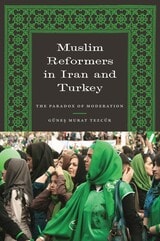
Muslim Reformers in Iran and Turkey
The Paradox of ModerationBy Güneş Murat Tezcür
University of Texas Press, 2010
Moderation theory describes the process through which radical political actors develop commitments to electoral competition, political pluralism, human rights, and rule of law and come to prefer negotiation, reconciliation, and electoral politics over provocation, confrontation, and contentious action. Revisiting this theory through an examination of two of the most prominent moderate Islamic political forces in recent history, Muslim Reformers in Iran and Turkey analyzes the gains made and methods implemented by the Reform Front in the Islamic Republic of Iran and the Justice and Development Party in Turkey.
Both of these groups represent Muslim reformers who came into continual conflict with unelected adversaries who attempted to block their reformist agendas. Based on extensive field research in both locales, Muslim Reformers in Iran and Turkey argues that behavioral moderation as practiced by these groups may actually inhibit democratic progress. Political scientist Güneş Murat Tezcür observes that the ability to implement conciliatory tactics, organize electoral parties, and make political compromises impeded democracy when pursued by the Reform Front and the Justice and Development Party. Challenging conventional wisdom, Tezcür's findings have broad implications for the dynamics of democratic progress.
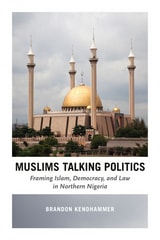
Muslims Talking Politics
Framing Islam, Democracy, and Law in Northern NigeriaBrandon Kendhammer
University of Chicago Press, 2016
Kendhammer argues that despite Nigeria’s struggles with jihadist insurgency, its recent history is really one of tenuous and fragile reconciliation between mass democratic aspirations and concerted popular efforts to preserve Islamic values in government and law. Combining an innovative analysis of Nigeria’s Islamic and political history with visits to the living rooms of working families, he sketches how this reconciliation has been constructed in the conversations, debates, and everyday experiences of Nigerian Muslims. In doing so, he uncovers valuable new lessons—ones rooted in the real politics of ordinary life—for how democracy might work alongside the legal recognition of Islamic values, a question that extends far beyond Nigeria and into the Muslim world at large.
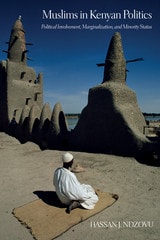
Muslims in Kenyan Politics
Political Involvement, Marginalization, and Minority StatusHassan J. Ndzovu
Northwestern University Press, 2014
Kenya’s Muslim population comprises ethnic Arabs, Indians, and black Africans, and its status has varied historically. Under British rule, an imposed racial hierarchy affected Muslims particularly, thwarting the development of a united political voice. Drawing on a broad range of interviews and historical research, Ndzovu presents a nuanced picture of political associations during the postcolonial period and explores the role of Kenyan Muslims as political actors.
Muslims in a Post-9/11 America
A Survey of Attitudes and Beliefs and Their Implications for U.S. National Security PolicyRachel M. Gillum
University of Michigan Press, 2018
Muslims in a Post-9/11 America examines how public fears about Muslims in the United States compare with the reality of American Muslims’ attitudes on a range of relevant issues. While most research on Muslim Americans focuses on Arab Muslims, a quarter of the Muslim American population, Rachel Gillum includes perspectives of Muslims from various ethnic and national communities—from African Americans to those of Pakistani, Iranian, or Eastern European descent. Using interviews and one of the largest nationwide surveys of Muslim Americans to date, Gillum examines more than three generations of Muslim American immigrants to assess how segments of the Muslim American community are integrating into the U.S. social fabric, and how they respond to post-9/11 policy changes. Gillum’s findings challenge perceptions of Muslims as a homogeneous, isolated, un-American, and potentially violent segment of the U.S. population.
Despite these realities, negative political rhetoric around Muslim Americans persists. The findings suggest that the policies designed to keep America safe from terrorist attacks may have eroded one of law enforcement’s greatest assets in the fight against violent extremism—a relationship of trust and goodwill between the Muslim American community and the U.S. government. Gillum argues for policies and law enforcement tactics that will bring nuanced understandings of this diverse category of Americans and build trust, rather than alienate Muslim communities.