Results by title
59 books match the query 'Jewish women' and 5 start with m
MAKING STORIES, MAKING SELVES
FEMINIST REFLECTIONS ON THE HOLOCAUSTR. Ruth Linden
The Ohio State University Press, 1995
Urged forward by these silences, Linden, a feminist and sociologist, began to interview Jewish Holocaust survivors in 1983. As Linden interprets survivors' accounts of the death camps and the resistance, she reveals complex ways in which selves are constructed through storytelling. The stories that unfold are continuously fashioned and refashioned—never stripped of context or frozen in time. What emerges is an unexpectedly elegant montage in which interviewee, interviewer, and author are intertwined.
Linden's meetings with survivors and her encounters with their stories transformed her as a feminist, a Jew, and a social scientist. Her analysis reveals the intimate connections between an ethnographer's lived experience and her interpretations of others'. Linden's reflections on the process of ethnography belie the rhetoric of positivism in the social sciences. They will inspire other scholars to break free of research and writing practices in their own disciplines that efface the ineluctable bond between knower and known. All readers will be challenged to reexamine the Holocaust in an intensely personal light and to reconsider the meanings of survival in our own time.
Cutting across the boundaries of ethnography and autobiography to create a new kind of text, Making Stories, Making Selves offers a significant contribution to interpretive social science and the literature of the Holocaust. Linden's original and courageous work is vital reading for Holocaust scholars, students of modern Jewish life, sociologists, feminist theorists, and all readers seeking to understand their own relationship to the Holocaust.

Marriage and Divorce in the Jewish State
Israel's Civil WarSusan M. Weiss and Netty C. Gross-Horowitz
Brandeis University Press, 2012
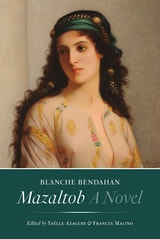
Mazaltob
A NovelBlanche Bendahan
Brandeis University Press, 2024
Raised in the Judería or Jewish quarter of Tetouan, Morocco, at the turn of the 20th-century, sixteen-year-old Mazaltob finds herself betrothed to José, an uncouth man from her own community who has returned from Argentina to take a wife. Mazaltob, however, is in love with Jean, who is French, half-Jewish, and a free spirit. In this classic of North African Jewish fiction, Blanche Bendahan evokes the two compelling forces tearing Mazaltob apart in her body and soul: her loyalty to the Judería and her powerful desire to follow her own voice and find true love. Bendahan’s nuanced and moving novel is a masterly exploration of the language, religion, and quotidian customs constraining North African Jewish women on the cusp of emancipation and decolonization. Yaëlle Azagury and Frances Malino provide the first English translation of this modern coming-of-age tale, awarded a prize by the Académie Française in 1930, and analyze the ways in which Mazaltob, with its disconcerting blend of ethnographic details and modernist experimentation, is the first of its genre—that of the feminist Sephardi novel. A historical introduction, a literary analysis, and annotations elucidate historical and cultural terms for readers, supplementing the author’s original notes.
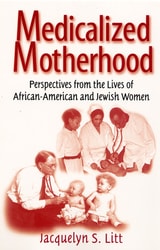
Medicalized Motherhood
Perspectives from the Lives of African-American and Jewish WomenJacquelyn S. Litt
Rutgers University Press, 1999
When Jacquelyn S. Litt interviewed African-American and Jewish women who raised their children in the 1930s and 1940s, she found that these women responded to experts' advice in ways uniquely shaped by their ethnicity, race, and class. For middle-class African-American and Jewish women, medicalization took place in ethnically/racially segregated networks and functioned as a collectively held strategy for social advance as much as a set of technical practices for raising healthy children. For poor, single African-American mothers, everyday networks offered limited access to medical institutions or mainstream norms. Medical discourse was largely controlled by white women and men, which left these women disempowered in medical institutions and marginal to dominant definitions of acceptable mothering.
Litt's book is enriched with many narratives from the mothers themselves. Both the women's voices and her acute sociological research bring to light how medicalized motherhood, while not the single cause of difference and inequality among the women, was a site where they were produced.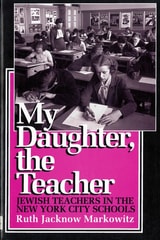
My Daughter, the Teacher
Jewish Teachers in the New York City SchoolsMarkowitz, Ruth Jacknow
Rutgers University Press, 1993