Results by title
99 books match the query 'Kinship' and 3 start with m
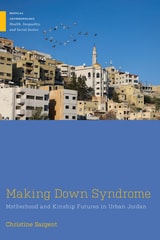
Making Down Syndrome
Motherhood and Kinship Futures in Urban JordanChristine Sargent
Rutgers University Press, 2026
Making Down Syndrome: Motherhood and Kinship Futures in Urban Jordan draws on ethnographic research conducted primarily in Jordan’s capital city of Amman to explore how the label and identity of Down syndrome is gaining increasing cohesiveness. Focused on the experiences of mothers, who serve as an entry point for understanding broader family dynamics and choices, the book argues that practices and ideologies of care play a central role in making Down syndrome’s embodied and political realities. They do so through the momentum of kinship futures, or futures imagined through the prism of kinship roles and relations, which shape how families organize and distribute care between and beyond kinship networks and under conditions of economic and political uncertainty. By approaching everyday life in Jordan through the lens of disability, Making Down Syndrome offers new insights into how people navigate structures of family, gender, power, inequality, and precarity, all while trying to maintain hope for and cultivate better futures.

Margaret Mead and Ruth Benedict
The Kinship of WomenHilary Lapsley
University of Massachusetts Press, 2001
Masculinity, Motherhood, and Mockery
Psychoanalyzing Culture and the Iatmul Naven Rite in New GuineaEric Kline Silverman
University of Michigan Press, 2001
Throughout this work, Eric Silverman details the dialogics of mothering and manhood throughout Eastern Iatmul culture, including in his analysis cosmology and myth; food- and childraising; architecture and canoes; ethnophysiology and sexuality; shame and hygiene; marriage and kinship; and perhaps most significantly, a ceremonial locus classicus in anthropology: the famous Iatmul naven rite. This book provides the first sustained examination of naven since Bateson, presenting new data and interpretations that are based entirely on original, first-hand ethnographic research.
The sustained engagement with anthropological and psychoanalytic theory coupled with a refreshing examination of a famous and still-enigmatic ritual is sure to make multiple contributions to pressing debates in contemporary anthropology and social theory.
Eric Silverman is Associate Professor of Anthropology, DePauw University.