52 books match the query 'Latin American literature' and 5 start with m
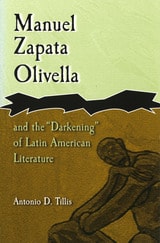
cover of Manuel Zapata Olivella and the "Darkening" of Latin American Literature

Manuel Zapata Olivella and the "Darkening" of Latin American Literature

Antonio D. Tillis

University of Missouri Press, 2005
Manuel Zapata Olivella and the “Darkening” of Latin American Literature is an examination of the fictional work of one of Latin America’s most prolific, yet overlooked, writers. Born in Colombia to parents of mixed ancestry, Zapata Olivella used his novels to explore the plight of the downtrodden in his nation and by extension the experience of blacks in other parts of the Americas. Author Antonio D. Tillis offers a critical examination of Zapata Olivella’s major works of fiction from the 1940s to the 1990s, including Tierra mojada (1947); Pasión vagabunda (1949); He visto la noche (1953); La Calle 10 (1960); En Chimá nace un santo (1963); Las claves mágicas de América (1989); and Hemingway, el cazador de la muerte (1993).
            Tillis focuses on the development of the “black aesthetic” in Zapata Olivella’s stories, in which the circumstances of the people of African heritage are centered in the narrative discourse. Tillis also traces Zapata Olivella’s novelistic effort to incorporate the Africa-descended subject into the literature of Latin America. A critical look at the placement of Afro–Latin American protagonists reveals the sociopolitical and historical challenges of citizenship and community. In addition, this study explores tenets of postcolonial and postmodern thought such as place, displacement, marginalization, historiographic metafiction, and chronological disjuncture in relation to Zapata Olivella’s fiction. Tillis concludes that the novelistic trajectory of this Afro-Colombian writer was one that brought into literary history an often overlooked subject: the disenfranchised citizen of African ancestry.
            By expanding and updating the current scholarship on Zapata Olivella, Tillis leads us to new contexts for and interpretations of this author’s work. This analysis will be welcomed by readers who are just beginning to discover the writings of Zapata Olivella, and its new approach to those writings will be appreciated by scholars who are already familiar with his works.   
[more]
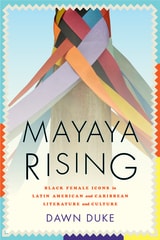
cover of Mayaya Rising: Black Female Icons in Latin American and Caribbean Literature and Culture

Mayaya Rising

Black Female Icons in Latin American and Caribbean Literature and Culture

Dawn Duke

Bucknell University Press, 2023
Who are the Black heroines of Latin America and the Caribbean? Where do we turn for models of transcendence among women of African ancestry in the region? In answer to the historical dearth of such exemplars, Mayaya Rising explores and celebrates the work of writers who intentionally center powerful female cultural archetypes. In this inventive analysis, Duke proposes three case studies and a corresponding womanist methodology through which to study and rediscover these figures. The musical Cuban-Dominican sisters and former slaves Teodora and Micaela Ginés inspired Aida Cartagena Portalatin’s epic poem Yania tierra; the Nicaraguan matriarch of the May Pole, “Miss Lizzie,” figures prominently in four anthologies from the country’s Bluefields region; and the iconic palenqueras of Cartagena, Colombia are magnified in the work of poets María Teresa Ramírez Neiva and Mirian Díaz Pérez. In elevating these figures and foregrounding these works, Duke restores and repairs the scholarly record.
[more]
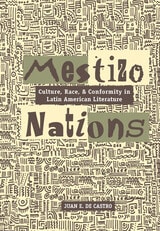
cover of Mestizo Nations: Culture, Race, and Conformity in Latin American Literature

Mestizo Nations

Culture, Race, and Conformity in Latin American Literature

Juan E. De Castro

University of Arizona Press, 2002

Nationality in Latin America has long been entwined with questions of racial identity. Just as American-born colonial elites grounded their struggle for independence from Spain and Portugal in the history of Amerindian resistance, constructions of nationality were based on the notion of the fusion of populations heterogeneous in culture, race, and language. But this rhetorical celebration of difference was framed by a real-life pressure to assimilate into cultures always defined by Iberian American elites. In Mestizo Nations, Juan De Castro explores the construction of nationality in Latin American and Chicano literature and thought during the nineteenth and twentieth centuries. Focusing on the discourse of mestizaje—which proposes the creation of a homogenous culture out of American Indian, black, and Iberian elements—he examines a selection of texts that represent the entire history and regional landscape of Latin American culture in its Western, indigenous, and neo-African traditions from Independence to the present.

Through them, he delineates some of the ambiguities and contradictions that have beset this discourse. Among texts considered are the Indianist novel Iracema by the nineteenth-century Brazilian author José de Alencar; the Tradiciones peruanas, Peruvian Ricardo Palma's fictionalizations of national difference; and historical and sociological essays by the Peruvian Marxist José Carlos Mariátegui and the Brazilian intellectual Gilberto Freyre. And because questions raised by this discourse are equally relevant to postmodern concerns with national and transnational heterogeneity, De Castro also analyzes such recent examples as the Cuban dance band Los Van Van's use of Afrocentric lyrics; Richard Rodriguez's interpretations of North American reality; and points of contact and divergence between José María Arguedas's novel The Fox from Up Above and the Fox from Down Below and writings of Gloria Anzaldúa and Julia Kristeva.

By updating the concept of mestizaje as a critical tool for analyzing literary text and cultural trends—incorporating not only race, culture, and nationality but also gender, language, and politics—De Castro shows the implications of this Latin American discursive tradition for current critical debates in cultural and area studies. Mestizo Nations contains important insights for all Latin Americanists as a tool for understanding racial relations and cultural hybridization, creating not only an important commentary on Latin America but also a critique of American life in the age of multiculturalism.
[more]
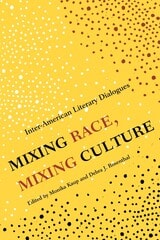
cover of Mixing Race, Mixing Culture: Inter-American Literary Dialogues

Mixing Race, Mixing Culture

Inter-American Literary Dialogues

Edited by Monika Kaup and Debra Rosenthal

University of Texas Press, 2002

Over the last five centuries, the story of the Americas has been a story of the mixing of races and cultures. Not surprisingly, the issue of miscegenation, with its attendant fears and hopes, has been a pervasive theme in New World literature, as writers from Canada to Argentina confront the legacy of cultural hybridization and fusion.

This book takes up the challenge of transforming American literary and cultural studies into a comparative discipline by examining the dynamics of racial and cultural mixture and its opposite tendency, racial and cultural disjunction, in the literatures of the Americas. Editors Kaup and Rosenthal have brought together a distinguished set of scholars who compare the treatment of racial and cultural mixtures in literature from North America, the Caribbean, and Latin America. From various angles, they remap the Americas as a multicultural and multiracial hemisphere, with a common history of colonialism, slavery, racism, and racial and cultural hybridity.
[more]
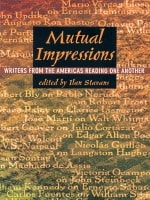
cover of Mutual Impressions: Writers from the Americas Reading One Another

Mutual Impressions

Writers from the Americas Reading One Another

Ilan Stavans, ed.

Duke University Press, 1999

It is commonly assumed that the United States and Latin America, culturally so different, move artistically to very different rhythms. Also common is the assumption that, with rare exception, the literary figures on one side of the global North/South divide have had little interest in the work of their counterparts. With Mutual Impressions Ilan Stavans dispels these notions by showing how solid the bridges between writers and across borders have been, at least since the early days of this century, and how crucial they are likely to become as we enter the next millennium.
Divided into symmetrical halves—South reading North and North reading South—the book presents essays by leading novelists, poets, and other writers that focus on the work of another literary figure from across the divide. Borges, for example, finds in Hawthorne the perfect precursor to his own interest in allegories; Katherine Anne Porter examines José Joaquín Fernández de Lizardi as a rascal whose picaresque views of life in The Itching Parrot served to launch the Latin American novel; Cortázar’s study of the plots and style of Poe shows an affinity that left an indelible mark on the Argentine’s short fiction; Susan Sontag views Machado de Assis as the ultimate mirror, a proto–postmodernist.
With other essays by Thomas Pynchon, William H. Gass, John Updike, Gabriel García Márquez, Alejo Carpentier, John Barth, Robert Coover, Pedro Henríquez Ureña, Grace Paley, Juan Carlos Onetti, and Mark Strand, among others, Mutual Impressions offers a remarkable view of the connections that comprise a literary tradition of the Americas. It is a book that will surprise and enliven its readers as it informs and awakens in them a sense of wonder.

Contributors. John Barth, José Bianco, Robert Bly, Jorge Luis Borges, Alejo Carpentier, Hiber Conteris, Robert Coover, Julio Cortázar, Ezequiel Martínez Estrada, Waldo Frank, Carlos Fuentes, William H. Gass, Nicolás Guillén, William Kennedy, Mario Vargas Llosa, Gabriel García Márquez, José Martí, Pablo Neruda, Victoria Ocampo, Juan Carlos Onetti, Grace Paley, Octavio Paz, Katherine Anne Porter, Thomas Pynchon, Kenneth Rexroth, Antonio Benítez Rojo, Barbara Probst Solomon, Susan Sontag, Ilan Stavans, Mark Strand, John Updike, Pedro Henríque Ureña, Derek Walcott, Paul West

[more]